Problem and decision
ProblemExternal listing shapes, operational workflows, analytics, and AI-assisted actions had to evolve without corrupting source meaning or making retries unsafe.
DecisionKeep typed RESO transformation as the only listing path, separate operational and analytical stores, and make every durable workflow replayable and reviewable.
Scope
- Team
- One person
- Scale
- Public details are limited to architecture and operational decisions I can responsibly describe
- Links
- Live
Outcomes
- 90+ SQL migrations versioned migration files in the repository
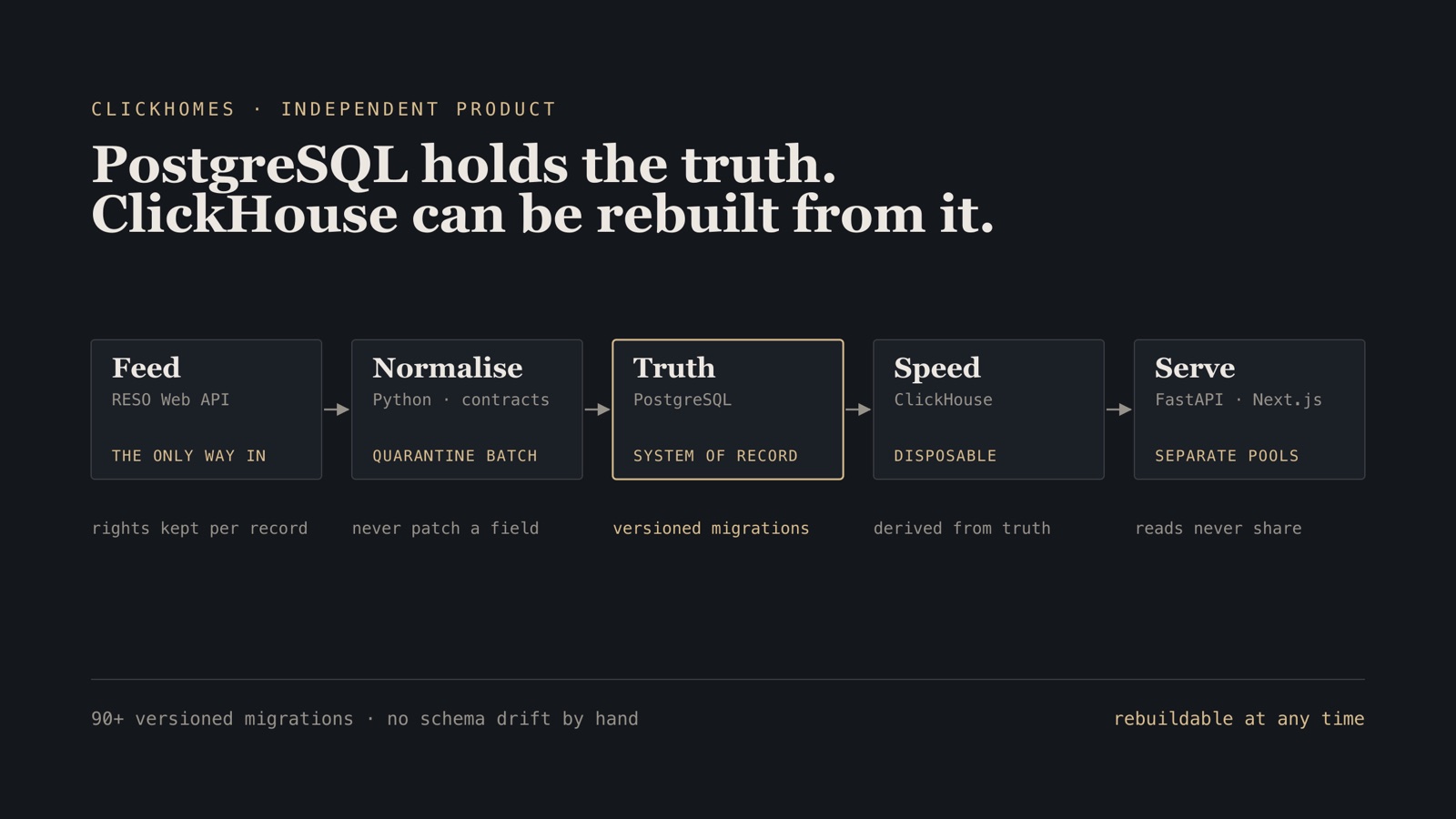
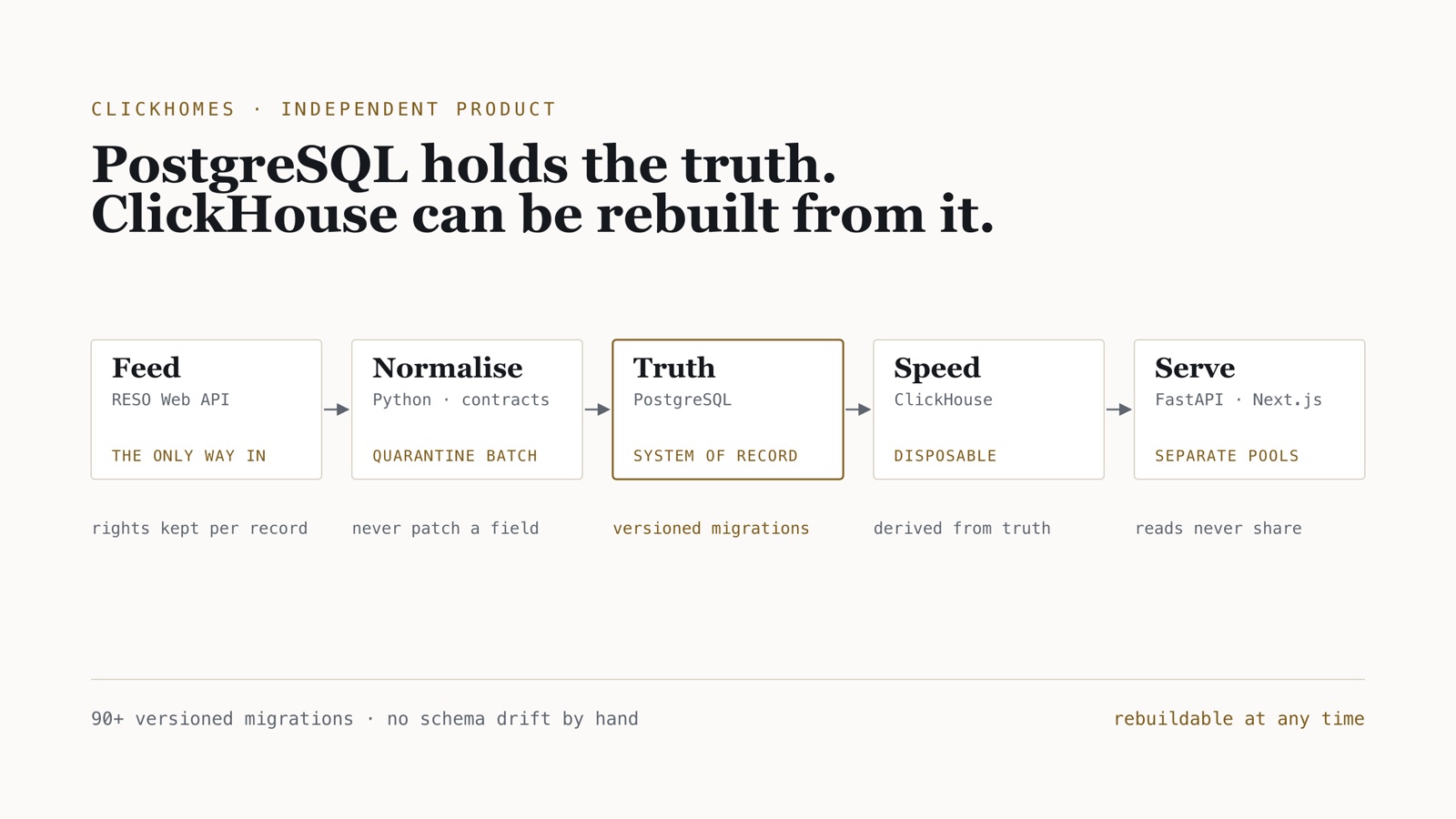
- Feed RESO Web API The only way in. Source and rights metadata retained per record.
- Normalise Python · contracts Contract violations quarantine the batch instead of the field.
- Truth PostgreSQL System of record. 90+ versioned migrations, no schema drift by hand.
- Speed ClickHouse Derived, disposable, rebuildable from Postgres at any time.
- Serve FastAPI · Next.js Operational and analytical reads never share a connection pool.
Context
ClickHomes is the product I build outside work. It gives me something valuable that an employer project cannot: permission to discuss the decisions publicly because the code, the trade-offs, and the consequences are mine.
The product spans public discovery, decision tools, operational workflows, analytics, and AI-assisted work. The engineering challenge is to let each surface evolve without weakening source provenance or creating a second version of truth.
Constraints
This is a one-person product, so the recovery path has to remain understandable months after I last touched it. External listing shapes can change without notice, migrations must work for both fresh and long-lived environments, and background retries cannot duplicate user-visible state.
The public case study also has a deliberate boundary: it explains the contracts and failure handling without exposing private connector details, provider credentials, user data, or commercial claims.
Architecture
External market data follows one path: connector, RESO transformation, gold loader, and RESO-aligned analytical models. The connector retains source and rights metadata. The transformer owns field meaning. The loader accepts typed records, not arbitrary dictionaries.
PostgreSQL stores operational truth: users, sessions, leads, CRM state, and workflow history. ClickHouse stores listings, market data, analytics, and scoring. FastAPI routes stay thin; services own decisions; repositories own queries. This split prevents product workflows from becoming accidental analytics jobs and keeps listing reads away from operational transactions.
AI-assisted work enters through one agent service and becomes durable only through typed workflow records with provenance, validation state, and history. A transcript alone is not product state.
Decisions and rejected alternatives
| Decision | Alternative rejected | Why it stays | Cost accepted |
|---|---|---|---|
| Transform every listing source through RESO | Let each connector write its own shape | Source differences stop at one typed boundary | New source fields need deliberate mapping |
| Separate PostgreSQL and ClickHouse by workload | Put every model in one familiar database | Operational truth and analytical reads scale independently | Cross-store workflows need explicit orchestration |
| Keep API → service → repository boundaries | Put data access in endpoints for speed | Decisions remain testable and database code stays local | More files for small features |
| Version every schema change | Patch long-lived environments manually | Fresh and existing environments converge | Even small changes require review |
| Make jobs idempotent with stable keys | Track partial retries by hand | Replays converge instead of duplicate | Conflict rules take design time |
| Persist AI-assisted actions as typed records | Treat chat output as sufficient | Results can be reviewed, compared, and corrected | Policy and schema versions must remain compatible |
Evidence
The private repository carries 90+ versioned SQL migrations. The count is self-reported implementation evidence, with its counting method disclosed; it is not presented as independently verifiable while the repository remains private.
The stronger engineering signal is the set of enforced boundaries: external data cannot bypass RESO transformation, operational and analytical state have separate stores, background work is designed for retry, and AI-assisted actions keep the context needed for review.
This page deliberately stops short of private connector details, credentials, user data, or commercial claims. Public architecture should demonstrate judgment without turning sensitive implementation into marketing copy.
Operating and recovery
The operating routine is deliberately unremarkable: migrations are versioned, background work receives stable keys, invalid inputs retain a reason, and changes include a rollback or repair note. The value is not novelty. It is being able to return months later and understand what happened without relying on memory.
When an AI-assisted action matters to the product, the durable record stores its validation and provenance state. The interface may change; the review boundary should not.
Reflection
I would write the recovery path earlier. My first instinct on a new project is still to prove the happy path and add replay afterwards. That order feels fast for a week and expensive for the next year.
I would also introduce stable read models sooner. Physical schemas need to evolve; product consumers should not have to follow every internal change. A narrow compatibility layer costs less than coordinating the same migration across every reader.
The lesson is ordinary and worth repeating: the quality of a data product shows up in its second attempt—the retry, the backfill, the correction, and the explanation—not only in the first successful demo.
Related work
All case studiesplatform-deployments: a release is a commit, and a bad one stops itself
Author
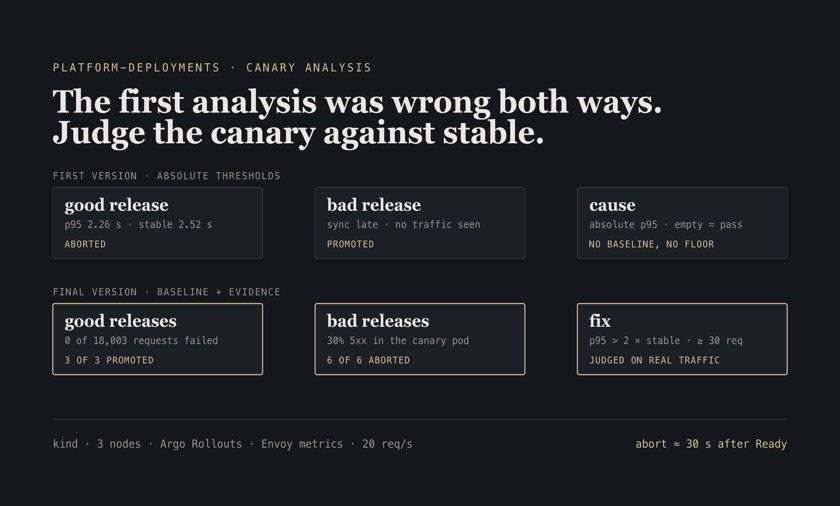
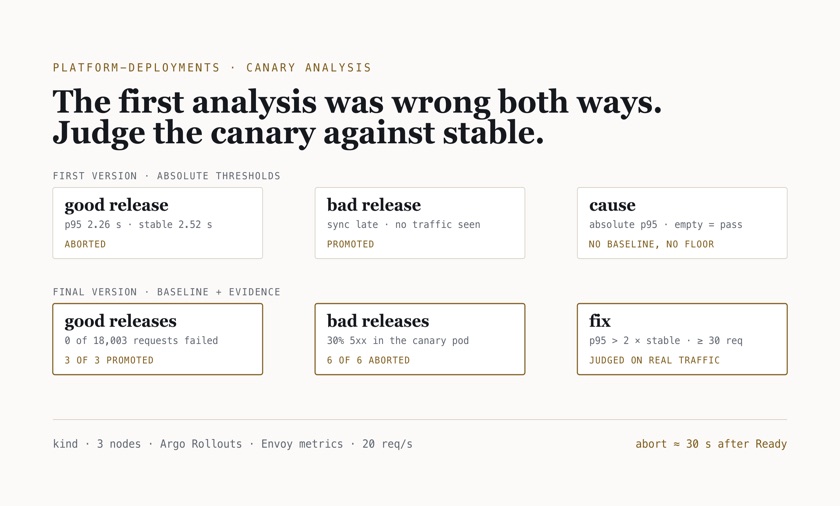
Readiness probes cannot see a release that starts cleanly and then fails real requests; only the traffic can
6 of 6 bad releases aborted by canary analysisa release whose Envoy sidecar returns 500 on 30% of requests, under 20 req/s from k6; three runs with keep-alive clients, three with a new connection per request; Prometheus analysis every 15 s after a 30 s initial delay · measured Oct 2026 · kind, three nodes
0 of 18,003 requests failed across three good canary releasesk6 at 20 req/s for five minutes per run, GET /healthz and GET /review-queue with a 10 s timeout; canary 20% → 50% with 60 s pauses, background analysis and an evidence step before 100% · measured Oct 2026 · kind, three nodes
Kubernetes · kind · Argo CD · Argo Rollouts · Envoy · Prometheus
Continue the conversation
See the full career record, or get in touch about a senior data, platform, or AI engineering role.