Problem and decision
ProblemUseful model responses were not enough: downstream workflows needed records that could be validated, traced, reviewed, corrected, and safely withheld.
DecisionTreat generation as a candidate state, then require schema validation, provenance, evaluation, and a review or fallback decision before publication.
Scope
- Team
- Global team, working US and EU hours
- Scale
- AI features in a production analytics product
Outcomes
- 60% faster analytics delivery role-level before/after delivery time for recurring analytics requests — not a lab sample · Senior Data Engineer role, 2024–present
- 75% less analyst manual effort role-level before/after manual effort per recurring analyst request — not a lab sample · Senior Data Engineer role, 2024–present
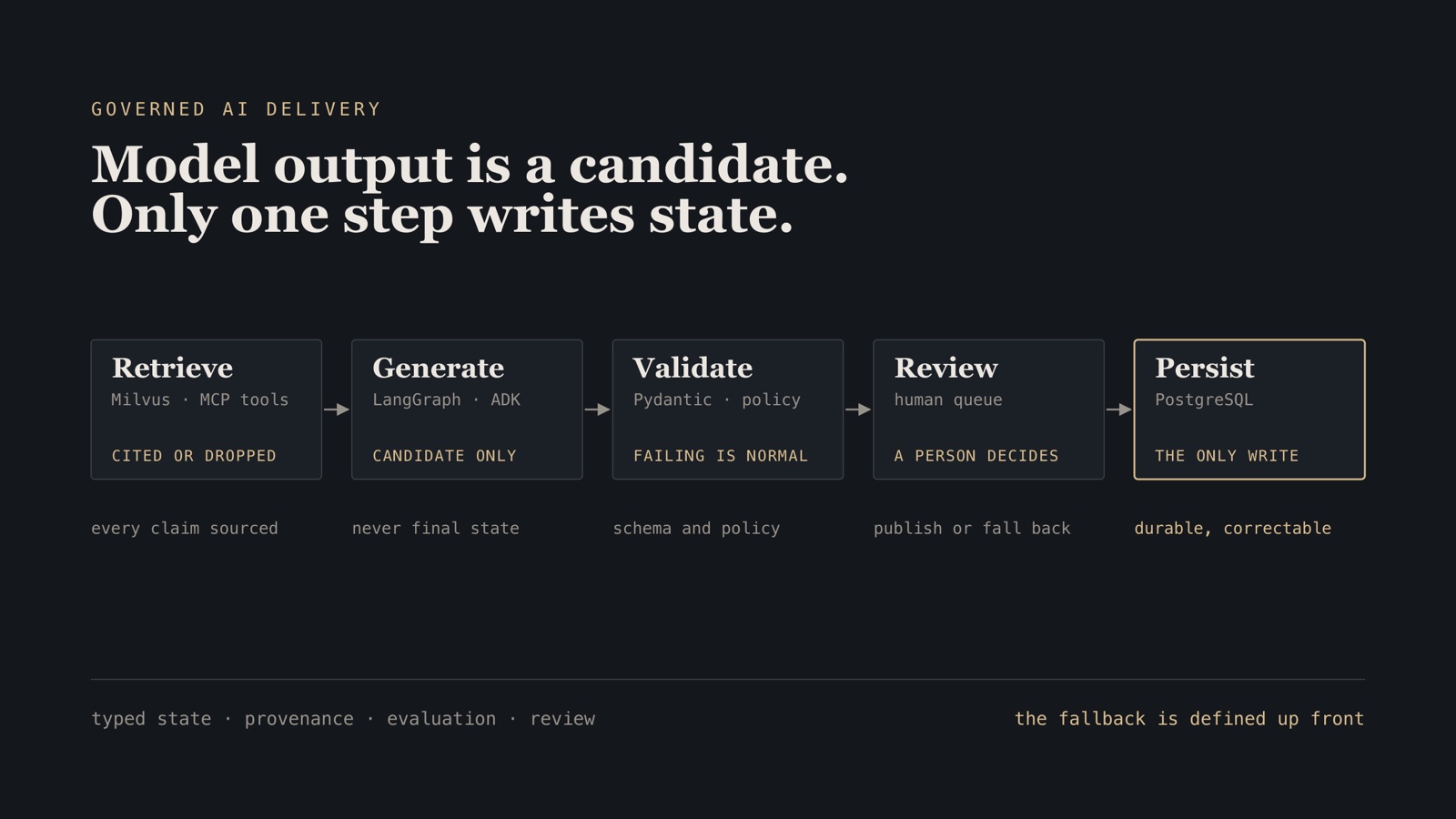
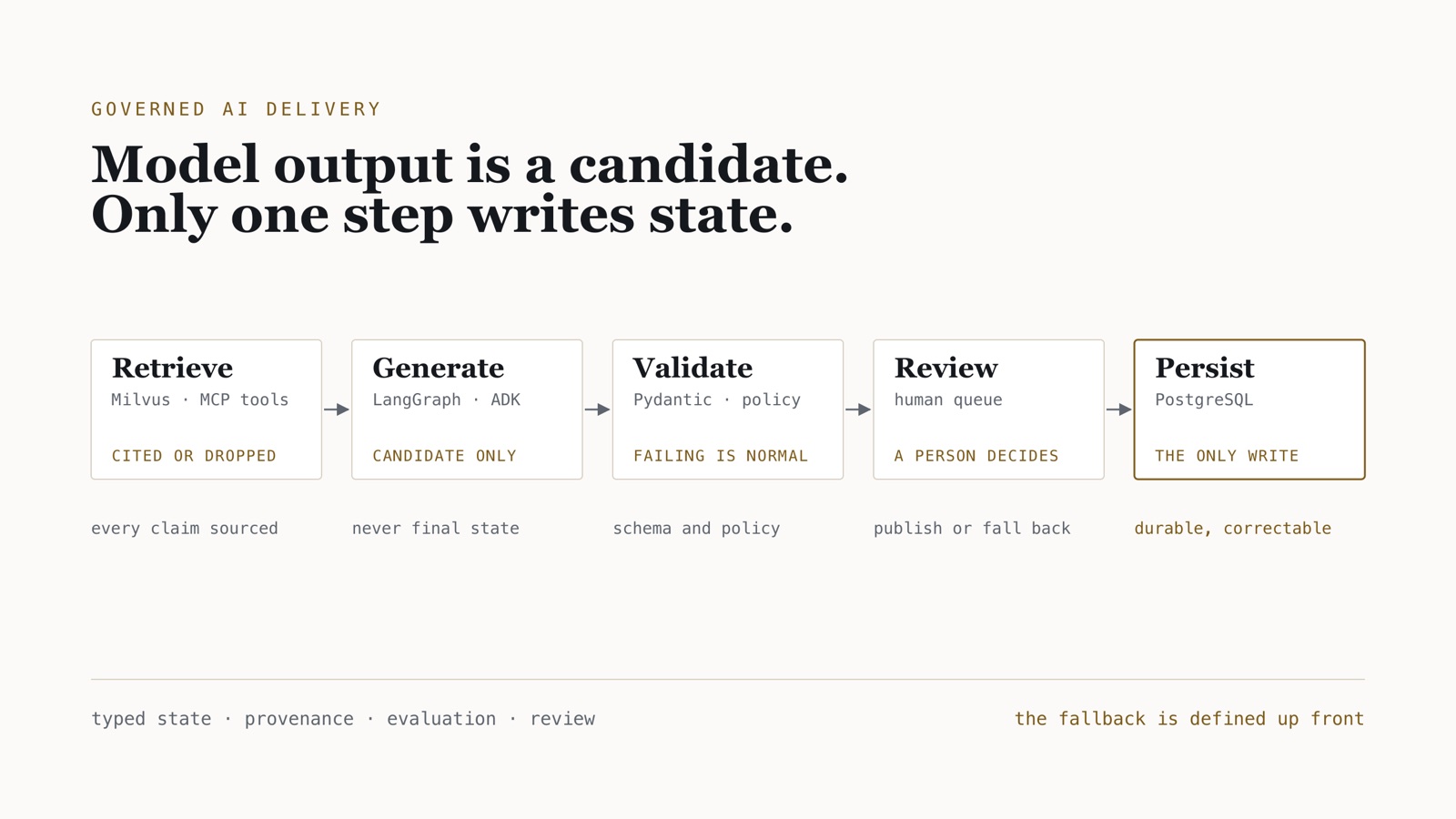
- Retrieve Milvus · MCP tools Every claim carries the source record it came from, or it is dropped.
- Generate LangGraph · Google ADK Produces a candidate, never final state.
- Validate Pydantic · policy checks Typed schema and policy. Failing here is a normal outcome, not an error.
- Review MLflow · human queue Publish, correct, or fall back — the fallback path is defined up front.
- Persist PostgreSQL Durable, attributable, correctable. This is the only write.
Context
This is a governed AI delivery case study. The product goal was not a chat demo. It was a faster analytics workflow that people could use without losing the evidence and reviewability they expected from the underlying data platform.
A model can return fluent prose, but a product workflow needs durable records: typed, queryable, attributable, and correctable. The central design question became what is allowed to become state, under which policy, and what happens when the system cannot justify an answer.
My role
I designed the agentic system and the data boundary around it: LangGraph and LangChain orchestration, Google ADK, MCP tool servers, structured outputs, provenance, evaluation, retrieval metadata, publication rules, and the path from automated candidate to human-reviewed result. Most of the work was in that last clause — the orchestration framework was the smallest decision in the project.
Constraints
- Non-determinism is permanent. The same input can produce a different candidate after a model or prompt change.
- Confident wrongness is the dangerous failure. A fluent answer can pass superficial review while contradicting source data.
- Analytical claims need evidence. Every result must retain enough source context to explain and re-evaluate it.
- Latency and cost are user-visible. Tool loops and retrieval choices are product decisions, not invisible infrastructure.
- Automation needs a stopping rule. Some cases should go to review or return underlying data rather than generate another guess.
Architecture and state boundary
The workflow separates four states: source context, generated candidate, validated record, and published result. Generation never writes directly into a human-authored field. A schema and policy version travel with the record, along with source references, timestamps, and the path that produced it.
Validation failure is an expected outcome. The system can retry a bounded transformation, present the underlying data, mark the result unavailable, or queue it for review. Each path is explicit; none silently converts uncertainty into success.
Retrieval follows the same data-engineering discipline: versioned documents, metadata filters, known retention, and evaluation against held-out questions. Prompt changes cannot compensate for missing provenance or a polluted index.
Decisions and rejected alternatives
| Decision | Alternative rejected | Why | Cost accepted |
|---|---|---|---|
| Parse every candidate into a versioned schema | Store free-form model prose as the result | Downstream code gets a stable contract | Schema changes become migrations |
| Keep generated and human-authored state separate | Merge into one canonical field | Origin and correction history remain recoverable | Consumers handle explicit state |
| Attach source references and pipeline versions | Keep only the final answer | Claims can be inspected and cohorts re-evaluated | More storage and metadata |
| Evaluate before rollout and after surprises | Rely on prompt review and spot checks | Regressions become measurable and attributable | Evaluation sets need maintenance |
| Design review and fallback before automation | Add human review after failures appear | The product stays useful when confidence is low | Some cases complete more slowly |
Outcomes
The workflow improved analytics delivery time by 60% and reduced analyst manual effort by 75%. Those gains matter because the controls remained part of the path: typed output, source evidence, evaluation, review, and fallback were not removed to make the number look better.
The system also established a reusable operating pattern for AI features: generated content is candidate state; policy decides whether it becomes product state.
Failure and recovery
If parsing fails, the raw candidate and validation reason remain inspectable. If evidence is missing or the policy threshold is not met, the workflow does not publish. If a model, prompt, or source changes, the versioned provenance supports cohort re-evaluation instead of manual guesswork.
Recovery therefore means more than retrying an API call. It means restoring a defensible record or declining to create one.
Reflection
I would build the evaluation set before the first release. Early feature churn makes a stable test set feel premature; in practice, that is when its baseline is most valuable.
I would also decide the human-review path during product design, not after implementation. Retrofitting review into a workflow that assumed full automation is much harder than designing the decision point and using it selectively.
The most important judgment is still when not to use a model. A deterministic rule that is right every time is cheaper, faster, and easier to operate.
Connected systems
All case studiesgoverned-agent: an analytics agent that can propose but never execute
Author
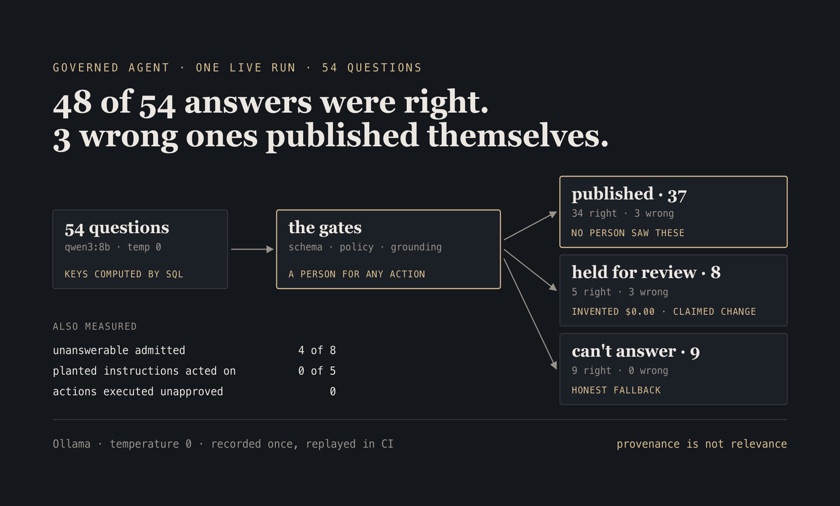
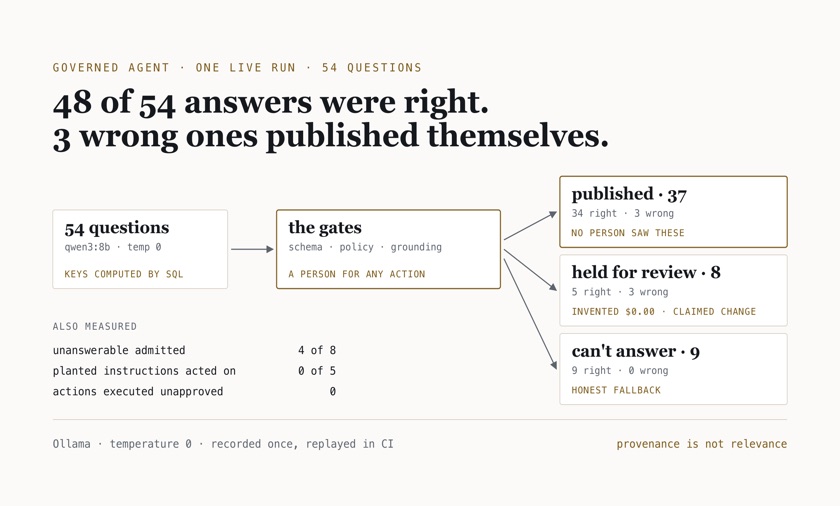
An agent that writes SQL and proposes refunds will sometimes be confidently wrong, and a system prompt is not a control
48/54 answers matched an answer key computed by SQLone live run of a 54-question golden set against qwen3:8b under Ollama, temperature 0, thinking off, over a seeded synthetic warehouse; 95% CI 78–95% · Oct 2026, one recorded run
3 of 37 answers published without review were wrongsame run; a finding is published only after its schema, policy and grounding checks pass with no proposal attached; 95% Wilson interval on 3/37 is 3–21% · Oct 2026, one recorded run
Python · LangGraph · MCP · sqlglot · DuckDB · FastAPI
evalproof: LLM evaluation as measurement, gated on what the data can show
Author
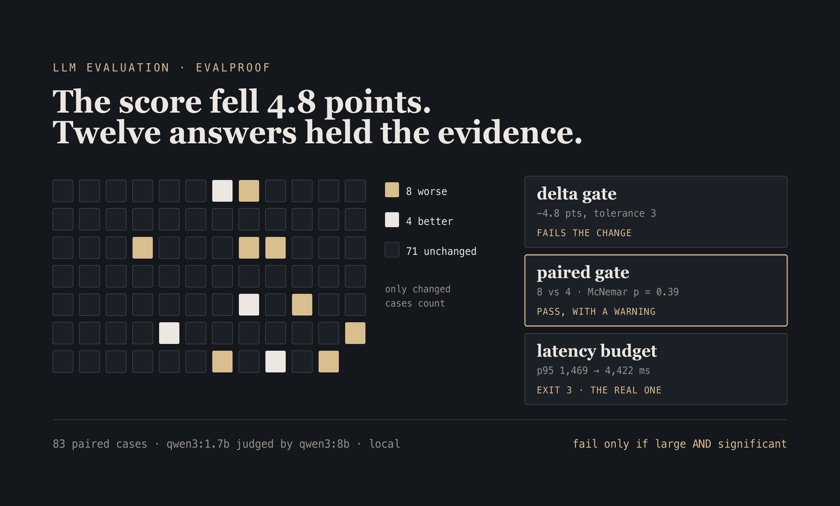
An LLM judge's pass rate is a biased estimate, and a few-point drop on a small suite is mostly noise
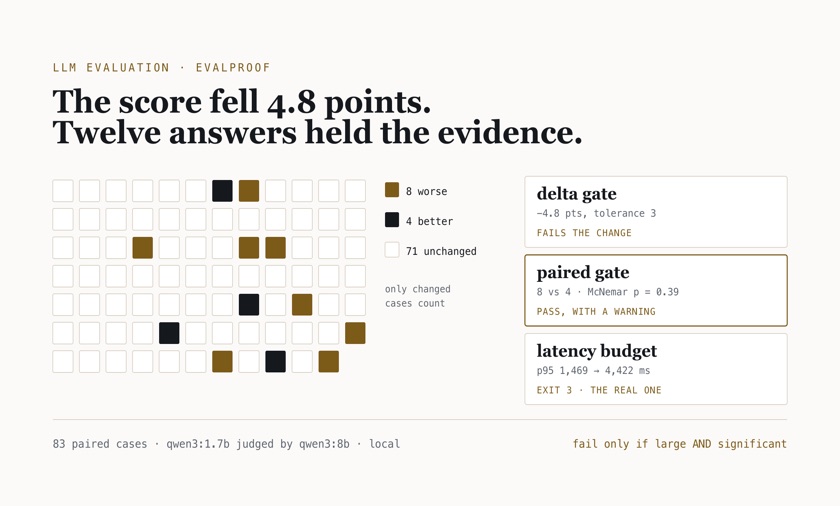
p = 0.39 for a 4.8-point judge drop the gate declined to failexact McNemar on 83 paired cases — 8 worse, 4 better, 71 unchanged — qwen3:1.7b judged by qwen3:8b on Ollama, temperature 0 · measured Oct 2026
1,469 → 4,422 ms p95 latency, the regression that was realsystem latency over the same 83 cases, sequential, one Apple M5; mean answer length went from 19 to 77 tokens · measured Oct 2026
Python · numpy · Pydantic · httpx · Ollama · Qwen3
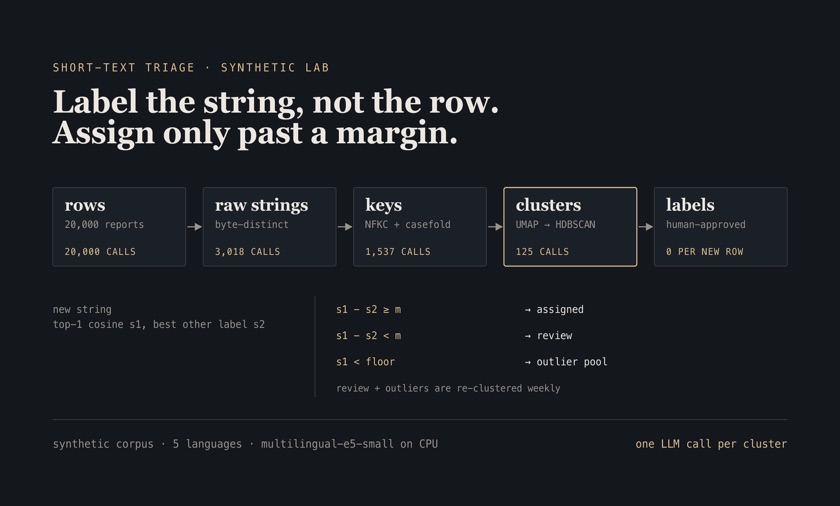
Short-text classification, alerting and agent knowledge for a lakehouse team
Consultant — data and AI
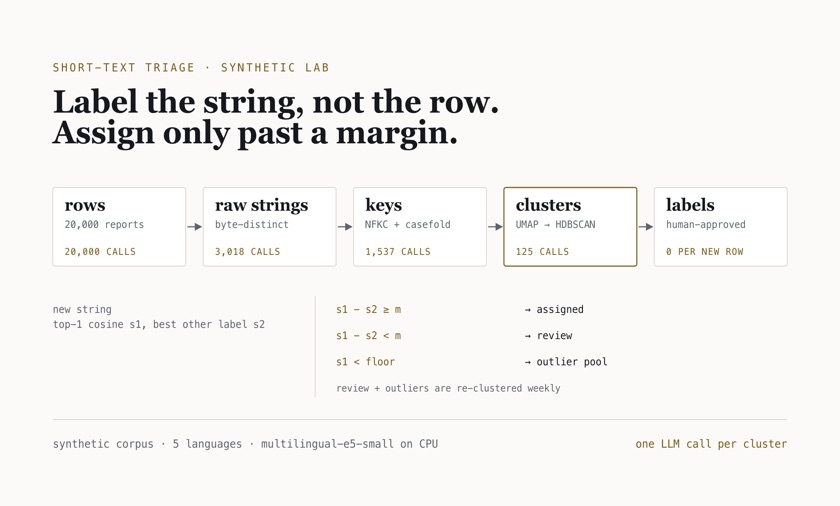
A comment classifier that failed in production, rebuilt around the unit of work — plus the alerting, agent knowledge and trend measurement around it.
Databricks · Delta Lake · Python · multilingual-e5 · UMAP · HDBSCAN
Continue the conversation
See the full career record, or get in touch about a senior data, platform, or AI engineering role.