Problem and decision
ProblemEvery RAG system meets the same early question — do we need a vector database, or is Postgres enough, and do we need hybrid search at all? Vendor benchmarks answer it for their own engine. I wanted the answer on public data, with pinned versions, measuring the trade-offs that actually decide a production choice.
DecisionEmbed once and load identical vectors into every engine, compute exact ground truth, compare engines at equal recall rather than equal settings, and publish the runs that flatter nobody — including my own measurement mistakes.
Scope
- Team
- One person
- Scale
- 381,559 vectors × 384 dimensions; PostgreSQL 18 with pgvector, Qdrant and OpenSearch, each in its own container with 4 CPUs and 5 GiB
- Links
- Source
Measured results
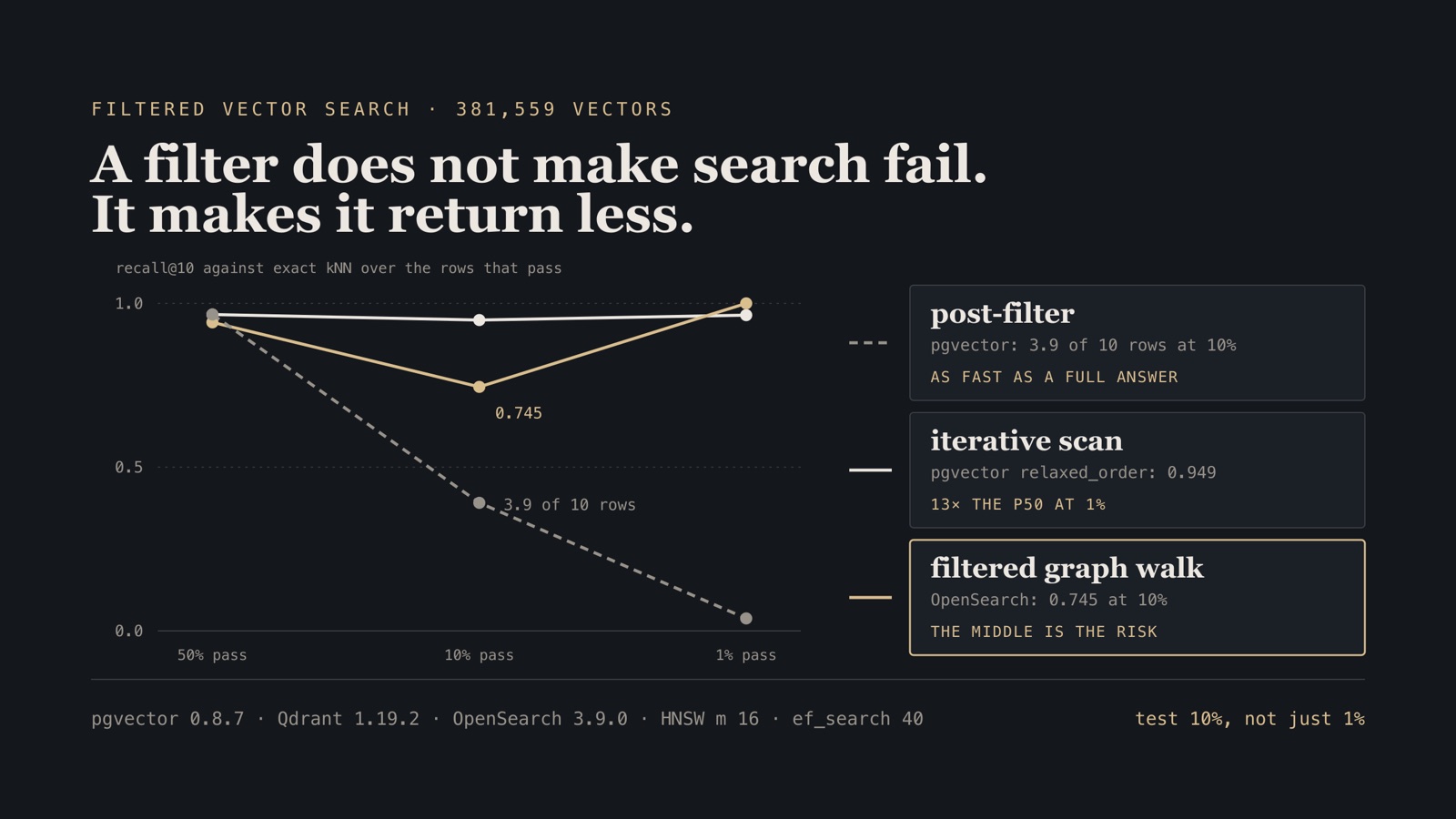
- 3.9 of 10 rows returned by post-filtered HNSW at 10% selectivity pgvector 0.8.7 HNSW at ef_search 40 with iterative scan off, 1,000 queries over 381,559 vectors, a filter keeping 10% of rows; recall@10 0.391 against exact kNN over the rows that pass · measured 2026
- 0.745 recall@10 of OpenSearch's efficient filter at 10% selectivity filter inside the knn clause, Faiss HNSW at ef_search 40, 1,000 queries over 381,559 vectors, against exact kNN over the rows that pass · measured 2026
- 0.949 recall@10 restored by pgvector's iterative scan at 10% selectivity hnsw.iterative_scan = relaxed_order, ef_search 40, same queries and filter as the post-filtered run · measured 2026
- ≤ 0.0015 nDCG@10 between pgvector, Qdrant and OpenSearch and exact search the same bge-small vectors loaded into all three engines, ef_search 200, scored against human relevance judgements on SciFact, ArguAna and Touché 2020 · measured 2026
- Corpus BEIR · args.me 986 near-copies of the queries held out; left in, recall read 0.965 at ef_search 10.
- Embed bge-small-en-v1.5 · sentence-transformers Embedded once at a pinned revision; every engine loads the same float32 arrays.
- Truth numpy Exact kNN over only the rows that pass the filter, so lost recall is the index's.
- Engines pgvector · Qdrant · OpenSearch At a 10% filter, post-filtered pgvector HNSW returned 3.9 of 10 rows, and no error.
- Measure rbench · results JSON Refuses to time off mains power; five interleaved passes, medians, JSON committed.
Context
The question behind this repository is one every RAG system meets early, and one I kept answering from other people’s benchmarks: is Postgres with pgvector enough, or does retrieval need a dedicated vector database — and does hybrid search earn its complexity? Vendor benchmarks measure their own engine on their own terms. Public comparisons usually change two things at once, the engine and the embeddings, so a gap in quality could be either.
retrieval-bench holds everything else fixed. One embedding pass, one set of float32 vectors, loaded unchanged into PostgreSQL 18 with pgvector 0.8.7, Qdrant 1.19.2 and OpenSearch 3.9.0. Every number it publishes is in MEASUREMENTS.md, drawn from JSON results the repository commits.
Constraints
Public data with licences I could check at the source, not at a mirror: SciFact, ArguAna and Touché 2020 on args.me, all under CC BY 4.0 (SciFact’s abstracts under ODC-By), credited in the repository’s NOTICE. NFCorpus and NQ were left out because their original licences could not be confirmed, and MS MARCO because it is non-commercial.
The engines run on one host, each in its own container capped at 4 CPUs and 5 GiB, and only the engine under test runs while anything is timed. There is no network between client and database, so latency is client-observed with each engine’s round-trip floor published beside it (0.15 to 0.28 ms). Everything fits in memory; quantisation, on-disk indexes and multi-node deployments are outside this run.
Architecture
A small Python harness, rbench, downloads the BEIR datasets, embeds each corpus once with bge-small-en-v1.5 at a pinned revision, and computes exact nearest neighbours in numpy — with any filter applied — as ground truth. Each engine is one adapter class behind a common protocol: build from scratch, search with an ef_search or probes setting and an optional filter, insert, report sizes. The same runner drives quality runs against human relevance judgements, recall–latency sweeps, filtered search, concurrency from 1 to 16 client processes, and inserts while querying. make smoke pushes synthetic data through every adapter in CI.
In the code
The 10% result turns on one session setting, not on the query. With hnsw.iterative_scan off, the index scan hands Postgres ef_search candidates (40 here) and the WHERE clause runs on those, so a 10% filter leaves about four; with relaxed_order, the same SQL keeps walking the graph until ten rows pass.
ITERATIVE = {"default": "off", "post": "off", "relaxed": "relaxed_order", "strict": "strict_order"}
# …
    def _configure(self, q: Query) -> None:
        mode = ITERATIVE[q.strategy]
        if self.index == "hnsw":
            self._set("hnsw.ef_search", str(q.ef or 40))
            self._set("hnsw.iterative_scan", mode)
        else:
            if mode == "strict_order":
                raise ValueError("ivfflat supports relaxed_order only")
            self._set("ivfflat.probes", str(q.probes or 1))
            self._set("ivfflat.iterative_scan", mode)

    def _sql(self, q: Query) -> tuple[str, tuple[object, ...]]:
        where, args = "", tuple[object, ...]()
        if q.bucket_lt is not None:
            where, args = "WHERE bucket < %s", (q.bucket_lt,)
        sql = f"SELECT id FROM {self.table} {where} ORDER BY embedding <#> %s LIMIT %s"
        return sql, args + (q.vector, q.k)
The whole adapter, including the EXPLAIN the harness records beside every filtered result, is in src/retrieval_bench/engines/pgvector.py.
Decisions and trade-offs
| Decision | Alternative considered | Why | What it cost |
|---|---|---|---|
| Embed once, load the same arrays everywhere | Let each engine’s integration embed | A quality gap between engines is then an index gap, not a model gap | Nothing engine-specific, such as built-in quantisation, is exercised |
Compare at equal recall (each engine’s smallest ef_search reaching 0.95) |
Compare at equal settings | The same ef_search bought recall from 0.82 to 0.90 across engines |
Operating points must be re-derived whenever a version changes |
| Exact ground truth over the rows that pass a filter | Relevance judgements only | Isolates what the index loses from what the model gets wrong | Filtered runs measure recall, not answer relevance |
| A synthetic hash filter at 50%, 10% and 1% | A real metadata field | A field correlated with content would measure the data, not the engine | Real tenant and date filters behave differently and are not measured |
| Hold out 986 near-duplicates of the query set | Use the corpus as published | 98.5% of queries had a near-copy in the index, inflating recall | The ANN corpus differs from the quality corpus by those rows |
| Refuse to time anything off mains power | Trust the operator | A battery run was several times slower and had to be discarded | Timed runs need the machine plugged in, checked before and after |
Results
On the same vectors, the three engines differed from exact search by ≤ 0.0015 nDCG@10 on all three datasets, and at recall@10 ≈ 0.97 their median latencies differed by 0.13 ms. Choosing between them on quality or single-query speed would be choosing on noise. What separated them was everything around the query:
| Question | Measured |
|---|---|
| What does a selective filter do? | Post-filtered pgvector HNSW returned 3.9 of 10 rows at 10% selectivity, as fast as a full answer. OpenSearch’s efficient filter returned ten rows with recall 0.745. pgvector’s relaxed_order iterative scan restored recall to 0.949 |
| How far does it scale on 4 CPUs? | Peak at 8 clients: Qdrant 5,643 QPS, OpenSearch 4,920, pgvector HNSW 4,483; IVFFlat tops out at 732 |
| What happens while rows are written? | pgvector inserts 639 rows/s with query latency unchanged; Qdrant ingests 25× faster, and its median rose from 0.66 to 2.30 ms until its optimiser finished 86 s later |
| Is hybrid search worth it? | As a hedge: +1.3 nDCG@10 on SciFact, +7.3 on Touché, −2.2 on ArguAna. A larger embedding model gained more than fusion where both were measured |
| Can Postgres do the keyword half? | Not with built-in full-text: the best variant trailed BM25 by 8 to 23 points, and hybrid built on it scored below vector search alone on all three datasets |
| What does it cost to hold? | pgvector stores every vector twice, table and index; OpenSearch’s container used 3.7 GiB including a fixed 2 GiB heap |
The filtered results are the ones that changed what I would ship, and they are written up in Filtered vector search returned four rows instead of ten.
What went wrong
The repository keeps a failure log, because each failure changed the design.
The first sweep was too good. pgvector reached recall@10 of 0.965 at ef_search = 10 on 382,000 vectors. ArguAna and args.me both scraped the same debate site, so 98.5% of the queries already had a near-identical document in the index. Holding those 986 rows out dropped a query’s median similarity to its nearest document from 0.988 to 0.861, in line with Touché’s own topics.
A warm-up was not a warm-up. One setting’s throughput rose from 459 to 703 QPS over three passes after a 50-query warm-up. Every point now gets a full warm-up pass and five timed passes interleaved across the sweep.
The machine was on battery. A rerun came back several times slower — p50 5.65 ms against 1.26 — because macOS had switched on Low Power Mode. The harness now refuses to start a timed run off mains power and records the power state in every result.
Postgres full-text found nothing. websearch_to_tsquery ANDs every term, so 274 of 300 SciFact claims matched no document, and the ts_rank_cd ranker most examples use halved the score even with ORed terms.
What I’d do differently
Use a filter that correlates with content. The hash filter is the cleanest test of an index and the least like production. A tenant or date field, where the passing rows cluster, is the next run, because it can make a graph walk better or worse and I do not know which.
Test significance. Quality differences are reported without significance tests, and Touché’s 49 topics make its column noisy. Differences of a few thousandths of nDCG@10 should carry an interval, not a ranking.
Measure what larger corpora need. Quantisation, on-disk indexes, updates and deletes under load, and multi-node deployments all change the picture past the size where everything fits in memory, and none of them are in this run.
Connected systems
All case studiesA lakehouse, and the RAG pipeline that runs on it
Personal lab
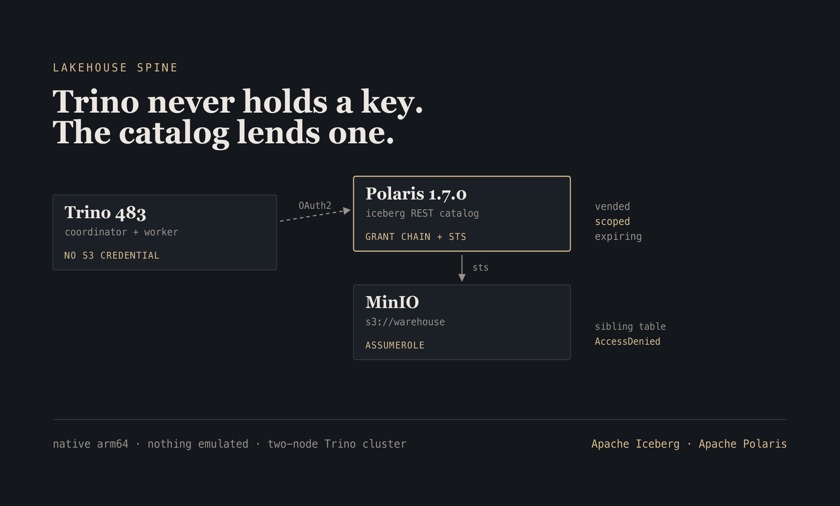
The two halves of the thesis as one system: Trino and Iceberg underneath, retrieval and answers on top, both measured
88 ms one-month predicate over 1.5M Iceberg rowsmedian of 7 server-side runs from system.runtime.queries, after 2 warm-ups, on a month-partitioned Iceberg table · measured 2026 · 2024 stack rebuilt
909,968 rows recovered by snapshot rollbackan over-broad DELETE (a WHERE reaching years further back than intended), then ALTER TABLE EXECUTE rollback_to_snapshot, counted against the pre-incident total · measured 2026 · 2024 stack rebuilt
Trino · Apache Iceberg · Apache Polaris · StarRocks · Apache Spark · Delta Lake
governed-agent: an analytics agent that can propose but never execute
Author
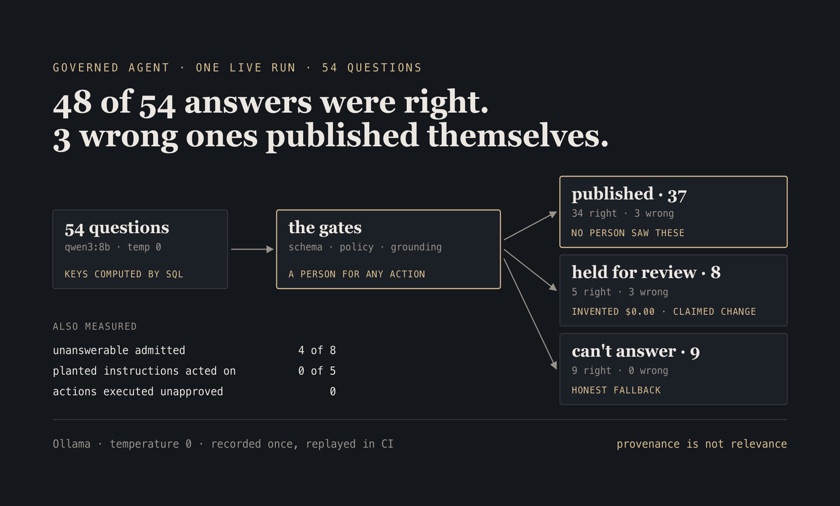
An agent that writes SQL and proposes refunds will sometimes be confidently wrong, and a system prompt is not a control
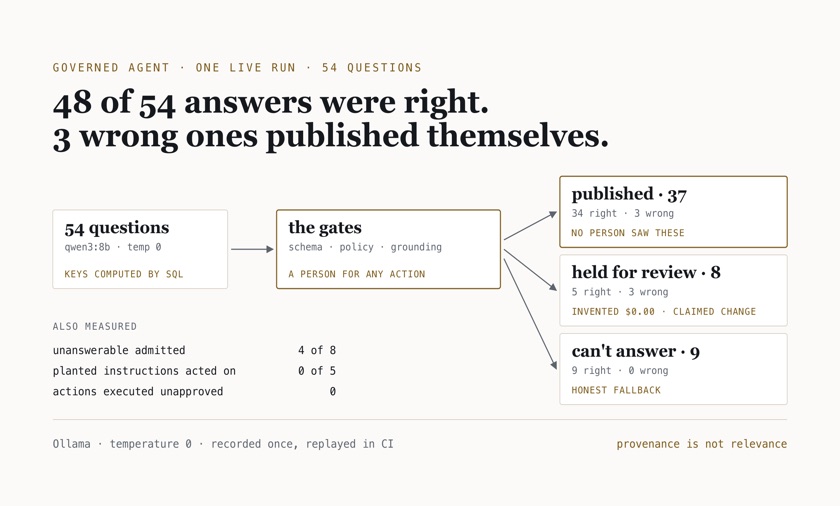
48/54 answers matched an answer key computed by SQLone live run of a 54-question golden set against qwen3:8b under Ollama, temperature 0, thinking off, over a seeded synthetic warehouse; 95% CI 78–95% · Oct 2026, one recorded run
3 of 37 answers published without review were wrongsame run; a finding is published only after its schema, policy and grounding checks pass with no proposal attached; 95% Wilson interval on 3/37 is 3–21% · Oct 2026, one recorded run
Python · LangGraph · MCP · sqlglot · DuckDB · FastAPI
evalproof: LLM evaluation as measurement, gated on what the data can show
Author
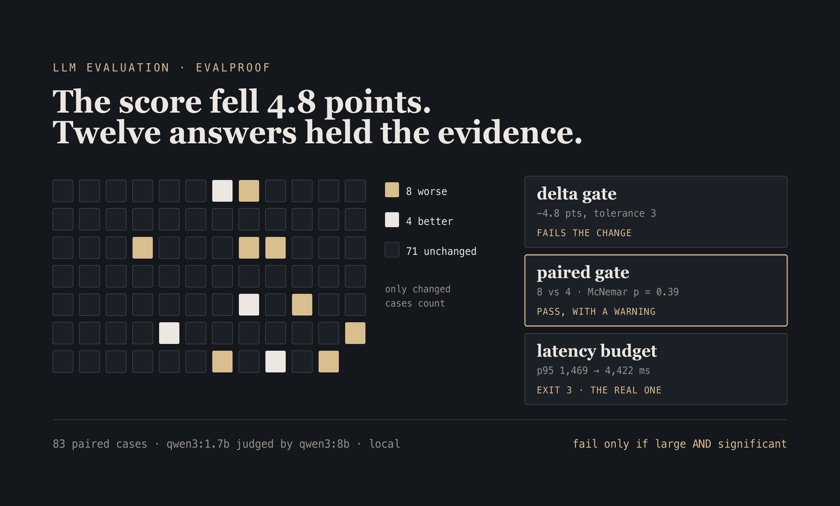
An LLM judge's pass rate is a biased estimate, and a few-point drop on a small suite is mostly noise
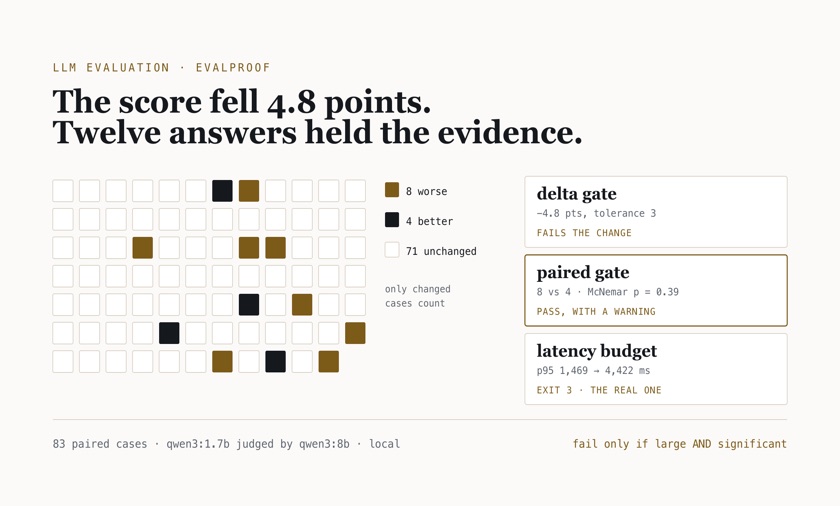
p = 0.39 for a 4.8-point judge drop the gate declined to failexact McNemar on 83 paired cases — 8 worse, 4 better, 71 unchanged — qwen3:1.7b judged by qwen3:8b on Ollama, temperature 0 · measured Oct 2026
1,469 → 4,422 ms p95 latency, the regression that was realsystem latency over the same 83 cases, sequential, one Apple M5; mean answer length went from 19 to 77 tokens · measured Oct 2026
Python · numpy · Pydantic · httpx · Ollama · Qwen3
Continue the conversation
See the full career record, or get in touch about a senior data, platform, or AI engineering role.