Problem and decision
ProblemThis site claims I design data platforms and the agentic systems that run on them. The platform work and the AI work were evidenced separately, which proves each half and not the sentence. I wanted one rig where the same storage carries both, and where the claims about it are numbers rather than adjectives.
DecisionRebuild two real client stacks on current versions rather than write about the originals, measure everything server-side, and publish the failures — including the ones where the tool reported success.
Scope
- Team
- One person
- Scale
- One host, every service its own container: MinIO, Apache Polaris 1.7.0, Trino 483 (coordinator + worker), StarRocks 4.1.4, Spark 4.0.4 with Delta 4.0.0, Chroma, Ollama, Airflow 3.3.1 — every image native arm64
- Links
- Source
Measured results
- 88 ms one-month predicate over 1.5M Iceberg rows median of 7 server-side runs from system.runtime.queries, after 2 warm-ups, on a month-partitioned Iceberg table · measured 2026 · 2024 stack rebuilt
- 909,968 rows recovered by snapshot rollback an over-broad DELETE (a WHERE reaching years further back than intended), then ALTER TABLE EXECUTE rollback_to_snapshot, counted against the pre-incident total · measured 2026 · 2024 stack rebuilt
- 0 tokens spent refusing an out-of-corpus question asked a question with no answer in the corpus; nearest passage sat at cosine distance 0.923 against a 0.75 threshold, so the model was never called · measured 2026 · 2025 stack rebuilt
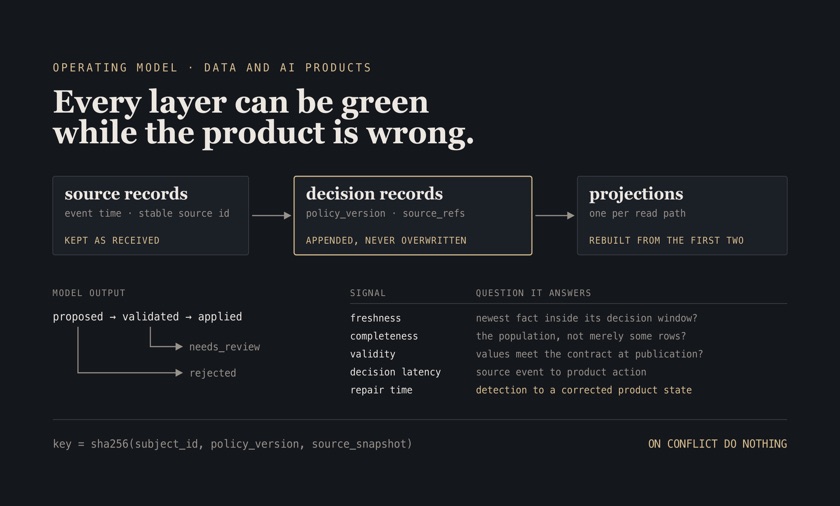
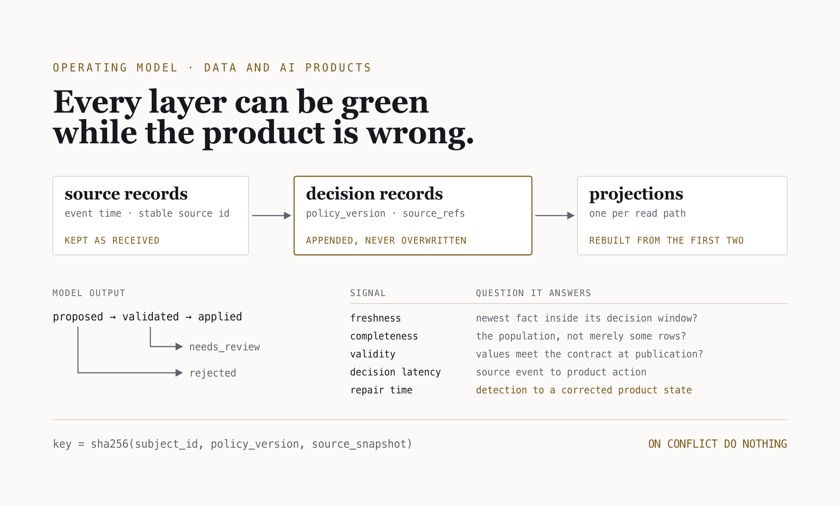
- Land robots.txt · JSONL Append-only. Everything downstream is derived, so a re-scrape is rare and a re-run is cheap.
- Refine Spark 4 · Delta Lake Bronze rewrites from raw; silver merges. Only one of those can forget a bad key.
- Embed MiniLM-L6-v2 · Chroma Chunk id is a hash of the source, so a re-run updates a vector instead of duplicating it.
- Retrieve cosine distance The grounding boundary. Nothing within threshold means no answer, decided before any inference.
- Answer llama3.2 · FastAPI Cites the passages it used, or declines. A refusal costs no tokens.
Context
The two case studies above this one evidence the halves. data-platform-practice is the platform; governed-ai-delivery is the agentic layer. Both are professional work, both are real, and neither shows the thing the headline actually claims — that the second runs on the first.
So this is one rig where it does. A lakehouse underneath: object storage, an Iceberg REST catalog that decides who may touch a table, two query engines reading the same tables. A retrieval pipeline on top: the same storage refined through Delta, embedded, and served as answers that cite their sources.
Both halves were rebuilt from client projects — a January 2024 Trino/Iceberg build and a July 2025 RAG pipeline. Neither could be simply refreshed. The 2024 stack’s catalog image has not been updated since August 2024 and its metastore is superseded; the 2025 stack’s Spark image has no tags left on Docker Hub (the bitnamilegacy copies are frozen), and it required three hand-downloaded JARs that were absent from its own repository. That failure is in the write-ups because it is the more useful lesson: the stack did not break from a bad upgrade, it broke because a vendor changed its distribution model and :latest left nothing to fall back to.
What it proves
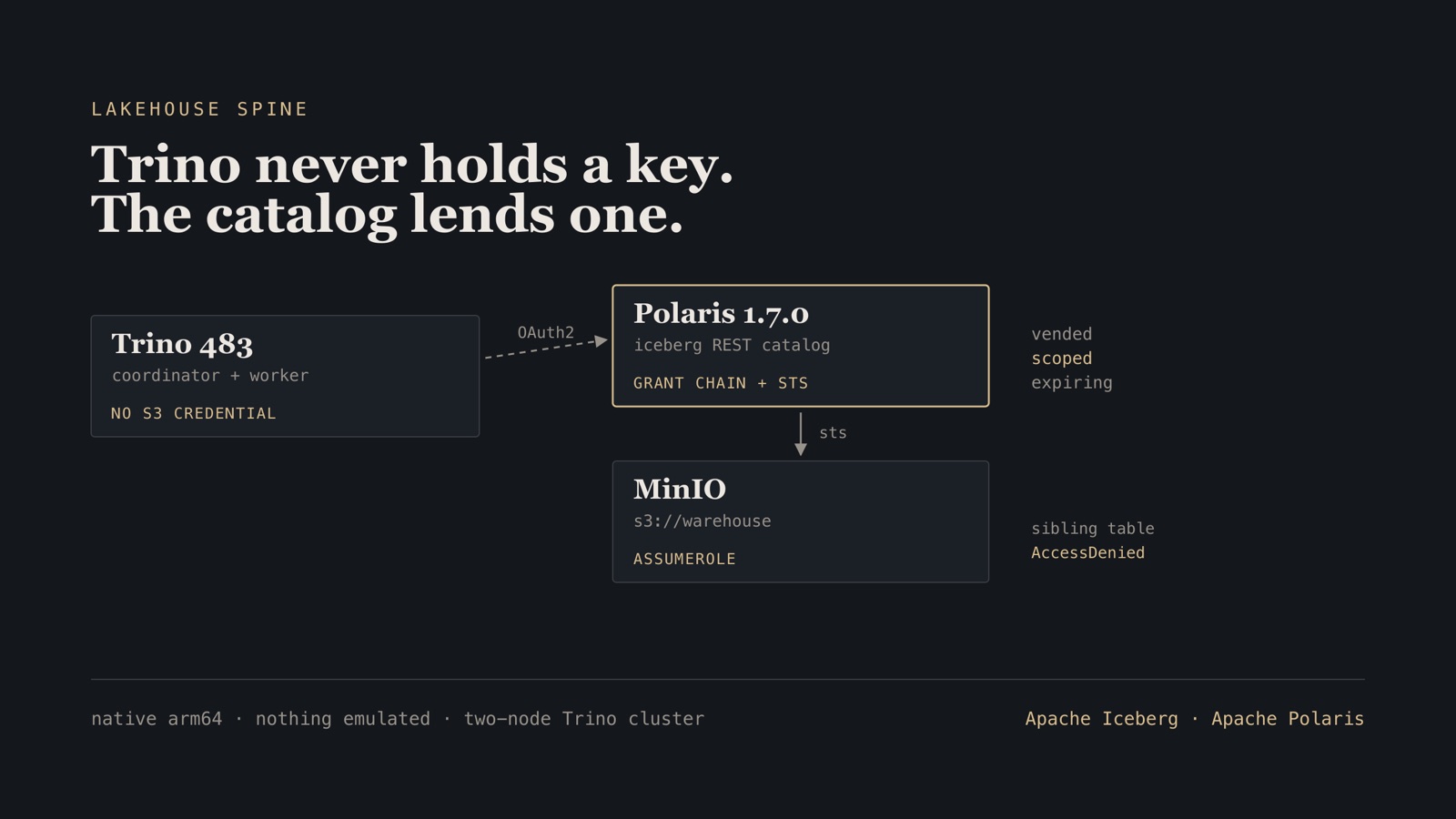
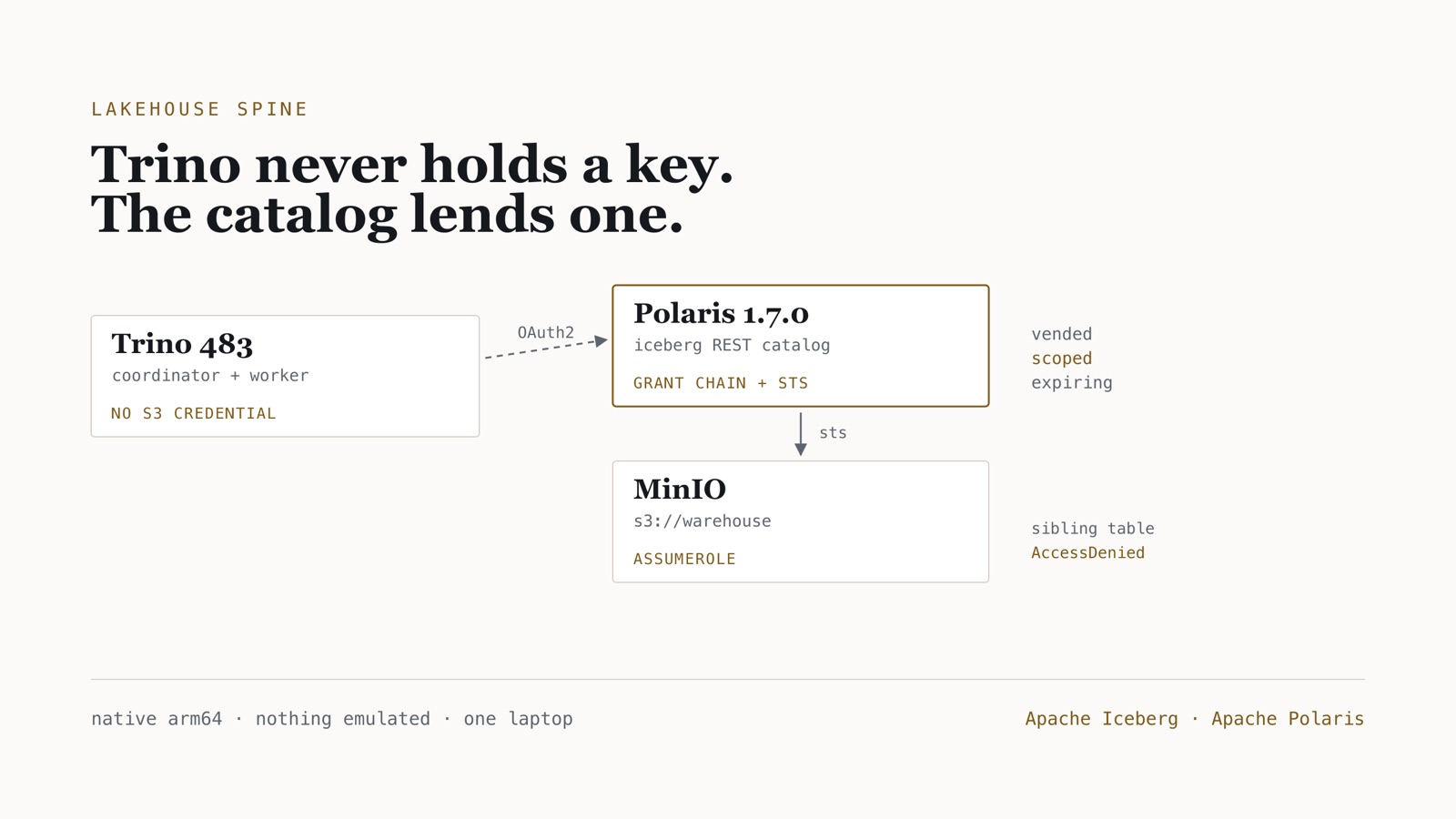
Storage that lends credentials instead of sharing them. Trino holds no S3 key. It authenticates to Apache Polaris as an OAuth2 principal; Polaris checks a grant chain, calls STS, and returns a credential scoped to one table prefix. That is a claim, so it was tested rather than asserted:
credential vended for bronze.orders
  own prefix                 ALLOW  84 objects
  sibling bronze.customers   DENY   AccessDenied
  whole warehouse bucket     DENY   AccessDenied
StarRocks was then attached to the same catalog with one DDL statement, no table definitions, and no S3 credentials of its own. The boundary is engine-independent, which is the actual argument for a REST catalog over a metastore — and the reason to test it before choosing one.
A recovery that was performed, not described. An over-broad DELETE removed 909,968 rows. rollback_to_snapshot returned all of them in 589 ms of wall clock, most of it CLI startup, because a rollback moves a pointer rather than data. Then expire_snapshots demonstrated where that safety net ends: the same time-travel read afterwards returns Iceberg snapshot ID does not exists. Retention is a recovery policy, not housekeeping.
Grounding enforced at the retriever. The RAG endpoint answers with the passages it used, or declines. Asked something outside its corpus, the nearest passage sat at cosine distance 0.923 against a 0.75 threshold — so the response carried a retrieve timing and no generate timing at all. The model was never called. A refusal that costs no inference is a threshold, not a prompt, and it is the cheapest safety property in the system.
What it does not prove
Every service shares one host. The query timings are honest ceilings for 8 CPUs and 11.67 GB, not production numbers, and the language model is a 1B running on CPU — chosen so that the pipeline around it is the subject rather than the model.
The engine comparison is narrower than it looks: StarRocks returned in 34 ms against Trino’s 99 ms on one partition-pruned aggregate, which is close to the shape StarRocks is built for and says nothing about federation or large joins. The useful conclusion is not which is faster. It is that the question can now be measured on the same tables without migrating anything, which before a REST catalog meant a copy.
The failure worth keeping
Three of the failures across this rig were reported as successes by the tool that caused them, and one propagated across three stores.
A charset guess in the scraper put a stray character on every section title. Fixing it changed the titles, which changed the sha256(url::section) chunk id — and every store downstream was upsert-only. Delta’s MERGE inserts and updates; it never deletes a row the source stopped producing. Chroma’s upsert behaves the same. So silver went from 170 rows to 323, gold inherited it, the vector store inherited it, and the retriever answered one question with both copies of the same passage at distances 0.2338 and 0.2350.
From the outside that reads as a model problem: repetitive answer, redundant citations. It is a pipeline problem three layers upstream, from a bug that had already been fixed at the source.
The operating rule it produced is the one I would take to a review: the question to ask of a pipeline is not whether a re-run adds the right rows, it is whether it removes the wrong ones. Bronze could. Nothing else could.
Write-ups
Every figure here comes from a run, and each stage is documented step by step with the failures included:
- The lakehouse spine — Trino, Iceberg and Polaris, and proving the vended credentials are scoped
- Bronze, silver, gold — dbt-trino and Airflow 3, and the partition spec dbt silently discards
- Iceberg maintenance — compaction measured, and a rollback performed
- Two engines, one catalog — StarRocks beside Trino, neither holding a key
- A RAG pipeline on a Delta lakehouse — and the bug that survived being fixed
Related work
All case studiesRebuilding a production data platform for scale and recovery
Data Engineer → Senior Data Engineer
A six-year platform story: faster processing, lower cost, safer change, and recovery designed before the incident.
50% faster core processingrole-level before/after wall-clock on the rebuilt Spark/Airflow path — not a lab sample · Data Engineer role, 2020–2024
40% lower infrastructure costrole-level before/after infrastructure run-rate on the Kubernetes migration — not a lab sample · Data Engineer role, 2020–2024
Python · SQL · Apache Spark · Apache Kafka · Apache Airflow · dbt
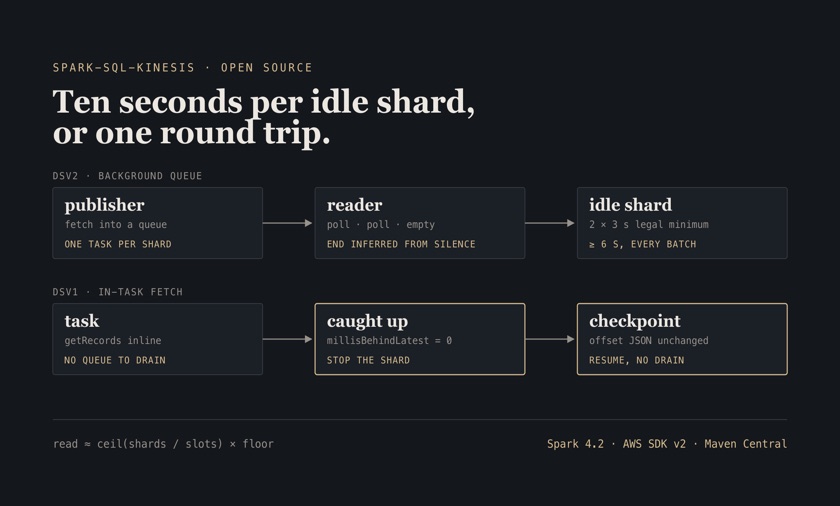
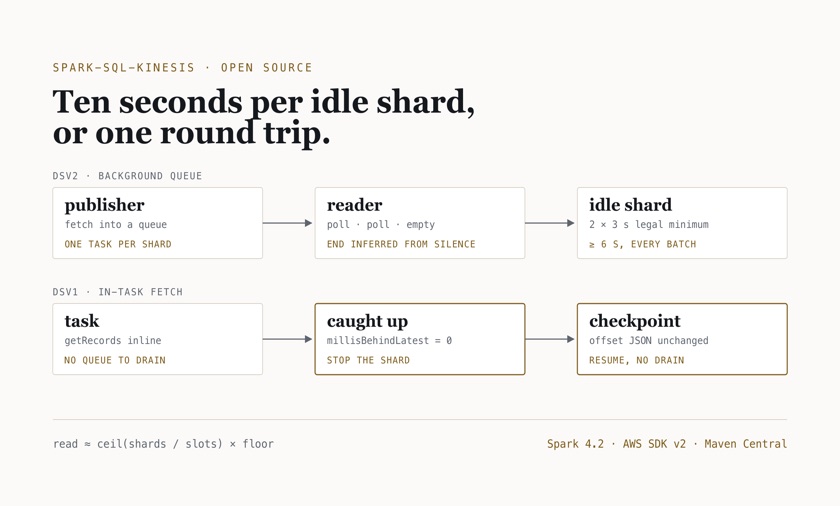
spark-sql-kinesis: a Kinesis source for Spark 4 without the idle-shard floor
Maintainer
Spark 4 dropped the AWS SDK the streaming connector depended on, and the maintained alternative paid seconds on every idle shard
≥ 6 s per idle shard, every batch, on the alternative connectorconnector source plus staging Spark UI stage timings; floor = empty-poll count × poll timeout, and the connector requires that product to exceed 5 s, so 6 s is the lowest it accepts · Aug 2026, staging
Scala · Apache Spark 4.2 · AWS SDK v2 · Amazon Kinesis · Kinesis Producer Library · Protobuf
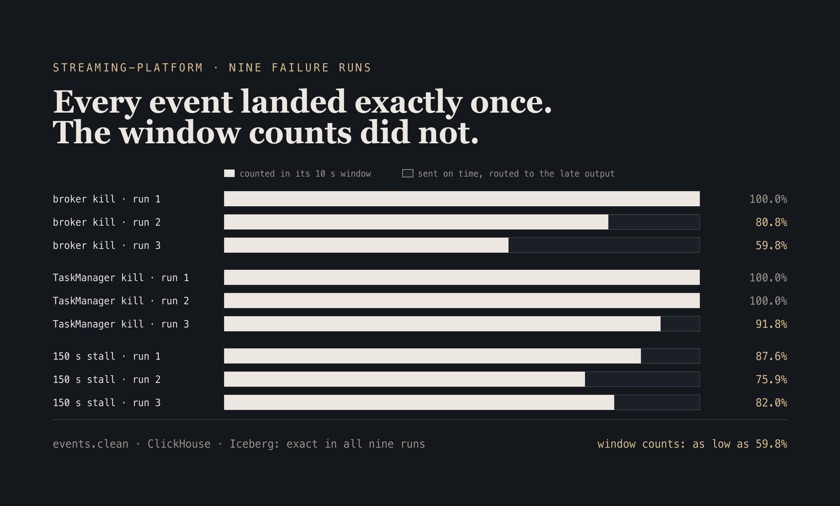
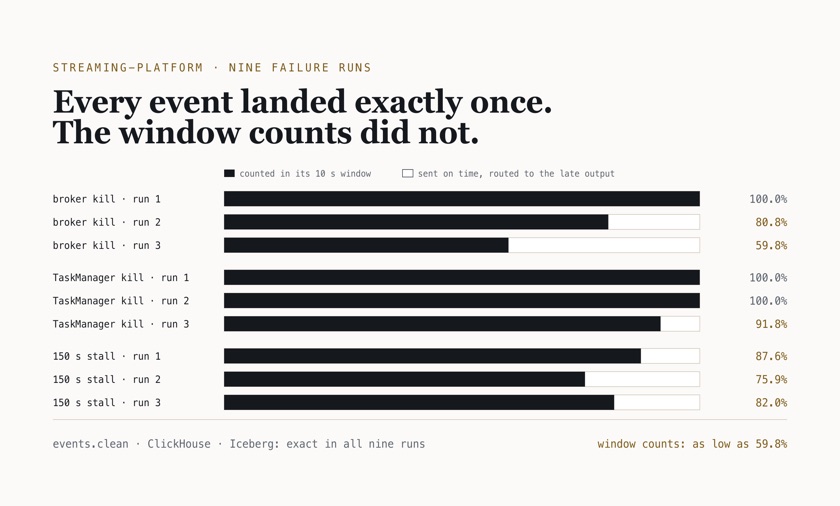
streaming-platform: exactly-once clickstream, counted at every layer
Author
Exactly-once is a claim about counts, so every layer was counted against a ledger, through broker kills, TaskManager kills and stalls
9 of 9 failure runs with every event layer exactthree controller-broker kills, three TaskManager kills and three 150 s stalls under load; Kafka, ClickHouse, Iceberg and the dead-letter topic reconciled against the generator's ledger by sequence number · Oct 2026
59.8% of on-time events left in the window counts after one broker kill118,229 of 197,749 on-time events counted in their 10 s windows in the worst of three broker-kill runs; the rest went to the late side output because catch-up reordered partitions past the 5 s watermark bound · Oct 2026
Apache Kafka 4.3 · Apache Flink 1.20 · ClickHouse · Apache Iceberg · Schema Registry · Avro · Prometheus
Continue the conversation
See the full career record, or get in touch about a senior data, platform, or AI engineering role.