What you'll build
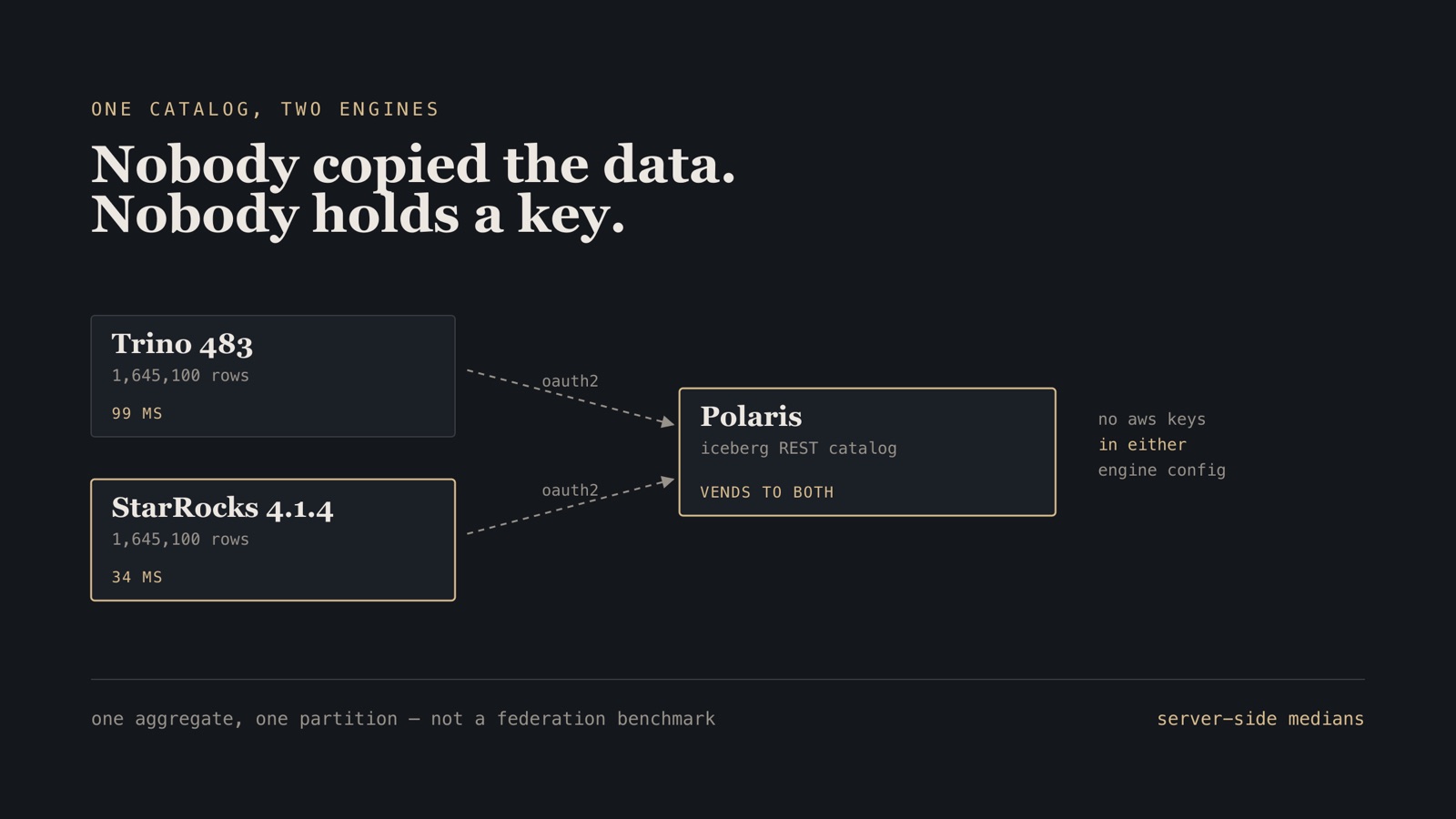
StarRocks 4.1.4 attached to the same Polaris catalog Trino writes through, reading the same tables with no copy and no S3 credentials of its own.
- Time
- ~20 min, mostly waiting for the StarRocks backend to register
- Level
- Intermediate
- Tested on
- macOS Darwin 25 · arm64 host · Docker Desktop 8 CPU / 11.67 GB · StarRocks 4.1.4 (allin1) · Trino 483 · Apache Polaris 1.7.0 · MinIO RELEASE.2025-09-07
Before you start
- The stack from parts one to three, with silver.orders_enriched populated
- About 3 GB of free container memory — stop Airflow if you are tight
On this page
- The claim a REST catalog is actually making
- Step 1 — StarRocks on the same network
- Step 2 — One catalog definition, no table definitions
- Step 3 — Does the second engine reintroduce standing keys?
- Step 4 — Measure both, fairly
- Step 5 — Clean up the shared debris
- Failure modes
- Clean up and operating consequence
The claim a REST catalog is actually making
Parts one to three built a lakehouse on Trino and never left it. That is a fine way to test Iceberg, and a poor way to test the catalog, because the argument for Polaris over Hive Metastore is not that it looks tables up faster.
The argument is that the catalog is the system of record, so a second engine should see the tables the first one wrote — without an export, a copy, a CREATE EXTERNAL TABLE per table, or a second set of credentials.
That last clause is the part worth checking. Part one went to some trouble to make Trino hold no standing S3 key. If adding StarRocks means pasting the MinIO keys into a second config file, the boundary is gone and the whole exercise was decoration.
So: attach StarRocks 4.1.4 to the same catalog, read the same tables, and see. The original 2024 build ran StarRocks 3.2 beside Trino 437 against Hive Metastore — same question, and the answer has changed.
Step 1 — StarRocks on the same network
  starrocks:
    image: starrocks/allin1-ubuntu:4.1.4
    profiles: ["engines"]
    depends_on:
      polaris:
        condition: service_healthy
    ports:
      - "9030:9030"   # MySQL protocol
      - "8030:8030"   # FE HTTP
    healthcheck:
      test: ["CMD-SHELL", "mysql -h127.0.0.1 -P9030 -uroot -e 'SELECT 1' || exit 1"]
      interval: 15s
      timeout: 10s
      retries: 40
      start_period: 90s
allin1 bundles the frontend and backend in one container. Production splits them; a lab that splits them spends 2 GB teaching nothing this post is about.
SELECT 1 succeeding does not mean StarRocks is ready. The FE accepts connections well before any BE registers, so the healthcheck above goes green and the first real query fails:
ERROR 1064 (HY000): Backend node not found. Check if any backend node is down.
The honest readiness signal is SHOW BACKENDS reporting Alive: true. If you are scripting a wait loop, poll that rather than a trivial query — otherwise you will write a retry that papers over a startup ordering bug you have not actually fixed.
Verify. SELECT current_version() returns 4.1.4-… rather than the backend error.
Step 2 — One catalog definition, no table definitions
CREATE EXTERNAL CATALOG lakehouse PROPERTIES (
  'type' = 'iceberg',
  'iceberg.catalog.type' = 'rest',
  'iceberg.catalog.uri' = 'http://polaris:8181/api/catalog',
  'iceberg.catalog.warehouse' = 'lakehouse',
  'iceberg.catalog.security' = 'oauth2',
  'iceberg.catalog.oauth2.credential' = 'root:s3cr3t-dev-only',
  'iceberg.catalog.oauth2.scope' = 'PRINCIPAL_ROLE:ALL',
  'iceberg.catalog.vended-credentials-enabled' = 'true',
  'aws.s3.endpoint' = 'http://minio:9000',
  'aws.s3.enable_path_style_access' = 'true'
);
That is the entire integration. No table DDL, no schema mirroring, no sync job.
Read it back:
SHOW DATABASES FROM lakehouse;
bronze
gold
information_schema
silver
silver_gold
silver_silver
Every namespace Trino created, immediately. Including silver_gold and silver_silver — the debris from the schema-naming bug in part two, which I had fixed in dbt but never cleaned out of the catalog.
That is a small thing that says something real: the catalog is shared, so mistakes are shared too. A second engine is also a second pair of eyes on your namespace hygiene.
SELECT count(*) FROM lakehouse.silver.orders_enriched;
1645100
Trino reports the same number for the same table.
Verify. Row counts match between engines, and SHOW DATABASES FROM lakehouse lists the namespaces you created in Trino.
Step 3 — Does the second engine reintroduce standing keys?
The catalog above declares vended-credentials-enabled and — deliberately — no aws.s3.access_key or aws.s3.secret_key at all. If StarRocks did not support vending, this would fail at first read.
It does not fail. 1,645,100 rows, with StarRocks obtaining short-lived credentials from Polaris exactly as Trino does: authenticate as an OAuth2 principal, receive a session token scoped to the table’s prefix, use it, discard it.
This is the result that justifies the architecture. The authorisation boundary built in part one is engine independent. Adding a query engine does not add a place where a long-lived S3 key has to live, which is the failure mode that quietly undoes most “we use a catalog” stories.
Check this on your own store rather than assuming it. Vending depends on the object store exposing STS and on the engine implementing the delegation header. Part one showed both failing against MinIO in different ways. The five-minute test is the one above: define a catalog with no keys in it and see whether a read succeeds.
Step 4 — Measure both, fairly
Same query, same table, same catalog:
SELECT count(*), sum(totalprice)
FROM lakehouse.silver.orders_enriched
WHERE orderdate >= CAST('1995-03-01' AS DATE) AND orderdate < CAST('1995-04-01' AS DATE);
Getting a comparable number took two attempts. Wall-clock through each engine’s CLI is useless: the Trino CLI starts a JVM, the MySQL client does not. Subtracting a SELECT 1 baseline from each was worse — it gave Trino a negative query time, because JVM startup varies by more than the query costs.
Both engines report their own timings, so use those. Trino from system.runtime.queries; StarRocks from its FE audit log:
grep 'orders_enriched' /data/deploy/starrocks/fe/log/fe.audit.log \
  | grep -o 'Time=[0-9]*' | tail -7
| engine | server-side median |
|---|---|
| Trino 483 | 99 ms |
| StarRocks 4.1.4 | 34 ms |
This is a narrow test and the number should be read narrowly. One aggregate over one month partition — about 19,000 rows, since 1.5 million TPC-H orders spread across 80 monthly partitions — on a single host. That is close to the shape StarRocks’ vectorised MPP engine is built for, and it says nothing about the cases Trino is usually chosen for: federating across catalogs, joining a lakehouse table to a Postgres table, or long multi-table joins where the cost model matters more than the scan.
The useful conclusion is not “StarRocks is 2.9× faster”. It is that you can now measure that question on your own data without migrating anything, because both engines read the same tables. Before a REST catalog, answering it meant a copy.
Step 5 — Clean up the shared debris
Since the catalog is shared, so is the tidying. From Trino:
DROP TABLE IF EXISTS lakehouse.silver_silver.orders_enriched;
DROP TABLE IF EXISTS lakehouse.silver_gold.daily_revenue;
DROP SCHEMA IF EXISTS lakehouse.silver_silver;
DROP SCHEMA IF EXISTS lakehouse.silver_gold;
bronze
gold
information_schema
silver
system
Note this needs DROP_WITH_PURGE_ENABLED from part two, or the drops fail with a Trino error that never mentions purge.
Failure modes
| Symptom | Cause | Repair |
|---|---|---|
Backend node not found |
FE up, BE not yet registered | Poll SHOW BACKENDS for Alive: true |
Catalog created, SHOW DATABASES empty |
OAuth2 scope or grant chain missing | Check PRINCIPAL_ROLE:ALL and the part-one grant chain |
| Reads fail with no S3 keys set | Engine or store lacks vending support | Test with a keyless catalog before committing to the design |
| Unexpected namespaces appear | Shared catalog, shared history | They are real; clean them from either engine |
| Engine timings wildly inconsistent | Measuring client startup | Use system.runtime.queries and fe.audit.log |
Clean up and operating consequence
docker compose --profile engines down
The rule: a catalog earns its place when the second engine costs one DDL statement and no new credentials.
That is a testable bar, and it is worth applying before committing to a catalog rather than after. Attach a second engine to a throwaway namespace, define it with no storage keys, and read a table the first engine wrote. If that works, the catalog is doing the job the architecture diagram claims. If it needs a copy, a manual table registration, or its own set of long-lived keys, you have a metadata service — which may still be worth running, but not for the reasons usually given.
The rest of this series is on GitHub as a single docker compose file: MinIO, Polaris, Trino, dbt, Airflow and StarRocks, with the figures from these four posts, and how each was measured, in its MEASUREMENTS.md.