Problem and decision
ProblemSpark 4 removed AWS SDK v1, the connector was pinned to SDK v1 and KCL 1.x past end of life, and the awslabs replacement waited out an idle floor on every shard in every micro-batch.
DecisionKeep the synchronous read model, port it to Spark 4.2 and AWS SDK v2, replace KCL with a small KPL decoder, and keep the checkpoint format byte-identical so production upgrades in place.
Scope
- Team
- Solo maintainer
- Scale
- Streaming jobs that read Kinesis on Spark 4
- Links
- Source
Outcomes
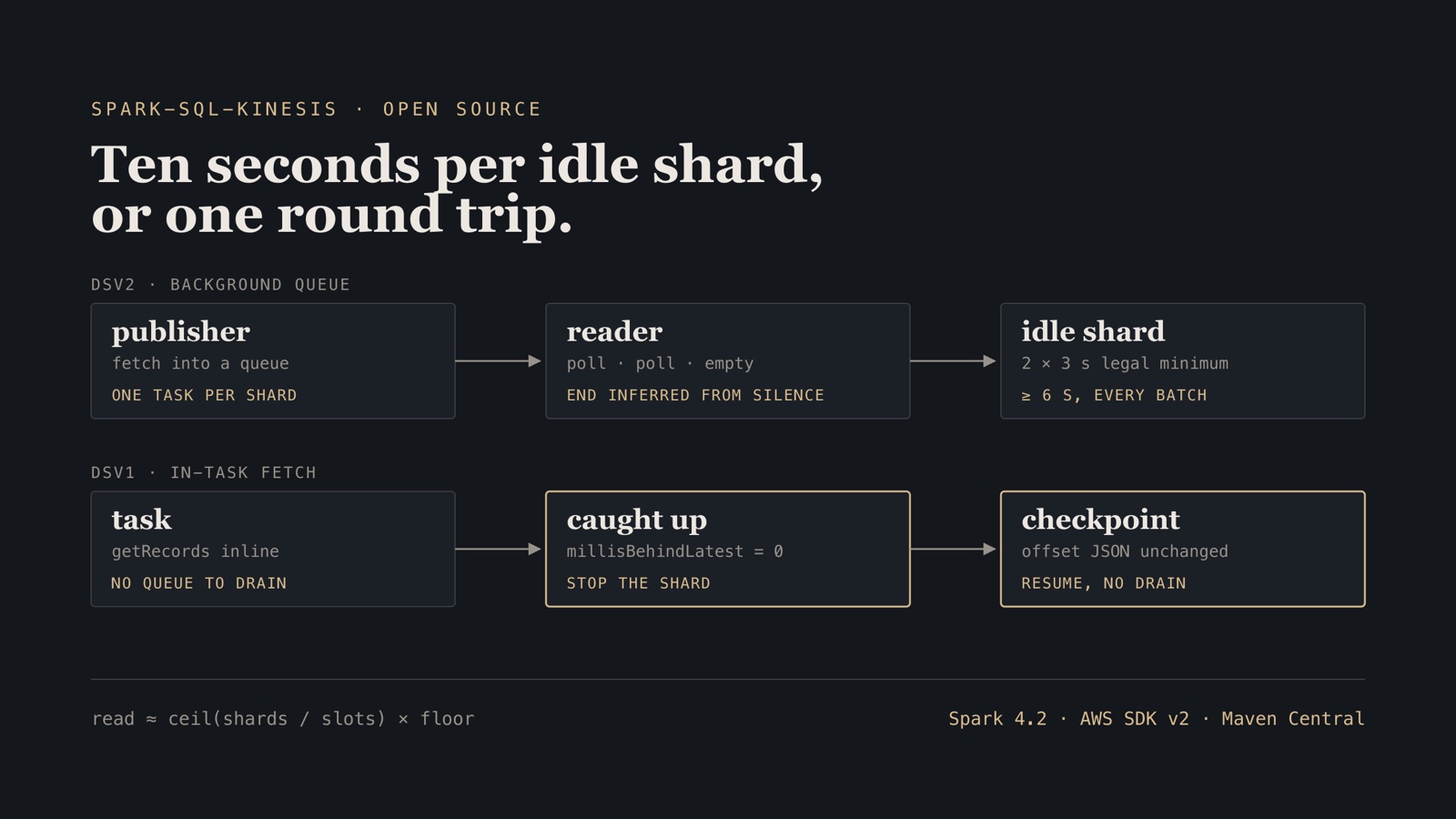
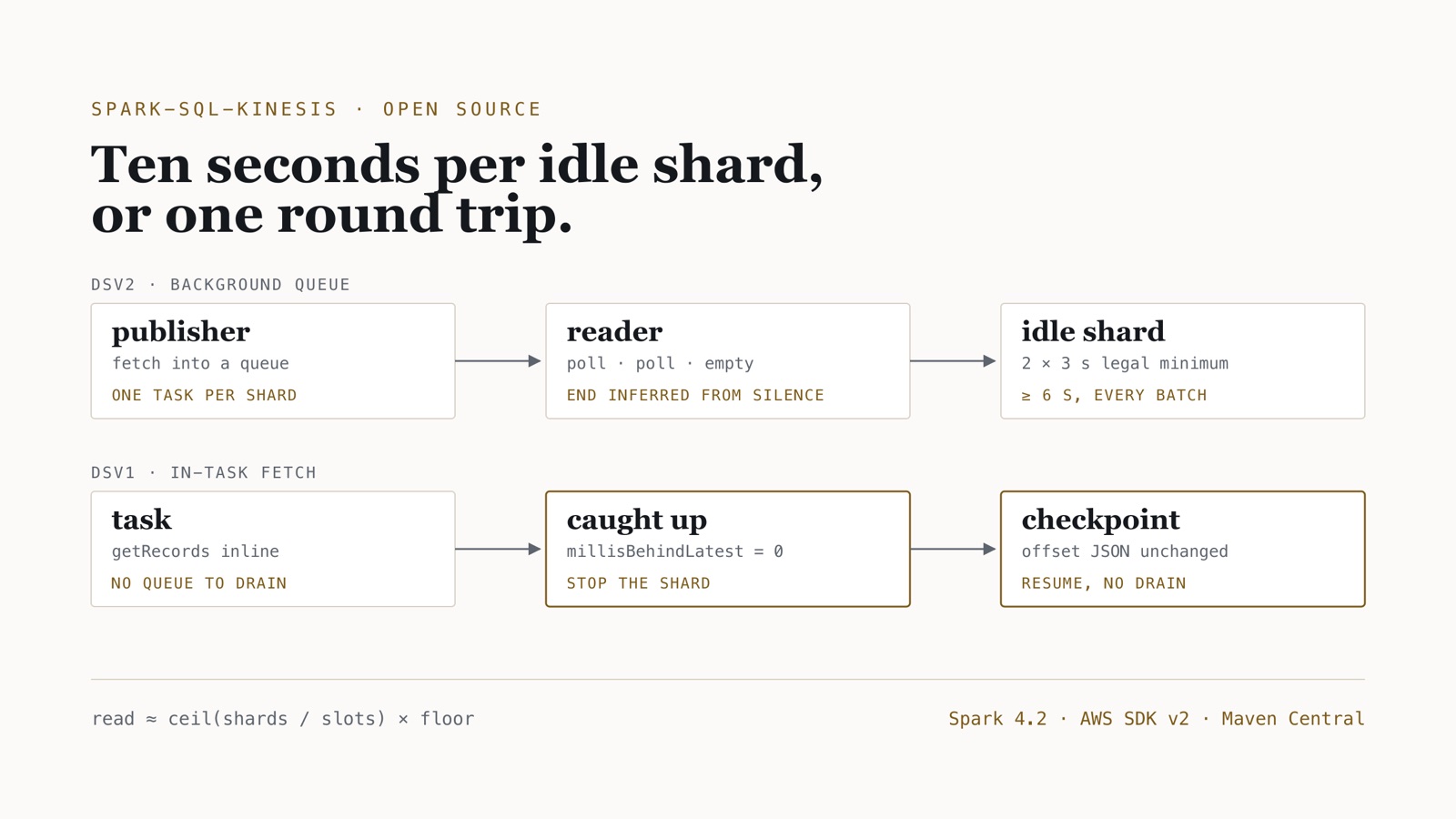
- ≥ 6 s per idle shard, every batch, on the alternative connector connector source plus staging Spark UI stage timings; floor = empty-poll count × poll timeout, and the connector requires that product to exceed 5 s, so 6 s is the lowest it accepts · Aug 2026, staging
- Resume Spark checkpoint · offset JSON Layout unchanged across versions, so a new build resumes the query's own checkpoint.
- Plan ListShards · avoidEmptyBatches No unread data on any shard means unchanged offsets and no empty micro-batch.
- Fetch GetRecords · AWS SDK v2 Stops when millisBehindLatest is 0, so an idle shard costs about one round trip.
- Decode AggregatorUtil · KPL protobuf Sub-records keep the parent's sequence number, which is what the checkpoint stores.
- Commit shard-commit · Hadoop FileContext Advances only to records emitted downstream: a replay can duplicate, never skip.
Context
The connector reads and writes Amazon Kinesis from Spark Structured Streaming. Qubole wrote it; Ron Cemer ported it to Spark 3.2; then upstream was declared unmaintained and its use “strongly discouraged”. The streaming analytics platform I work on runs on it, so since 2023 I have carried it myself — Spark 3.2, 3.3 and 3.4 builds, Scala 2.13, in a public repository.
Spark 4 turned maintenance into a decision. The connector was pinned to AWS SDK v1, end of life on 2025-12-31, and KCL 1.x, end of life on 2026-01-30. The obvious replacement, the awslabs connector, reads through a background queue and infers end-of-data from consecutive empty polls, so every shard waits out a floor in every micro-batch, even with zero records. On a stream with many shards and modest traffic, that floor dominates batch latency.
My role
I own the connector end to end: the Spark 4.2 and AWS SDK v2 port, the KCL removal, the test suites, the release pipeline to Maven Central under io.github.technobasant, and the in-place production upgrade. Before porting, I measured the awslabs connector on staging and ran a production comparison — which taught me as much about benchmark contamination as about connectors. That story is written up in Ten seconds per idle shard.
In the code
This loop is why an idle shard costs about one API round trip instead of a floor. Each Spark task calls getRecords inline and stops on something it can observe directly — millisBehindLatest of 0, a closed shard, or the one-second fetch budget — rather than inferring the end of data from empty polls.
while (fetchedRecords.length == 0 && fetchNext == true)  {
  val currentTimestamp: Long = System.currentTimeMillis
  if (canFetchMoreRecords(currentTimestamp) && getShardIterator() != null) {
    // …
    addDelayInFetchingRecords(currentTimestamp)
    val records: GetRecordsResponse = kinesisReader.getKinesisRecords(
      _shardIterator, recordPerRequest)
    // de-aggregate records
    val deaggregateRecords = kinesisReader.deaggregateRecords(records.records, null)
    fetchedRecords = deaggregateRecords.asScala.toArray
    _shardIterator = records.nextShardIterator
    // …
    if ( _shardIterator == null ) {
      hasShardClosed = true
      fetchNext = false
    }
    if ( records.millisBehindLatest.longValue() == 0 ) {
      fetchNext = false
    }
  }
  else {
    // either we cannot fetch more records or ShardIterator was null
    fetchNext = false
  }
}
The rest of the per-shard read, including the shard commit on task completion, is in src/main/scala/org/apache/spark/sql/kinesis/KinesisSourceRDD.scala.
Decisions
| Decision | Alternative | Why |
|---|---|---|
| Keep the synchronous DataSource V1 read model | Adopt the awslabs DSv2 connector and tune it | Tuning cuts the floor to a legal minimum of six seconds per shard, at the cost of a task slot and a heap-resident queue per shard. The synchronous model stops when the shard reports it is caught up: one round trip. |
| Replace KCL with a small KPL decoder | Port to KCL 2.x | KCL was only needed to decode the KPL aggregation format, and the KPL already ships those protobuf classes. Dropping it removed DynamoDB, CloudWatch and Netty transitives without reworking resharding. |
| Keep the offset JSON and shard-commit layout byte-identical | A cleaner new checkpoint format | Running queries resume their existing checkpoints across a Spark major version: no write pause, no drain, no offset migration, no data gap. |
| Put the Spark version in the artifact version | One artifact across Spark minors | The connector links against Spark streaming internals that move between minors, so a jar is only valid for the minor it was built against. Making that visible prevents a silent mismatch. |
| Shade AWS SDK v2, Netty, protobuf and HttpClient | Rely on the cluster’s classpath | hadoop-aws brings its own SDK and HTTP clients; shading means the connector cannot collide with them. Apache HttpClient is pinned rather than left to ServiceLoader ordering. |
| Publish to Maven Central via the Central Portal | Hand-built jars in each deployment | The old release path targeted Sonatype’s retired OSSRH and no longer worked. A resolved dependency replaces a binary checked into lib/. |
Results
1.3.0_spark-4.2.0 is on Maven Central for Spark 4.2, Scala 2.13 and Java 17, with no com.amazonaws artifact left in the dependency tree. Production moved to it in place against existing checkpoints. The claim that nothing was lost rests on the unchanged offset format and resumed sequence numbers, not on a separate record-level reconciliation.
The choice of read model was validated against internal production traffic; those figures stay internal. The public evidence is on staging, a sixteen-shard test stream: the awslabs connector at its defaults took 174 s per micro-batch, almost all of it the idle floor paid in serial waves, and 47 s after giving it one task slot per shard and the lowest legal floor. Its remaining cost against the synchronous model is structural, not a tuning gap.
The port also surfaced three defects that no test had reached. A credentials builder stored session credentials and never read them. Shard listing sent streamName together with nextToken, which the API rejects on paginated calls. And the first test of the new decoder showed the protobuf version was too old for the KPL’s generated code — a NoClassDefFoundError that only appears at runtime, when a record is decoded.
What I would do differently
Benchmark with one consumer from the start. My first production comparison ran beside the live job on the same stream, shared its per-shard read limits, and slowed it by roughly 70%. Every number from that run was void, and I had to retract a projection built on it.
Publish a clean before-and-after for the port itself. The case for the synchronous model rests on the mechanism, staging measurements and internal production data. A public, single-consumer comparison on a reproducible stream would let anyone check it.
Close the resharding gaps. New and child shards created mid-query start from the configured position rather than the parent’s committed one, and with failondataloss=false a deleted shard is dropped with a warning. Both are documented and safe in steady state, and both are the next things worth fixing. A DataSource V2 rewrite stays on the roadmap only if it keeps the synchronous fetch.
Connected systems
All case studiesstreaming-platform: exactly-once clickstream, counted at every layer
Author
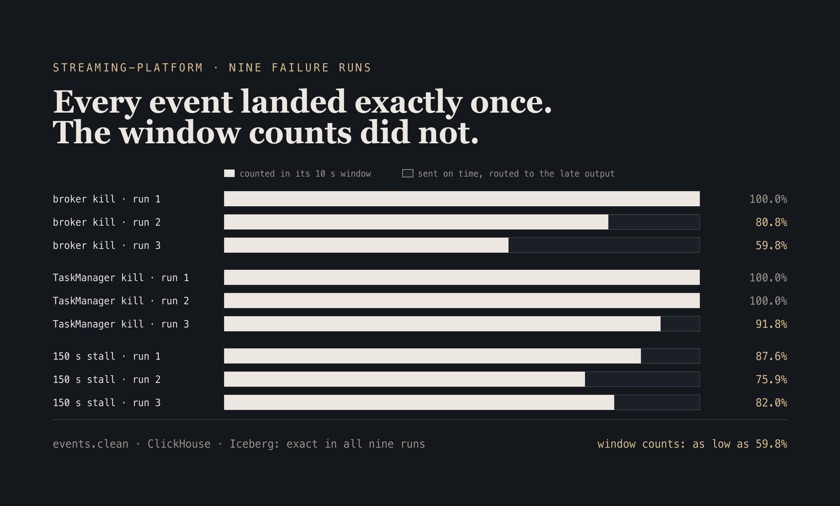
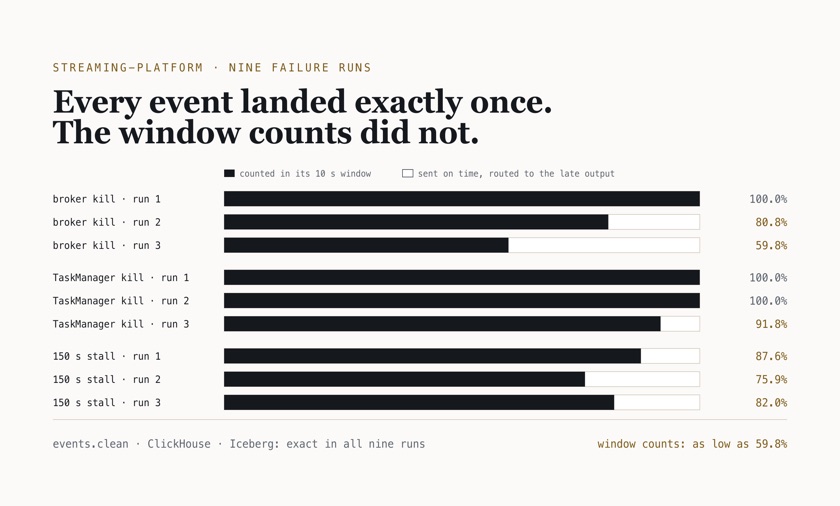
Exactly-once is a claim about counts, so every layer was counted against a ledger, through broker kills, TaskManager kills and stalls
9 of 9 failure runs with every event layer exactthree controller-broker kills, three TaskManager kills and three 150 s stalls under load; Kafka, ClickHouse, Iceberg and the dead-letter topic reconciled against the generator's ledger by sequence number · Oct 2026
59.8% of on-time events left in the window counts after one broker kill118,229 of 197,749 on-time events counted in their 10 s windows in the worst of three broker-kill runs; the rest went to the late side output because catch-up reordered partitions past the 5 s watermark bound · Oct 2026
Apache Kafka 4.3 · Apache Flink 1.20 · ClickHouse · Apache Iceberg · Schema Registry · Avro · Prometheus
Rebuilding a production data platform for scale and recovery
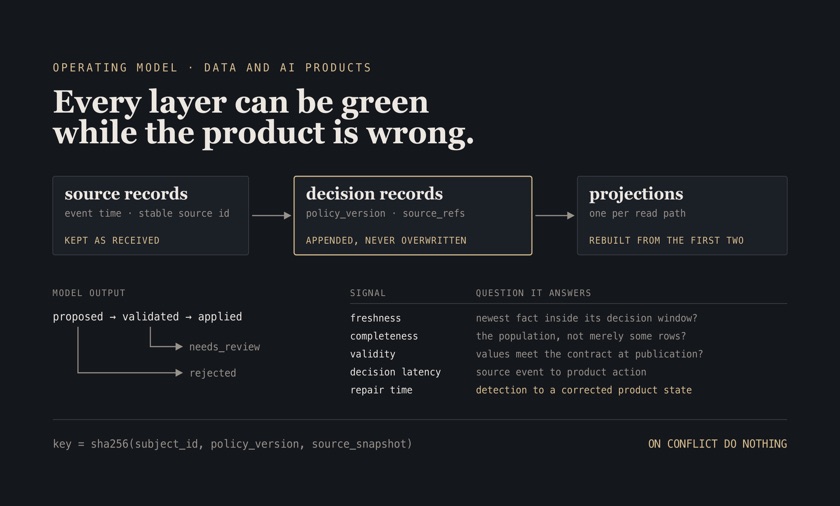
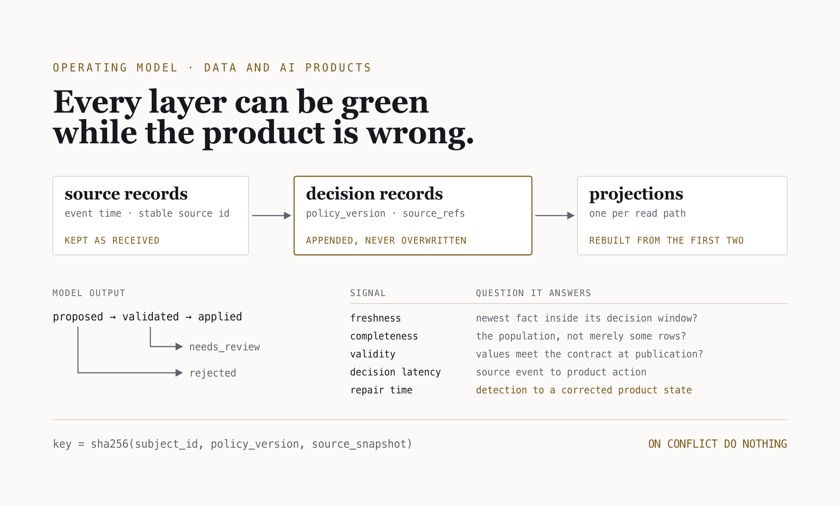
Data Engineer → Senior Data Engineer
A six-year platform story: faster processing, lower cost, safer change, and recovery designed before the incident.
50% faster core processingrole-level before/after wall-clock on the rebuilt Spark/Airflow path — not a lab sample · Data Engineer role, 2020–2024
40% lower infrastructure costrole-level before/after infrastructure run-rate on the Kubernetes migration — not a lab sample · Data Engineer role, 2020–2024
Python · SQL · Apache Spark · Apache Kafka · Apache Airflow · dbt
A lakehouse, and the RAG pipeline that runs on it
Personal lab
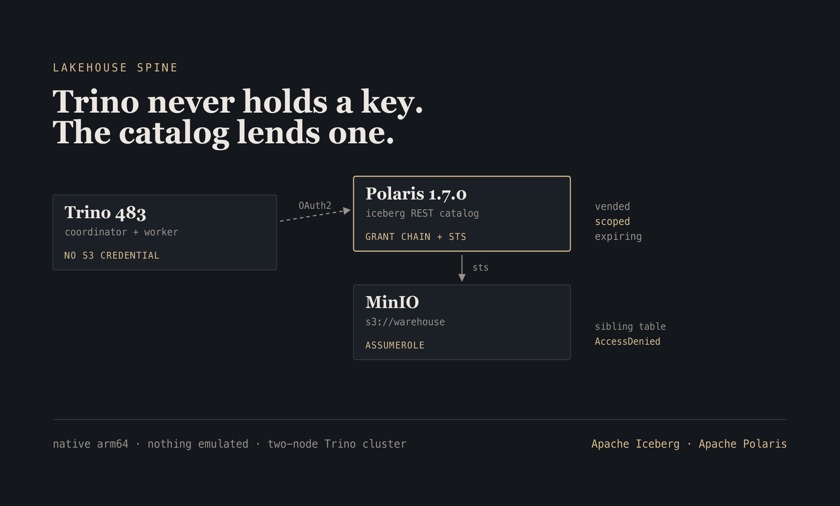
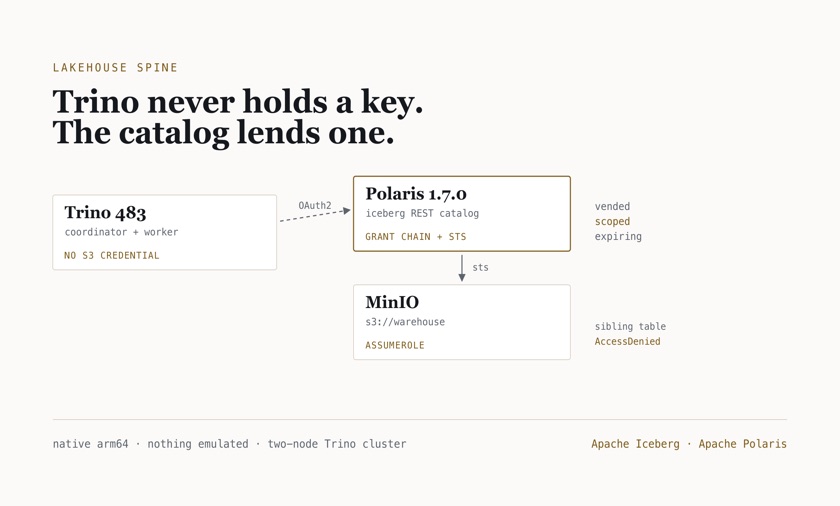
The two halves of the thesis as one system: Trino and Iceberg underneath, retrieval and answers on top, both measured
88 ms one-month predicate over 1.5M Iceberg rowsmedian of 7 server-side runs from system.runtime.queries, after 2 warm-ups, on a month-partitioned Iceberg table · measured 2026 · 2024 stack rebuilt
909,968 rows recovered by snapshot rollbackan over-broad DELETE (a WHERE reaching years further back than intended), then ALTER TABLE EXECUTE rollback_to_snapshot, counted against the pre-incident total · measured 2026 · 2024 stack rebuilt
Trino · Apache Iceberg · Apache Polaris · StarRocks · Apache Spark · Delta Lake
Continue the conversation
See the full career record, or get in touch about a senior data, platform, or AI engineering role.