Problem and decision
ProblemProcessing and serving had to scale without making schema change, replay, cost, or on-call work progressively less safe.
DecisionRebuild the core processing path, move orchestration onto Kubernetes, and make contracts, ownership, and replay part of the platform interface.
Scope
- Team
- Global team, working US and EU hours
- Scale
- Production mobile-analytics workloads across ingestion, processing, storage, and analytical serving
Outcomes
- 50% faster core processing role-level before/after wall-clock on the rebuilt Spark/Airflow path — not a lab sample · Data Engineer role, 2020–2024
- 40% lower infrastructure cost role-level before/after infrastructure run-rate on the Kubernetes migration — not a lab sample · Data Engineer role, 2020–2024
- 99.9% platform uptime sustained service availability on platform serving endpoints, rolling window · 2020–2026 platform ownership
- 50% lower p95 query latency role-level before/after p95 latency on the analytical serving path — not a lab sample · Data Engineer role, 2020–2024
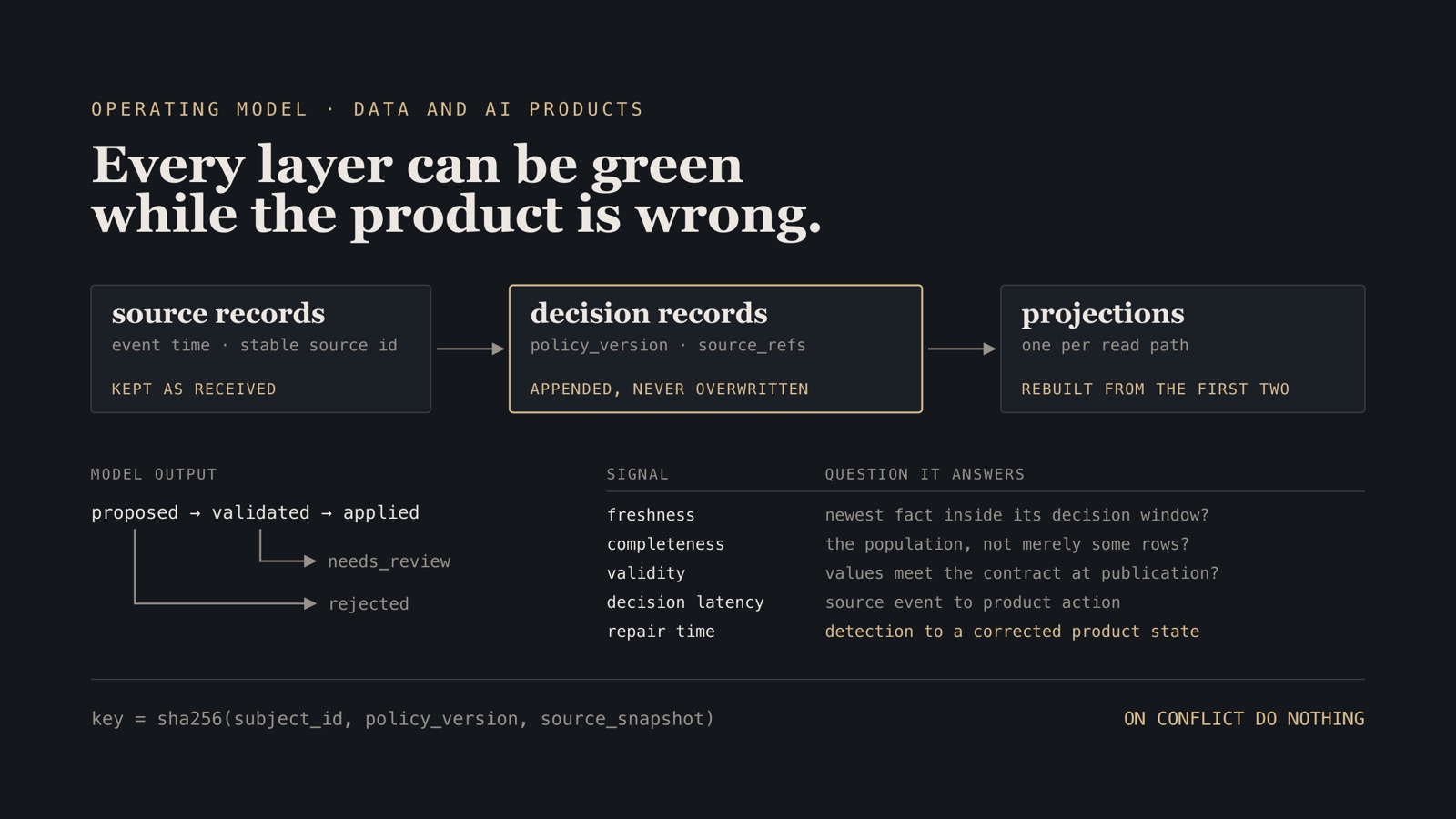

- Sources mobile SDK · service events · CDC Schema owned upstream, so ingestion cannot assume it is stable.
- Ingest Kafka · Airflow Buffered, so a slow downstream is backpressure rather than data loss.
- Process Spark · PySpark · dbt Idempotent by partition — a replay overwrites rather than appends.
- Store Iceberg · S3 Snapshots make a bad load reversible without restoring a backup.
- Serve Trino · ClickHouse Read paths modelled separately from write paths, on purpose.
Context
The platform sits downstream of producers it cannot control. Payloads drift, old clients keep sending, late data arrives after a partition looks complete, and a successful job can still publish an empty or misleading dataset. At this scale, the technical problem is not merely moving bytes. It is keeping every boundary understandable while volume, schemas, consumers, and cost all change.
My role
I grew from pipeline delivery into end-to-end system ownership: processing, orchestration, storage layout, the databases underneath serving, observability, recovery, and the design reviews connecting them. I led the core ETL rebuild and Kubernetes migration, set reliability and governance expectations, and mentored engineers so the operating model did not depend on one person.
Constraints
- Uncontrolled producers. The platform must accept old and new payload shapes without silently changing meaning.
- Correct and on time. Fresh wrong data and correct late data are both product failures.
- Replay under pressure. Backfills and late arrivals must be routine paths, not bespoke incident work.
- Cost follows data design. Partitioning, compaction, and retention decisions move the bill before instance tuning does.
- A small team owns a broad surface. Every added engine creates another upgrade, backup, and on-call obligation.
Architecture and operating model
The path is intentionally legible: ingest events, validate and govern them at a clear storage boundary, serve models designed around real read paths, and preserve a recovery route that can replay without duplicating state.
The processing layer moved to Spark/PySpark with Airflow orchestration. Lakehouse tables used explicit partition and schema-evolution rules instead of letting each job invent them. Kubernetes provided a common scheduling and scaling boundary. PostgreSQL, Trino, ClickHouse, Citus, and TimescaleDB were operated as part of the same system: query shape, data layout, replication, and recovery—not infrastructure knobs treated in isolation.
Reliability was defined at the dataset boundary. The meaningful signal is event time to queryable, measured per dataset with a named owner—not whether a DAG turned green.
Decisions and rejected alternatives
| Decision | Alternative rejected | Why | Cost accepted |
|---|---|---|---|
| Validate at the governed write boundary | Scatter checks through every job | One enforceable contract and one place to quarantine failures | Quarantine queues require ownership |
| Make loads idempotent with explicit watermarks | Treat replay as an incident procedure | Backfills converge on the same state | More write amplification and stricter keys |
| Evolve schemas additively with dated deprecation | Coordinate breaking renames | Consumers can migrate without a synchronized release | Temporary duplicate fields |
| Design tables around read paths | Scale infrastructure first | Layout removes more work than larger clusters hide | More up-front modeling |
| Standardize scheduling on Kubernetes | Keep workload-specific deployment paths | One capacity and operating model across the platform | Migration and platform learning cost |
Outcomes
- Core processing for 5 TB+ per day became 50% faster.
- The Kubernetes migration and capacity work reduced infrastructure cost by 40% while sustaining 99.9% uptime.
- Serving-path redesign reduced p95 latency by 50% across 100M+ analytical queries per day.
- Ownership, contracts, freshness objectives, and runbooks made failures attributable and recovery transferable rather than dependent on memory.
Recovery model
Replay is a first-class interface: stable keys, explicit watermarks, partitions that can be replaced without touching neighbours, and a record of rejected input with the reason attached. Runbooks state the decision points and validation queries, not only commands. A person returning months later should be able to tell what is safe to rerun and what result proves recovery.
Reflection
I would instrument consumers earlier. I have often known a dataset’s freshness better than whether anyone still depended on it. Consumer evidence makes retention and deprecation decisions much easier.
I would also write the runbook before the first incident and remove tools sooner. Every engine is a permanent operational obligation. Some of the strongest architecture decisions are deletions.
The multi-engine failover lab is where I keep testing the recovery half of this practice on hardware I control.
Related work
All case studiesspark-sql-kinesis: a Kinesis source for Spark 4 without the idle-shard floor
Maintainer
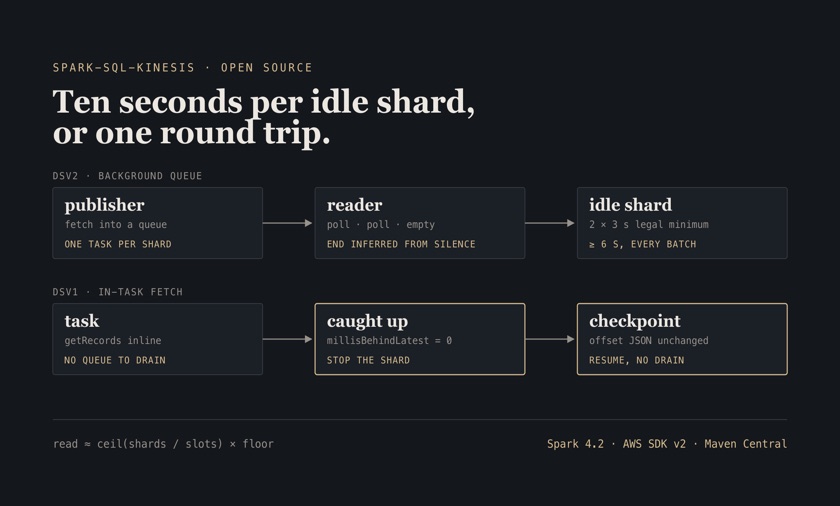
Spark 4 dropped the AWS SDK the streaming connector depended on, and the maintained alternative paid seconds on every idle shard
≥ 6 s per idle shard, every batch, on the alternative connectorconnector source plus staging Spark UI stage timings; floor = empty-poll count × poll timeout, and the connector requires that product to exceed 5 s, so 6 s is the lowest it accepts · Aug 2026, staging
Scala · Apache Spark 4.2 · AWS SDK v2 · Amazon Kinesis · Kinesis Producer Library · Protobuf
streaming-platform: exactly-once clickstream, counted at every layer
Author
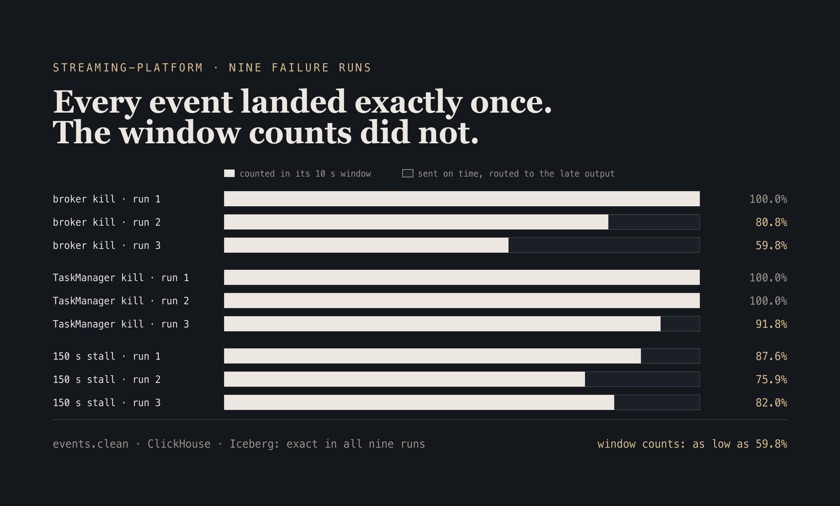
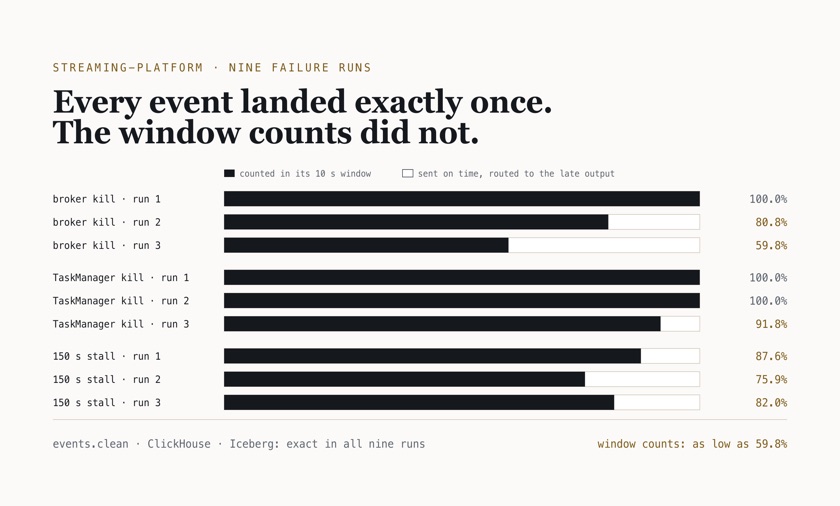
Exactly-once is a claim about counts, so every layer was counted against a ledger, through broker kills, TaskManager kills and stalls
9 of 9 failure runs with every event layer exactthree controller-broker kills, three TaskManager kills and three 150 s stalls under load; Kafka, ClickHouse, Iceberg and the dead-letter topic reconciled against the generator's ledger by sequence number · Oct 2026
59.8% of on-time events left in the window counts after one broker kill118,229 of 197,749 on-time events counted in their 10 s windows in the worst of three broker-kill runs; the rest went to the late side output because catch-up reordered partitions past the 5 s watermark bound · Oct 2026
Apache Kafka 4.3 · Apache Flink 1.20 · ClickHouse · Apache Iceberg · Schema Registry · Avro · Prometheus
A lakehouse, and the RAG pipeline that runs on it
Personal lab
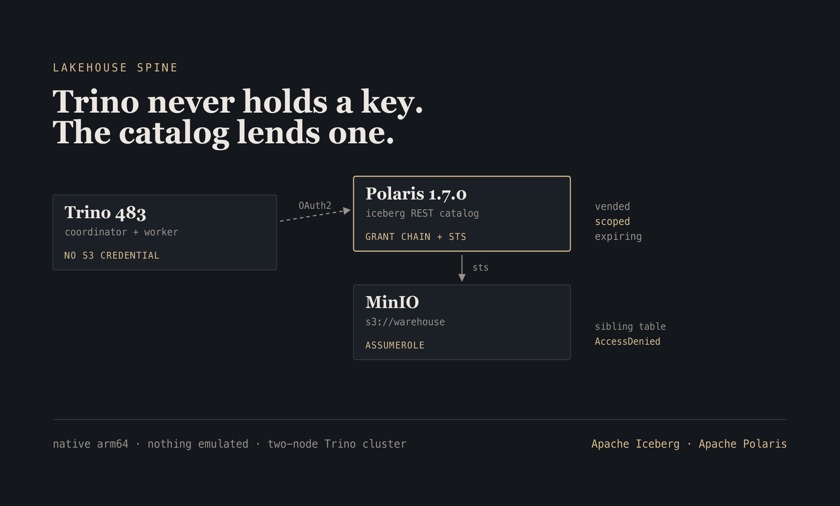
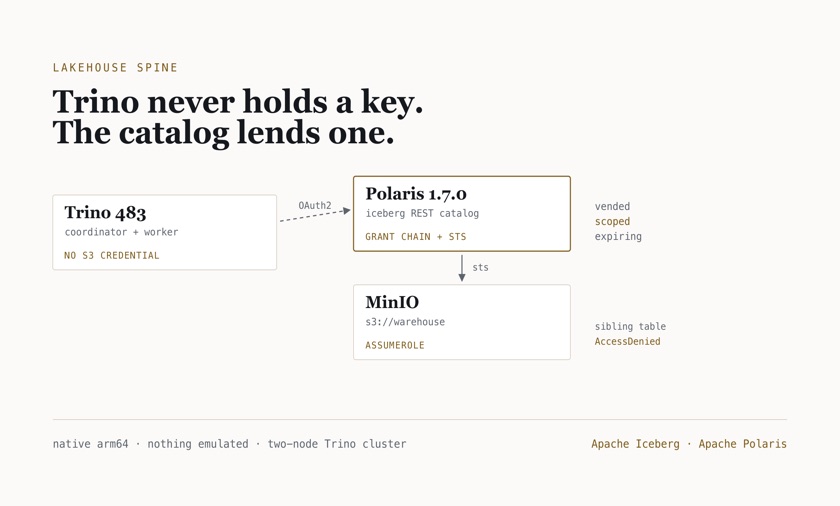
The two halves of the thesis as one system: Trino and Iceberg underneath, retrieval and answers on top, both measured
88 ms one-month predicate over 1.5M Iceberg rowsmedian of 7 server-side runs from system.runtime.queries, after 2 warm-ups, on a month-partitioned Iceberg table · measured 2026 · 2024 stack rebuilt
909,968 rows recovered by snapshot rollbackan over-broad DELETE (a WHERE reaching years further back than intended), then ALTER TABLE EXECUTE rollback_to_snapshot, counted against the pre-incident total · measured 2026 · 2024 stack rebuilt
Trino · Apache Iceberg · Apache Polaris · StarRocks · Apache Spark · Delta Lake
Continue the conversation
See the full career record, or get in touch about a senior data, platform, or AI engineering role.