
On this page
I used to draw data platforms underneath the product: neat boxes for ingestion, storage, transformation, and serving, with the “real” application sitting safely above them. The diagram was tidy and the boundary was wrong.
A user does not experience those boxes. They experience one answer. If a source arrives late, a transformation accepts an impossible value, a cache serves an old projection, and an AI workflow confidently acts on it, every individual service can be green while the product is wrong.
That changed the question I ask in design reviews. I no longer begin with, “What should process this data?” I begin with, “What promise is the product making, and how will we repair that promise when one layer lies?”
This is the operating model I now use. It is intentionally independent of any employer architecture or vendor stack.
Start with the decision window, not the job
“The pipeline runs every hour” is a schedule, not a reliability promise. The consumer cares whether the expected fact is queryable before a decision becomes stale.
For each product-facing dataset or endpoint, I write down five things:
- The fact: the smallest record the consumer actually needs.
- The clock: event time, processing time, or the time a decision must be made.
- The tolerance: how late, incomplete, or approximate the fact may be.
- The failure state: what the product shows when the promise cannot be met.
- The repair owner: who can replay, correct, or suppress the result safely.
That short contract changes the implementation. Freshness becomes a property of a published fact rather than a scheduler. Quarantine becomes a visible state instead of a forgotten dead-letter queue. A backfill becomes part of the interface, because a correction that never reaches the product is not a correction.
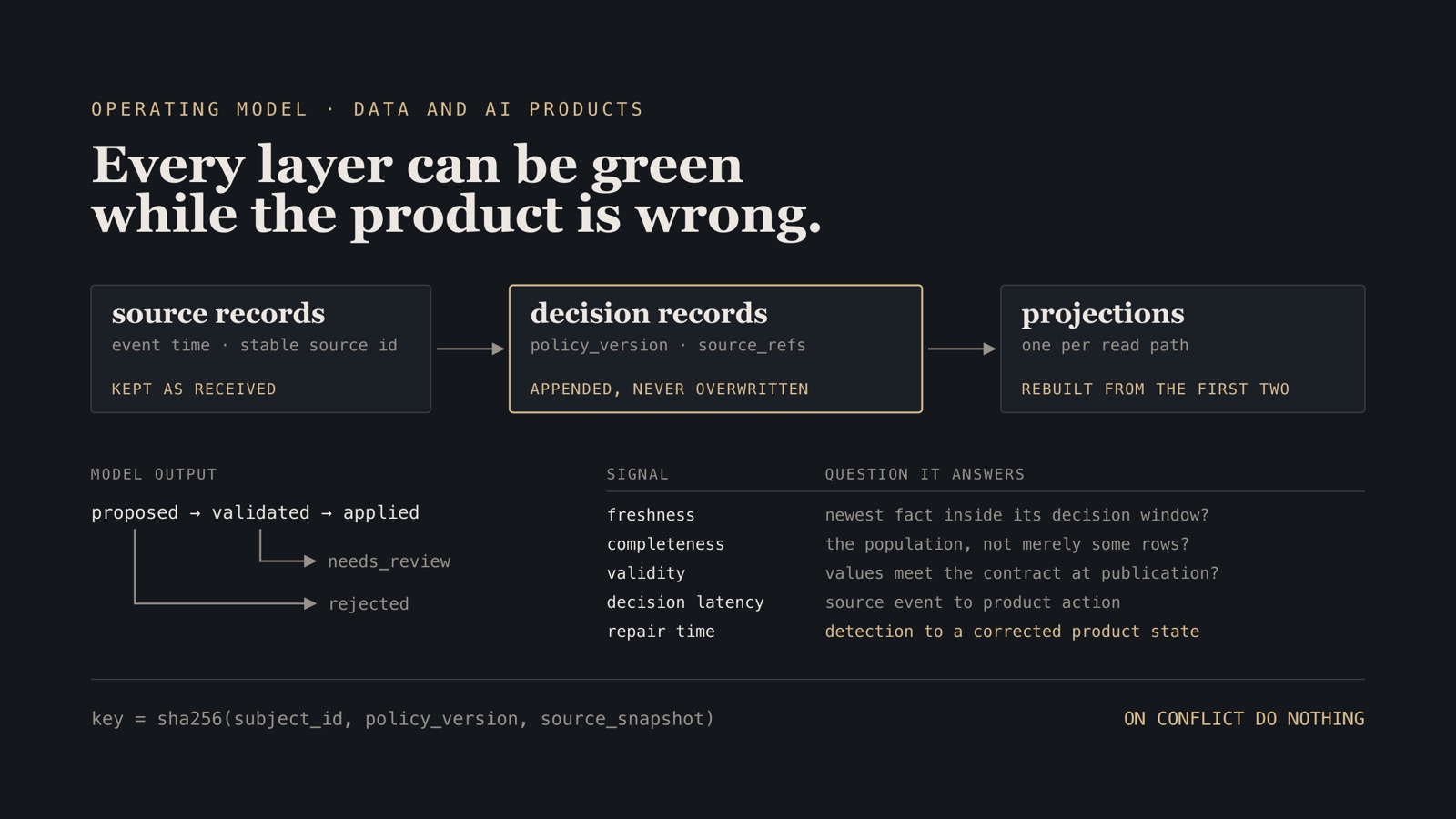
I also separate availability from fitness. A service can answer every request and still serve a stale or semantically invalid record. For data products, I want at least these signals beside ordinary uptime:
| Signal | Question it answers |
|---|---|
| Freshness | Is the newest expected fact available inside its decision window? |
| Completeness | Did the expected population arrive, not merely some records? |
| Validity | Do values satisfy the contract at the publication boundary? |
| Decision latency | How long from source event to a product action? |
| Repair time | How long from detection to a corrected product state? |
Make the boundary a record, not a feeling
Whenever automated output can change another workflow, I persist a decision record before I persist the effect. The record needs enough information to explain what happened without reconstructing it from logs scattered across services.
This small standard-library example is deliberately runnable. It validates confidence, requires source references, fixes the set of allowed outcomes, and emits a JSON-ready record. The type hints help the editor; the runtime checks protect the boundary.
from __future__ import annotations

from dataclasses import asdict, dataclass
from datetime import UTC, datetime
from typing import Literal

Outcome = Literal["approve", "reject", "needs_review"]
ALLOWED_OUTCOMES = {"approve", "reject", "needs_review"}


@dataclass(frozen=True, slots=True)
class DecisionRecord:
    subject_id: str
    outcome: Outcome
    confidence: float
    policy_version: str
    source_refs: tuple[str, ...]
    created_at: datetime

    def __post_init__(self) -> None:
        if not self.subject_id.strip():
            raise ValueError("subject_id must not be blank")
        if self.outcome not in ALLOWED_OUTCOMES:
            raise ValueError(f"unsupported outcome: {self.outcome}")
        if not 0.0 <= self.confidence <= 1.0:
            raise ValueError("confidence must be between 0 and 1")
        if not self.policy_version.strip():
            raise ValueError("policy_version must not be blank")
        if not self.source_refs or any(not ref.strip() for ref in self.source_refs):
            raise ValueError("at least one non-blank source reference is required")
        if self.created_at.tzinfo is None:
            raise ValueError("created_at must include a timezone")

    def to_dict(self) -> dict[str, object]:
        payload = asdict(self)
        payload["source_refs"] = list(self.source_refs)
        payload["created_at"] = self.created_at.isoformat()
        return payload


record = DecisionRecord(
    subject_id="case-1042",
    outcome="needs_review",
    confidence=0.71,
    policy_version="risk-policy-2026-08",
    source_refs=("snapshot:6b8f", "rule:missing-history"),
    created_at=datetime.now(UTC),
)

print(record.outcome)
print(record.to_dict()["policy_version"])
Running the file should produce the outcome and policy version:
$ python3 contracts/decision_record.py
needs_review
risk-policy-2026-08
The database should defend the same boundary. Application validation gives a useful error close to the producer; database constraints protect every write path, including scripts and future services.
CREATE TABLE decision_records (
    decision_id      bigint GENERATED ALWAYS AS IDENTITY PRIMARY KEY,
    idempotency_key  text        NOT NULL UNIQUE,
    subject_id       text        NOT NULL CHECK (btrim(subject_id) <> ''),
    outcome          text        NOT NULL
                     CHECK (outcome IN ('approve', 'reject', 'needs_review')),
    confidence       numeric(5,4) NOT NULL
                     CHECK (confidence BETWEEN 0 AND 1),
    policy_version   text        NOT NULL CHECK (btrim(policy_version) <> ''),
    source_refs      jsonb       NOT NULL
                     CHECK (jsonb_typeof(source_refs) = 'array'
                            AND jsonb_array_length(source_refs) > 0),
    created_at       timestamptz NOT NULL,
    recorded_at      timestamptz NOT NULL DEFAULT now()
);

CREATE INDEX decision_records_subject_time_idx
    ON decision_records (subject_id, created_at DESC);
Notice what is absent: a raw prompt as the only evidence, a free-form verdict, and an overwritten “current answer.” Those make a demo easy and a correction almost impossible.
Keep truth separate from projections
Product reads often need a shape that the source of truth should not have. A low-latency endpoint may want one precomputed row per subject; an audit may need the full history; an analyst may need a columnar projection. Those are different read paths, not competing definitions of truth.
I use three layers of responsibility:
- Source records preserve the facts received from producers, including event time and a stable source identifier.
- Decision records preserve what a policy or model concluded, the version that concluded it, and the evidence it used.
- Projections arrange those facts for a particular read path and may be rebuilt.
The third layer is disposable by design. If a projection is corrupted or its model changes, I should be able to rebuild it from the first two layers without inventing history. That repair path is more valuable than choosing a fashionable serving engine.
This distinction also makes corrections honest. A new policy should append a new decision; it should not mutate the old one until the audit trail agrees with the present. The product can point to the active decision while the history explains how it got there.
Treat AI as an unreliable producer
AI does not need a separate philosophy of reliability. It needs the same producer boundary as any source we do not fully control, with stricter attention to provenance and evaluation.
I model the workflow as explicit states:
proposed -> validated -> applied
    |           |
    |           +-> needs_review
    +--------------> rejected
“Proposed” is important. Model output has not become a product fact merely because inference returned successfully. It still has to pass structural validation, policy checks, evidence requirements, and—where the consequence justifies it—human review.
Confidence is not a universal truth meter either. A threshold only has meaning against an evaluated task, versioned data, and a defined cost for false approval versus false rejection. If those are missing, 0.93 is decoration.
For every automated decision, I want to answer:
- Which model, policy, and tool versions ran?
- Which source records were visible?
- Which checks passed, failed, or were skipped?
- Was a human review required, and who completed it?
- Can the effect be reversed without deleting the original record?
If the system cannot answer those questions, it is not ready to make a consequential change unattended.
Design replay and idempotency before launch
Retries happen everywhere: queues redeliver, clients time out after a successful write, operators replay a date range, and backfills overlap live traffic. “Exactly once” is often a property claimed by one component while the business effect crosses several.
I prefer an idempotency key derived from the stable inputs to the decision, such as:
from hashlib import sha256


def decision_key(
    subject_id: str,
    policy_version: str,
    source_snapshot: str,
) -> str:
    canonical = "\x1f".join((subject_id, policy_version, source_snapshot))
    return sha256(canonical.encode("utf-8")).hexdigest()
The write path then treats a duplicate as a known result, not a second decision:
INSERT INTO decision_records (
    idempotency_key,
    subject_id,
    outcome,
    confidence,
    policy_version,
    source_refs,
    created_at
)
VALUES (
    :idempotency_key,
    :subject_id,
    :outcome,
    :confidence,
    :policy_version,
    CAST(:source_refs AS jsonb),
    :created_at
)
ON CONFLICT (idempotency_key) DO NOTHING
RETURNING decision_id;
On a duplicate, RETURNING yields no row: the key already exists, so the caller reads the stored decision by idempotency_key and returns that.
There is a trade-off: the key encodes what I consider the identity of a decision. Changing that definition is a contract change. I document it and version the policy rather than hiding it in a helper function.
Replay needs a product rule too. When a corrected source record produces a different outcome, does the system apply it automatically, open a review, or leave the prior effect in place? That answer depends on consequence, not throughput. The platform can provide the mechanism; the product must own the policy.
Review the seams as one operating model
End-to-end ownership does not mean one person builds every service. It means the seams share one definition of correctness and one repair story.
This is the checklist I use before a data-backed or AI-assisted workflow ships:
- The consumer-facing fact and decision window are written down.
- Missing, late, duplicate, malformed, and contradictory inputs have named states.
- Automated output crosses typed validation before it can create an effect.
- The decision record includes policy version, evidence references, and time.
- The write path is idempotent under retry and replay.
- Projections can be rebuilt without rewriting source or decision history.
- Alerts point to a safe action, not merely a dashboard.
- A corrected decision can reach the product without erasing the old one.
- A human can stop or review the workflow when the consequence demands it.
The principle underneath all of this is modest: the platform is part of the product because it decides which facts the product may trust. Once that is explicit, architecture discussions get less theatrical. The useful questions become concrete: What is the promise? Where is it recorded? How does it fail? Who can repair it? And can they do so while the rest of the system keeps moving?