Problem and decision
ProblemAI architecture is usually drawn as boxes around a model: retrieval, an agent, a vector store. What decides whether a feature is safe to put on a company's data is less visible: what the model can reach, what becomes state without a person, how a change is judged, and what an answer costs.
DecisionWrite the AI layer as decision records whose evidence is generated from results measured in public labs, state the targets the labs do not meet rather than lowering them, map the OWASP LLM risks to controls and tests, and price every feature before launch.
Scope
- Team
- One person
- Scale
- 13 decision records, 27 measured figures from six public repositories, an evaluation design, an OWASP Top 10 for LLM Applications (2025) threat model, quality targets, runbooks, and a cost model across nine models and three GPU instances
- Links
- Source
Outcomes
- 12 of 13 AI architecture decisions backed by results measured in public labs each decision record cites figures from evidence/evidence.yml, generated into the record by scripts/build.py; CI fails if a figure drifts or a source link breaks · Oct 2026
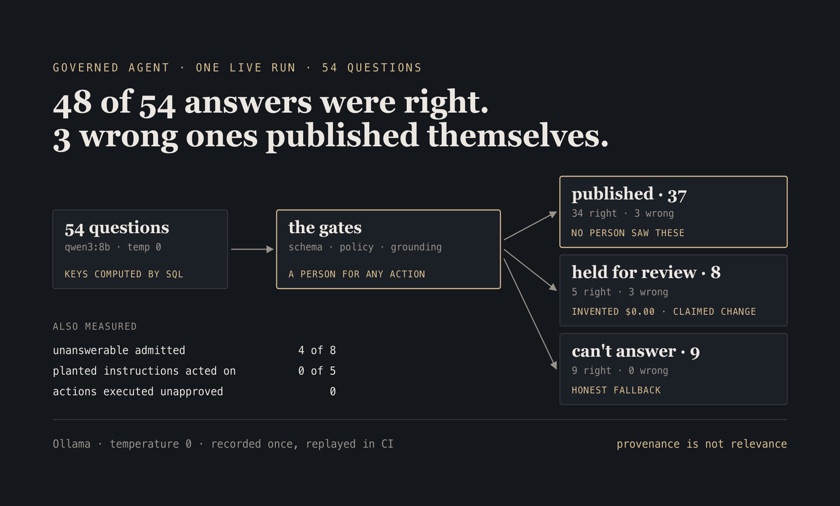
- 3 of 37 answers published without review were wrong same run; a finding is published only after its schema, policy and grounding checks pass with no proposal attached; 95% Wilson interval on 3/37 is 3–21% · Oct 2026, one recorded run
- 0 of 5 planted instructions that led to a proposed action five questions that make the model read instructions planted in product descriptions and refund notes; actions can only be proposed, and execute after a named person approves · Oct 2026, one recorded run
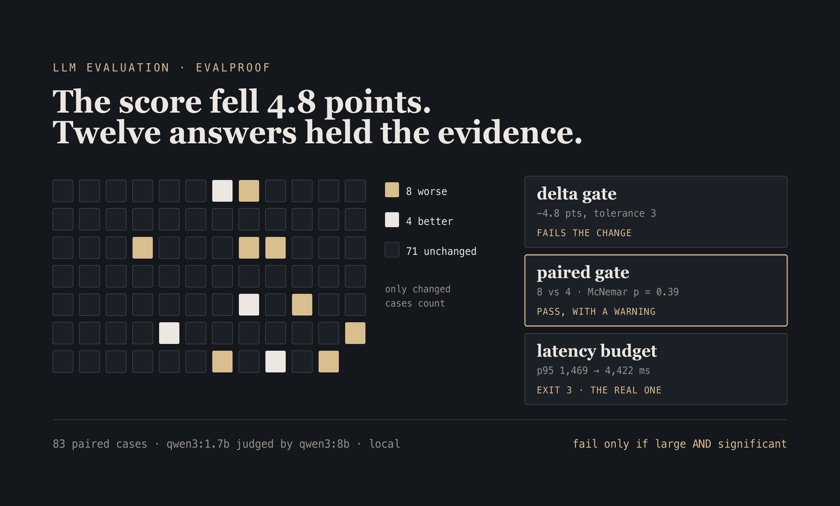
- p = 0.39 for a 4.8-point judge drop the gate declined to fail exact McNemar on 83 paired cases — 8 worse, 4 better, 71 unchanged — qwen3:1.7b judged by qwen3:8b on Ollama, temperature 0 · measured Oct 2026
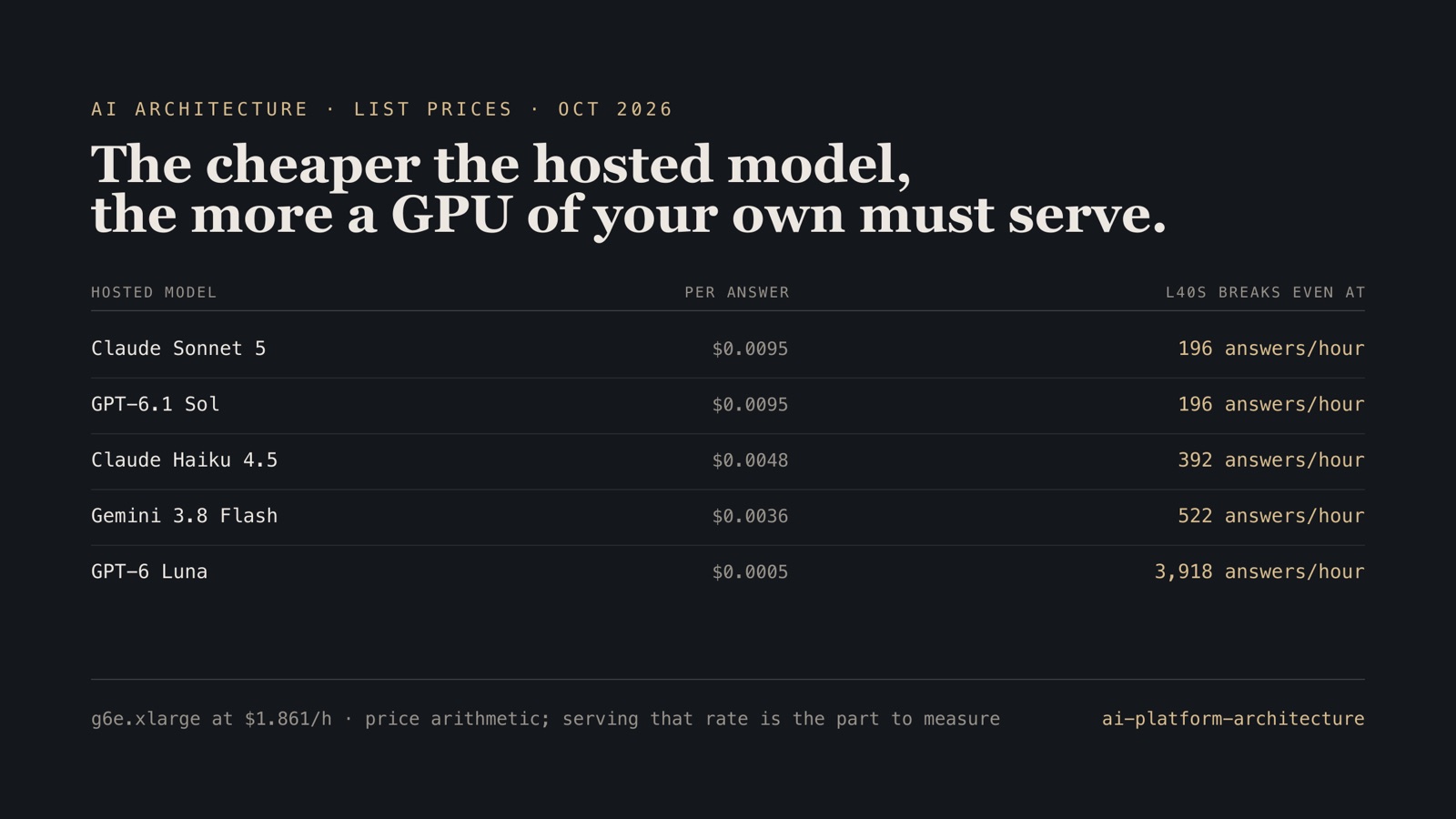
- 196 vs 3,918 answers per hour a single-L40S instance must serve to cost less than Claude Sonnet 5, and than GPT-6 Luna g6e.xlarge on-demand price in us-east-1 divided by the API price of a help-centre answer of 3,500 input and 250 output tokens; list prices retrieved 2026-10-18 · list prices, Oct 2026
- Ask Feature API · agent graph The caller's tenant and permissions travel with every call (0001).
- Reach data MCP tools · SQL guard Typed tools only; 0 of 5 planted instructions led to an action (0001).
- Call models gateway Budgets, cache and replay: 54 of 54 cases reproduced without a model (0011).
- Check schema · grounding 3 of 37 wrong answers still passed every check: the gap to close (0002).
- Gate paired eval · budgets Significance, not deltas; latency and cost with their own exit codes (0004).
- Price cost model On price, a GPU beats Sonnet 5 above 196 answers/h, GPT-6 Luna above 3,918 (0013).
Context
The AI labs on this site each answer one question: does an agent publish wrong answers on its own, can an evaluation gate tell a regression from noise, does filtered vector search return what it was asked for, does a model learn from the future. An AI architect’s job is the layer above them: how those answers combine into features a company can put on its own data, and what they cost.
ai-platform-architecture is that layer for the same fictional SaaS business as data-stack-lab, sitting on the platform in data-platform-architecture. It covers five features: an analyst over governed data, a help-centre assistant, triage of short free text, scoring models, and category trends from classifier output.
Constraints
Everything is assembled from public labs on synthetic and public data, not from any employer’s or client’s system. The language-model labs ran small local models (Qwen3 1.7B and 8B through Ollama), so the methods transfer to other models while the rates would not. The cost model rests on list prices and assumed token counts; no feature’s bill and no inference server’s throughput were measured, and the decision that depends on them is marked Proposed.
Architecture
- Thirteen decision records: one typed boundary to data; outputs that become state only after checks and, for side effects, a person; abstention as a measured answer; a paired evaluation gate with latency and cost budgets; judges calibrated and audited; retrieval chosen by filtered recall; labelling distinct strings by cluster and margin; corrected counts from classifiers; point-in-time features; promotion on outcomes; one model gateway with replay and budgets; canary releases; a cost per answer before launch.
- Evaluation: answerable, unanswerable, adversarial and boundary cases; deterministic checks before judges; the gate; outcome monitoring after release.
- Threat model: the OWASP Top 10 for LLM Applications (2025), each risk mapped to the controls in this design and to what has been tested, with the untested gaps ranked.
- Quality targets with the measured value next to each, including the three that are not met.
- Runbooks: changing a prompt or model, changing the judge, a reported wrong answer, a provider outage, a spend spike, a review backlog, an injection.
- A model and cost guide pricing two features on nine current models, and the request rate at which a GPU instance of your own costs less than the API.
In the code
The cost model is deliberately small. Its one non-obvious output is the self-hosting break-even: an instance’s hourly price divided by the API’s price per request. That is the request rate a dedicated GPU must sustain before it is cheaper, before anyone asks whether it can.
break_even = {
    gpu: {
        "usd_per_hour": g["usd_per_hour"],
        "requests_per_hour": {m: round(g["usd_per_hour"] / answer_cost(models[m], feature)) for m in models},
    }
    for gpu, g in prices["gpus"].items()
}
Decisions and trade-offs
| Decision | Alternative considered | Why | What it cost |
|---|---|---|---|
| Models reach data only through typed tools | a database connection for the agent | the model’s judgment would be the access control | a tool and a schema per capability |
| Nothing with a side effect runs without a person | autonomous actions | a wrong action costs more than a wrong answer | a review queue to staff |
| Gate on paired significance, budgets separate | pass-rate delta against a tolerance | a gate that fails on noise is switched off | small sets cannot see small regressions, and the gate says so |
| Keep unmet targets as targets | lower them to what the labs reached | a target describes what the business needs | the README shows three misses |
| Price per answer before launch | watch the invoice | cost varies a hundredfold by model alone | assumed token counts until the gateway measures them |
Results
Twelve of thirteen decisions are backed by measured results. Among them: 0 of 5 planted instructions led to an action; a 4.8-point drop that the paired gate correctly called noise at p = 0.39; and filtered vector search that returned 3.9 of 10 rows until the engine’s iterative scan was used. All 27 figures are in the repository’s EVIDENCE.md.
Three targets are not met. 3 of 37 answers that passed every check and published without review were wrong, against a target under 1%; 4 of 8 unanswerable questions were declined, against 7 of 8; accuracy was 48 of 54, just under 90%. The architecture keeps them as targets; they are what the next iteration of the checks is measured against.
What an answer costs. The same help-centre answer costs from $0.0005 to $0.0475 across the nine models priced. A single-L40S instance costs less than the API above 196 vs 3,918 answers an hour against Claude Sonnet 5 and GPT-6 Luna respectively. The reasoning is in the write-up.
What went wrong
The first README miscounted its own misses. It listed two unmet targets; 48 of 54 is 88.9%, under the 90% accuracy target, so there were three. The table and the text now say three.
A cover headline claimed more than the arithmetic. “A GPU pays off only against the bigger models” assumed that one instance cannot serve 3,918 answers an hour, which nobody measured. It now says what the numbers show: the cheaper the hosted model, the more a GPU of your own must serve.
A cost comparison mixed volume tiers. A draft contrasted $33 a month with $33,000; the second figure was a tier ten times larger. The same feature at the same volume ranges from $33 to $3,300.
What I’d do differently
Close the three gaps in the labs. The grounding check and abstention are where the governed agent is weakest; the next change to it should be judged against these targets.
Write the adversarial suites the threat model ranks first: tenant isolation, injection through retrieved documents, and spend caps under load.
Measure what the cost model assumes. Token counts per call from a running gateway, and the serving rate of an open model on one GPU instance, would turn the break-even from arithmetic into a decision.
The decisions, documents, cost model and checks are in ai-platform-architecture.
Connected systems
All case studiesgoverned-agent: an analytics agent that can propose but never execute
Author
An agent that writes SQL and proposes refunds will sometimes be confidently wrong, and a system prompt is not a control
48/54 answers matched an answer key computed by SQLone live run of a 54-question golden set against qwen3:8b under Ollama, temperature 0, thinking off, over a seeded synthetic warehouse; 95% CI 78–95% · Oct 2026, one recorded run
3 of 37 answers published without review were wrongsame run; a finding is published only after its schema, policy and grounding checks pass with no proposal attached; 95% Wilson interval on 3/37 is 3–21% · Oct 2026, one recorded run
Python · LangGraph · MCP · sqlglot · DuckDB · FastAPI
evalproof: LLM evaluation as measurement, gated on what the data can show
Author
An LLM judge's pass rate is a biased estimate, and a few-point drop on a small suite is mostly noise
p = 0.39 for a 4.8-point judge drop the gate declined to failexact McNemar on 83 paired cases — 8 worse, 4 better, 71 unchanged — qwen3:1.7b judged by qwen3:8b on Ollama, temperature 0 · measured Oct 2026
1,469 → 4,422 ms p95 latency, the regression that was realsystem latency over the same 83 cases, sequential, one Apple M5; mean answer length went from 19 to 77 tokens · measured Oct 2026
Python · numpy · Pydantic · httpx · Ollama · Qwen3
data-platform-architecture: a reference design where every decision cites a measurement
Author
Thirteen platform decisions, each tied to a result measured in a public lab, and a cost model that says what it does not know
12 of 13 platform decisions backed by results measured in public labseach decision record cites figures from evidence/evidence.yml, generated into the record by scripts/build.py; CI fails if a figure drifts or a source link breaks · Oct 2026
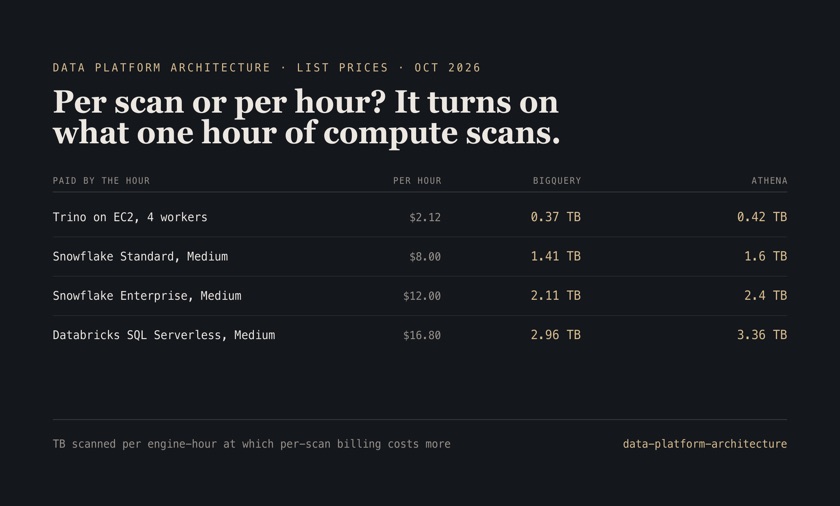
1.4–3.4 TB scanned per engine-hour before per-scan billing costs more than a managed warehousehourly list price of a Medium Snowflake (Standard, Enterprise) or Databricks SQL Serverless warehouse divided by the price per TB on BigQuery on-demand and Athena; AWS us-east-1, BigQuery US, retrieved 2026-10-18 · list prices, Oct 2026
Architecture decision records · Mermaid · Python · Apache Iceberg · Kafka · dbt
Continue the conversation
See the full career record, or get in touch about a senior data, platform, or AI engineering role.