Problem and decision
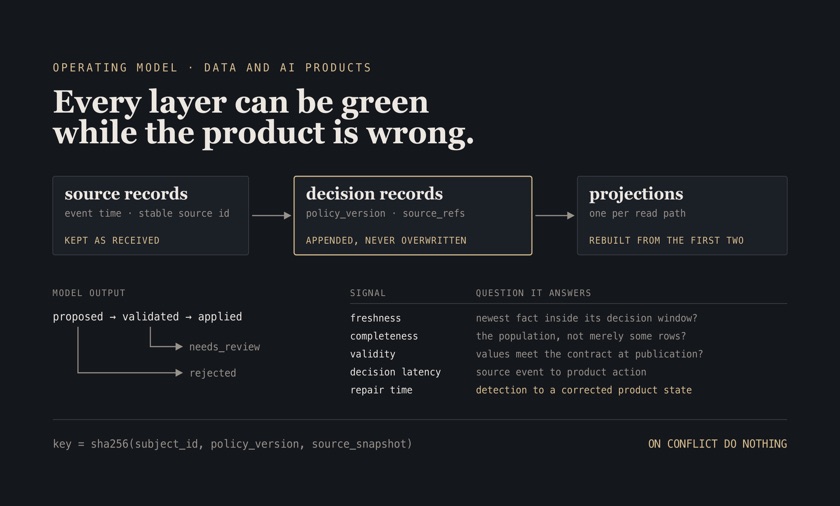
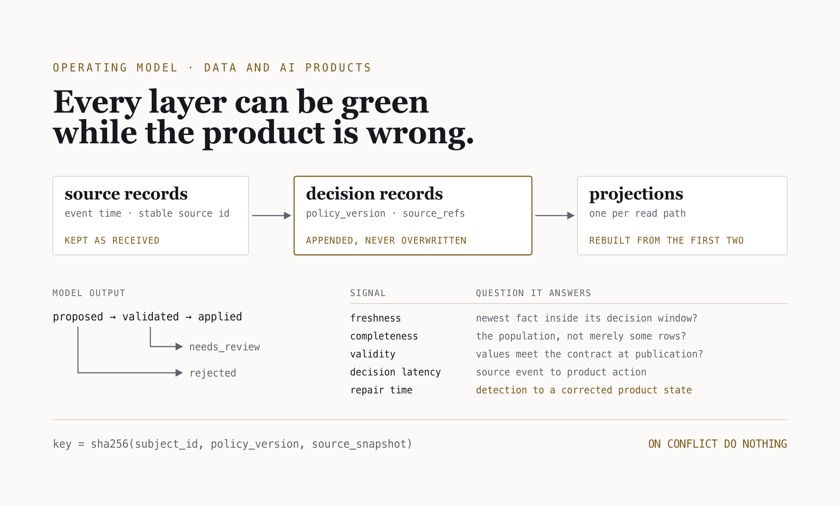
ProblemMost dbt and Airflow portfolios show code that runs. Whether it is right is a different question, and the usual checks (keys, totals, green task runs) cannot answer it: a join to the wrong version of a dimension, or a load that skips a day, is complete, correctly keyed and green.
DecisionGenerate the data so the correct answer is known, build each project the way production would see the data, check every result against that answer, and break things on purpose to see which tests and runs notice.
Scope
- Team
- One person
- Scale
- 1,000 accounts, 5,048 invoices and 913,388 events over a year; a dbt project with 11 models, 46 data tests and 3 unit tests; an Airflow 3 DAG backfilled four ways over 30 days; DuckDB
- Links
- Source
Measured results
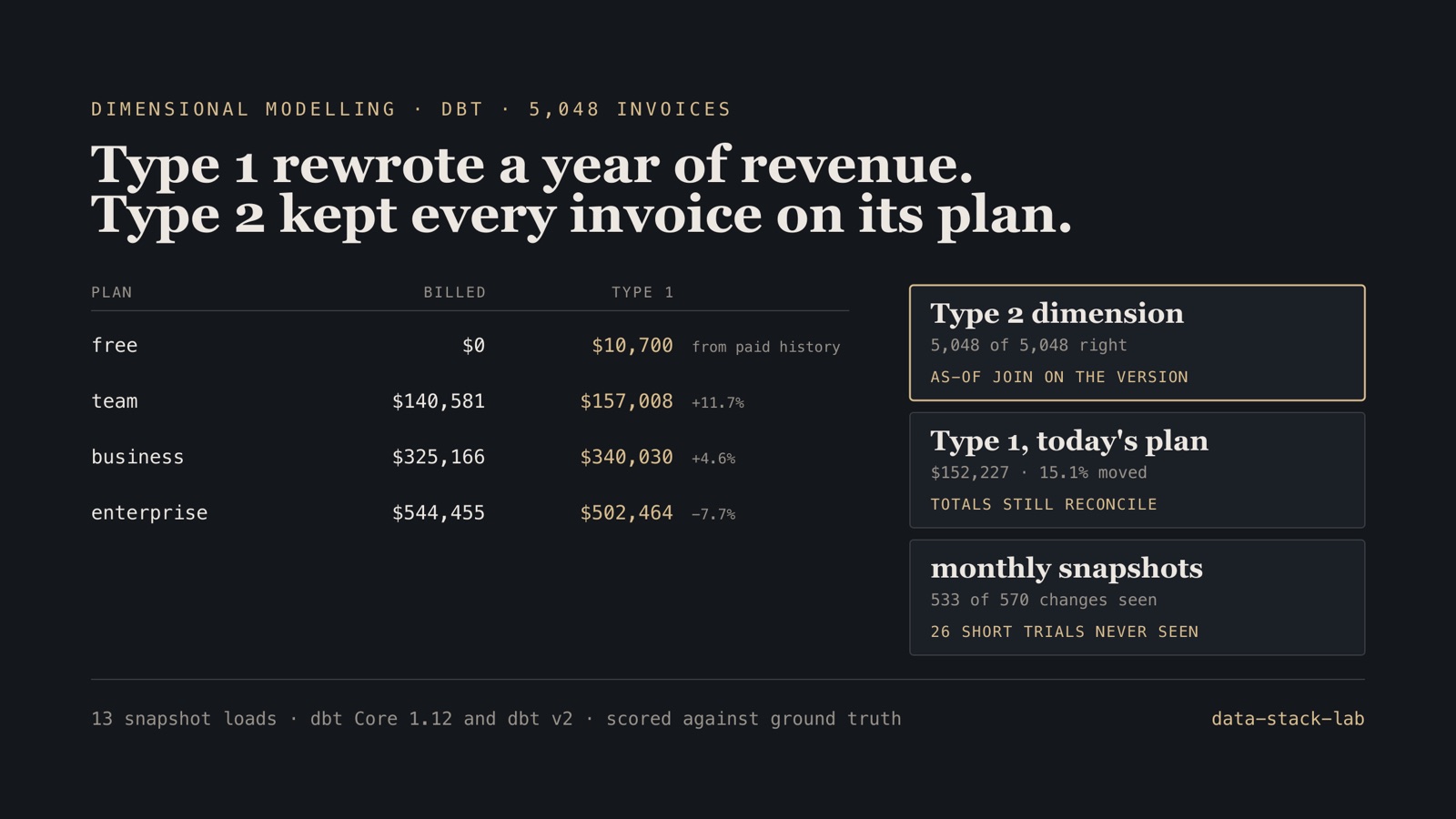
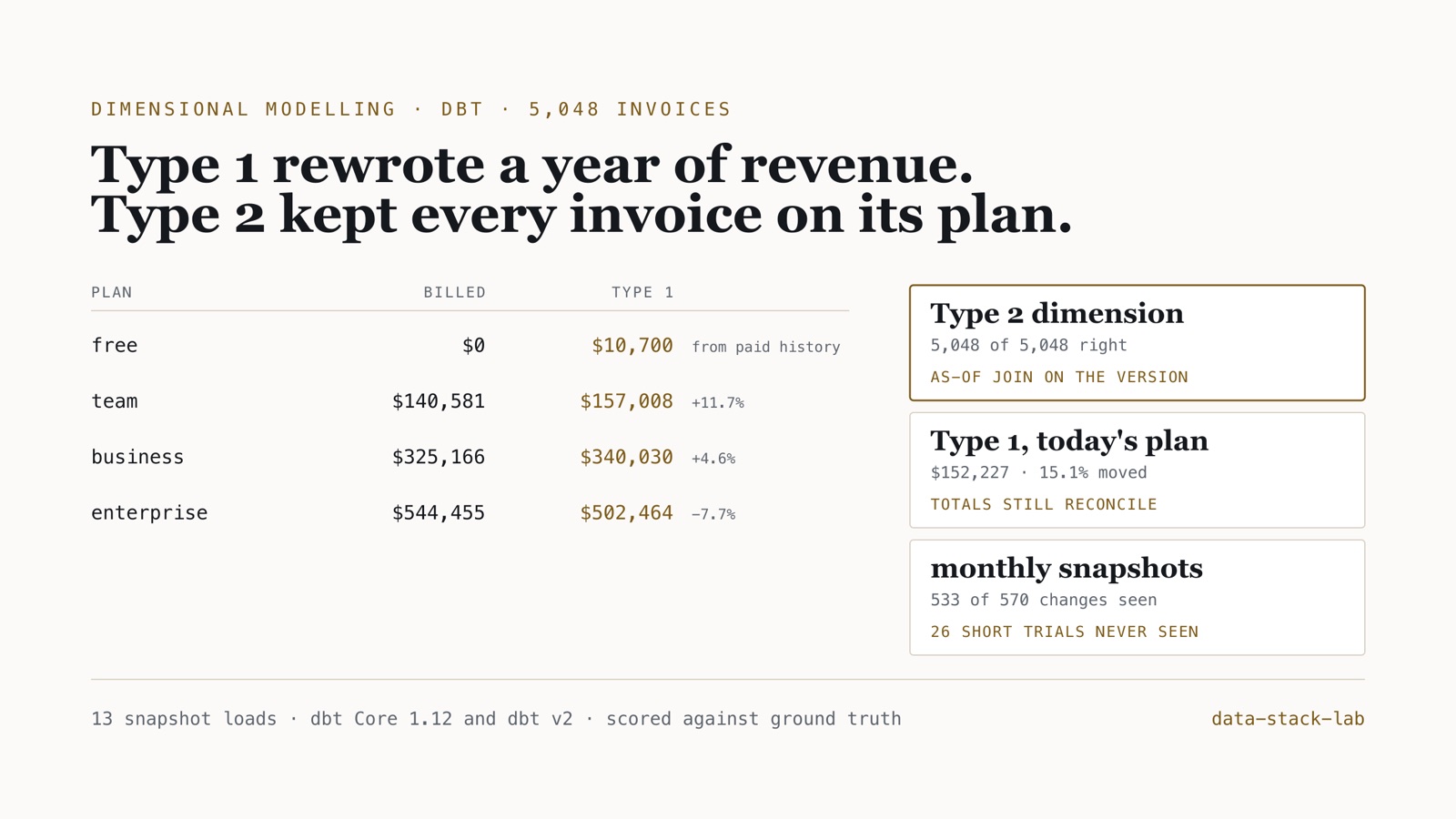
- 15.1% of a year's revenue on the wrong plan with a Type 1 account dimension 5,048 synthetic invoices (seed 7, Oct 2025 – Sep 2026) attributed by each account's current plan and compared with the plan the generator billed; $152,227 of $1,010,202 · measured Oct 2026
- 5,048 of 5,048 invoices on the plan they billed, Type 2 dimension from dbt snapshots as-of join of each invoice to the dim_account version in effect at billing, scored against the generator's truth file; the dimension was built from 13 monthly snapshot loads · measured Oct 2026
- 4 of 4 deliberate model breaks that failed the build each break applied to a copy of the dbt project and built twice, with unit tests and with data tests only; recorded per engine and checked in CI · measured Oct 2026
- 96.56% of a month's events lost by high-water-mark loads backfilled newest day first, every run green September 2026 backfilled through an Airflow 3.3 DAG, one run a day from the 30th back to the 1st; event-time and arrival-time watermark models scored against the 89,508 events that arrived · measured Oct 2026
- 0 of 89,508 events loaded by a data-interval incremental model on Airflow 3's default @daily, in 30 successful runs the same DAG on schedule "@daily", which Airflow 3.3 turns into a CronTriggerTimetable (create_cron_data_intervals = False); each run's data interval starts and ends at the instant it fires · measured Oct 2026
- Generate NumPy · PyArrow One seeded SaaS business; the generator also keeps the answers the warehouse never sees.
- Land Airflow 3 · DuckDB A daily DAG lands each day's files; monthly extracts feed the snapshots.
- Model dbt Core · dbt v2 A Type 2 star schema and three incremental strategies, in one project.
- Test unit tests · mutants 4 of 4 breaks caught; the wrong-version join only by a unit test.
- Backfill dag.test · scheduler September four ways; a real backfill matched the harness exactly.
- Check truth files Type 1: 15.1% misplaced. Newest-first watermarks: 96.56% lost.
Context
Data modelling and Airflow are each in about two of every five data-engineering job descriptions I have collected, and they are the skills a portfolio shows worst. A dbt project that runs proves the SQL compiles; a DAG that runs green proves the tasks finished. Neither proves the numbers are right, and the usual checks (unique keys, not-null columns, successful runs) are checks on shape, not on meaning.
data-stack-lab is a set of hands-on data engineering projects, one per tool, all on the same synthetic SaaS data. Each runs with one command and has its results checked in CI. Because the data is generated, the correct answer is known, so each project can prove its result instead of just running. This case covers the first two. The dbt project asks what keeping a dimension’s history is worth in dollars. The Airflow project asks which way of loading “only what is new” survives re-runs, backfills and an upgrade to Airflow 3.
Constraints
Everything is synthetic, and the business is deliberately small: four plans at one price each, no seats, proration, discounts or refunds. The rates at which accounts upgrade, downgrade, trial a plan and churn are assumptions, so the percentages describe this business rather than any real one.
The warehouse is DuckDB, so the module runs anywhere with no server, and CI rebuilds it on every commit. That rules out claims about Snowflake, Databricks or BigQuery behaviour. The SQL is written to be portable (dbt’s cross-database macros, no QUALIFY), and those platforms get their own modules running this same project. Timings came from one host, an Apple M5 with 24 GB, and are observations only; every other figure is a count over seeded data that CI reproduces byte for byte on Linux.
Architecture
- Generator. One seeded Python module writes the sources as an application would deliver them: a full extract of the accounts table on the first of each month (current state only), users, a price list, a billing export carrying amounts but not plans, and 913,388 product events, 0.8% of them delivered twice. It also writes two truth files the warehouse never sees: every account change with its timestamp, and the plan each invoice billed.
- Load and snapshot. A script replaces
raw.accountswith each month’s extract in turn and runsdbt snapshotafter each, 13 times, so the history in the warehouse is exactly what the extracts showed. - Model. Staging views normalise types and e-mail addresses and drop redelivered events. The marts are a Kimball star:
dim_account(Type 2),dim_plan,dim_dateanddim_user(Type 1, with personal data left in staging), and two facts,fct_invoicesandfct_daily_usage, each joined to the account version in effect when it happened. Arevenue_by_planmodel carries both attributions side by side. - Tests. Enforced contracts on the dimension and both facts; 46 data tests including three generic ones written for this (validity windows that neither overlap nor leave gaps, and a composite grain) and two reconciliations; 3 unit tests on hand-written rows.
- Airflow. One DAG, two tasks:
landreplaces a day’s partition of event files in the warehouse, andtransformruns three dbt incremental models that differ only in the filter that picks the batch (newer than the newest event time, newer than the newest arrival, or inside the run’s data interval). A harness backfills September four ways throughdag.test(); the in-order backfill was also run once onairflow standalonewithairflow backfill create. - Scoring. A measurement script compares the warehouse with the truth files. A mutation script breaks the models four ways and records which tests fail, per dbt engine. CI runs everything on dbt Core 1.12 and on dbt v2, and fails if a single published number or mutant result changes.
In the code
Two lines in the dimension decide whether every fact finds exactly one version. The first version is stretched back to signup, because an account that changed before its first extract is first seen later than it existed. The open version ends at a far-future date instead of NULL, so the as-of join in each fact stays a plain range predicate on any warehouse.
select
    v.dbt_scd_id as account_key,
    v.account_id,
    cast(v.version_number as integer) as version_number,
    v.account_name,
    v.industry,
    v.country,
    v.plan_id,
    p.plan_name,
    v.status,
    v.signup_at,
    case when v.version_number = 1 then v.signup_at else v.dbt_valid_from end as valid_from,
    coalesce(v.dbt_valid_to, cast('9999-12-31 00:00:00' as timestamp)) as valid_to,
    v.dbt_valid_to is null as is_current
from versions as v
inner join {{ ref('dim_plan') }} as p on v.plan_id = p.plan_id
Both lines are pinned by a unit test, and the mutation script deletes each in turn to check that something fails.
Decisions and trade-offs
| Decision | Alternative considered | Why | What it cost |
|---|---|---|---|
| Snapshot the raw source | Snapshot a cleaned staging model | The snapshot is the only record of history; it should keep exactly what arrived | Cleaning runs after the snapshot, on every build |
Timestamp strategy on the application’s updated_at |
Check strategy on chosen columns | Versions are dated when the change happened, not when the snapshot ran | 33 versions identical to the one before, from changes undone between two extracts |
| Stretch the first version back to signup | Leave a gap before the first extract | Without it, usage in the gap found no version at all | The gap’s state is assumed; version_number = 1 labels it |
Facts left-join the dimension, with not_null on the key |
Inner join | An unmatched fact fails the build instead of disappearing | One more test per fact |
| No dbt packages | dbt_utils for the generic tests | Runs offline and on dbt v2 unchanged | Three generic tests written by hand, under 50 lines |
| Score against a truth file | Trust the tests | Tests check shape; only the truth says whether the number is right | The truth exists only because the data is synthetic |
Results
Type 1 rewrote a year of revenue. Attributing each invoice to its account’s current plan put 15.1% of revenue on a plan the invoice did not bill: $152,227 of $1,010,202, across 873 invoices. Enterprise came out 7.7% low and team 11.7% high, and the free plan was credited with $10,700; the largest single flow was $60,939 of enterprise billing reported under business by accounts that later downgraded. The Type 2 dimension put 5,048 of 5,048 invoices on the right plan.
Snapshots see what extracts show. Monthly snapshots captured 533 of 570 changes made during the year; 26 of the 37 missed were trial upgrades that began and ended inside a month. Invoices, billed at the extract instant, lost nothing. Usage, which happens all month, put 734 of 906,015 events (0.08%) on the wrong plan with Type 2, against 13.65% with Type 1.
Tests that fail when they should. 4 of 4 deliberate breaks failed the build. The one that matters most, joining invoices to the current version, passed all 46 data tests (keys valid, every invoice present, revenue reconciled to the cent) and was caught only by a unit test that names the version each invoice must get. The full table and the per-engine record are in the write-up and the repository’s MEASUREMENTS.md.
High-water marks skip what runs out of order. Backfilled in order, the event-time model lost 2,034 of 2,291 late events and the other two lost nothing. When the file for 10 September landed two days late and the day was re-run, the arrival-time model loaded nothing for it. Backfilled newest day first, both watermark models lost 96.56% of the month with every run green. The data-interval model lost nothing in any of those orders. Details in the Airflow write-up.
Airflow 3’s @daily has no interval. On the default schedule, a CronTriggerTimetable in Airflow 3, each run’s data interval starts and ends at the same instant. The data-interval model loaded 0 of 89,508 events in 30 successful runs. saas_daily names CronDataIntervalTimetable explicitly, and a test pins both schedules. The real-scheduler backfill produced tables identical to the harness’s.
Two engines, one result. dbt v2 (the Apache-2.0 dbt-oss 2.0.8 distribution) built the same 11 models, passed the same tests and produced byte-identical measurements after one change to the YAML. End to end, 13 snapshot runs and a build took 83 s on dbt Core and 24 s on v2 on the same host.
What went wrong
dbt v2 passed two unit tests it should have failed. The mutation script showed that on v2, deleting the first-version stretch or the far-future end left the dimension’s unit test green. A wrong expected timestamp, even 1999, passes on v2, while a wrong string, integer or boolean fails. The SQL v2 compiles for the test returns both values, so the gap is in how it compares the rows it fetches. It is dbt-labs/dbt#15894, open since August, and I reproduced it on 2.0.8 with DuckDB. The data tests caught both breaks, which is the argument for having both layers; the repository now records the per-engine result, so CI fails when the behaviour changes.
v2 rejected a source property dbt Core accepts. loaded_at_field at the table level of a source is an error on v2, which wants it under config:. One line, but a project that runs on Core is not automatically a v2 project.
My first backfill covered the wrong days. The date passed to dag.test() is treated as the moment the run fires, so on a data-interval schedule it covers the day before; the scheduler’s own backfill labels the same run by the start of its window. Passing each day as the date covered 31 August to 29 September and reported 30 September’s 3,076 events as lost by the two strategies that were complete. Checking the harness against a scheduler run is what made the difference visible.
My first mutation run reported every break as surviving. The harness read the failing node’s name from the wrong segment of dbt’s unique id, which puts a unit test’s name last. All four breaks had in fact been caught. A harness that reports on tests needs its own known failure to check against before its output means anything.
What I’d do differently
Score the cadence, not just the model. The snapshot’s blind spot is set by how often the source is extracted. The next step is to rebuild the dimension from daily extracts and from a change-data-capture log of the same history and put the three side by side, which is a sharper argument for CDC than any diagram.
Add the platforms early. The model is portable by construction but proven only on DuckDB. Running the same dbt project on Snowflake and Databricks comes next, and type mapping in the contracts is where I expect the first surprises.
Run the other orders on the scheduler too. Only the in-order backfill ran on a real scheduler. The backwards and late-file cases ran through dag.test(); airflow backfill create --run-backwards and a cleared-and-re-run day on the scheduler would close that gap.
Lint the SQL. Formatting is consistent by hand. A SQL linter in CI would keep it that way once the project has more than one author.
The code, the data generator, and every measurement, backfill and mutant record are in data-stack-lab.
Connected systems
All case studiesdataset-registry: data contracts that wait for the consumers they break
Author
A breaking schema change should be a question to the teams it breaks, asked by a registry that knows who they are
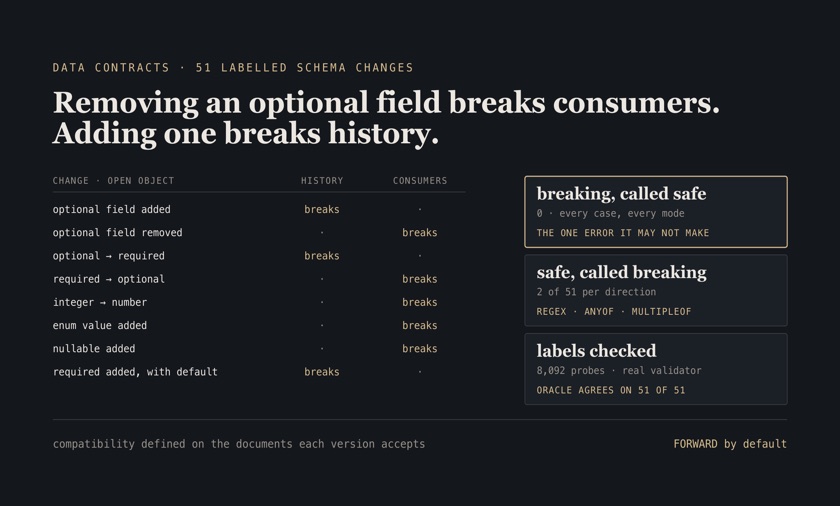
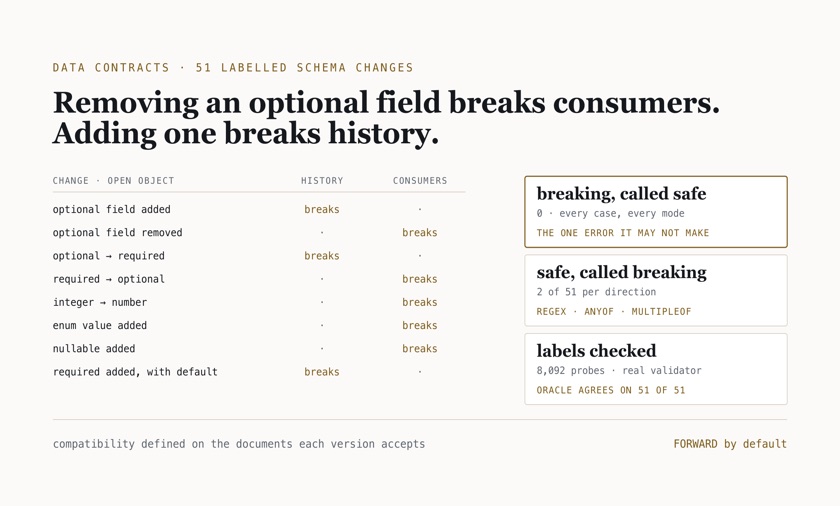
0 breaking schema changes passed as safe, in any mode51 hand-labelled JSON Schema changes, each scored under BACKWARD, FORWARD and FULL; every label cross-checked by an oracle that ran 8,092 generated probe documents through a real JSON Schema validator · measured Oct 2026
2 of 51 changes flagged as breaking that are safe, per directionthe same 51 cases; a widened and a narrowed regular expression, an added anyOf branch and an added multipleOf are flagged in both directions by design, and each truly breaks only one · measured Oct 2026
Go · PostgreSQL 18 · sqlc · OpenLineage · JSON Schema · Next.js
Rebuilding a production data platform for scale and recovery
Data Engineer → Senior Data Engineer
A six-year platform story: faster processing, lower cost, safer change, and recovery designed before the incident.
50% faster core processingrole-level before/after wall-clock on the rebuilt Spark/Airflow path — not a lab sample · Data Engineer role, 2020–2024
40% lower infrastructure costrole-level before/after infrastructure run-rate on the Kubernetes migration — not a lab sample · Data Engineer role, 2020–2024
Python · SQL · Apache Spark · Apache Kafka · Apache Airflow · dbt
streaming-platform: exactly-once clickstream, counted at every layer
Author
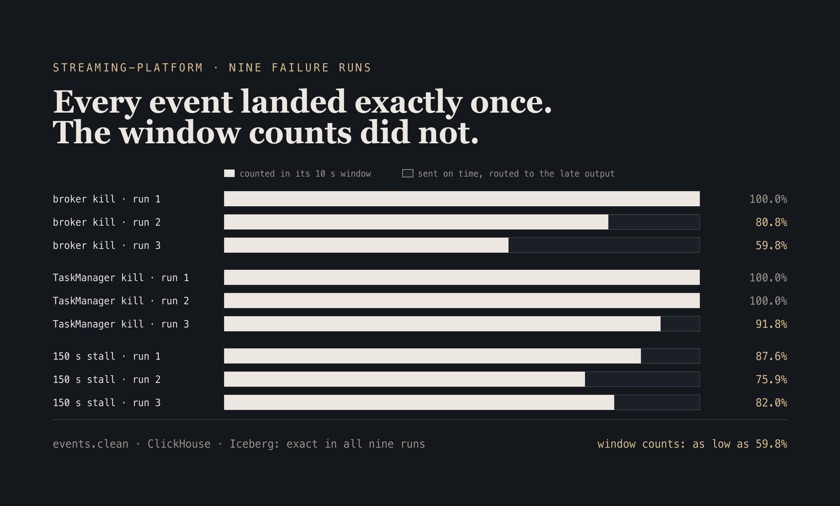
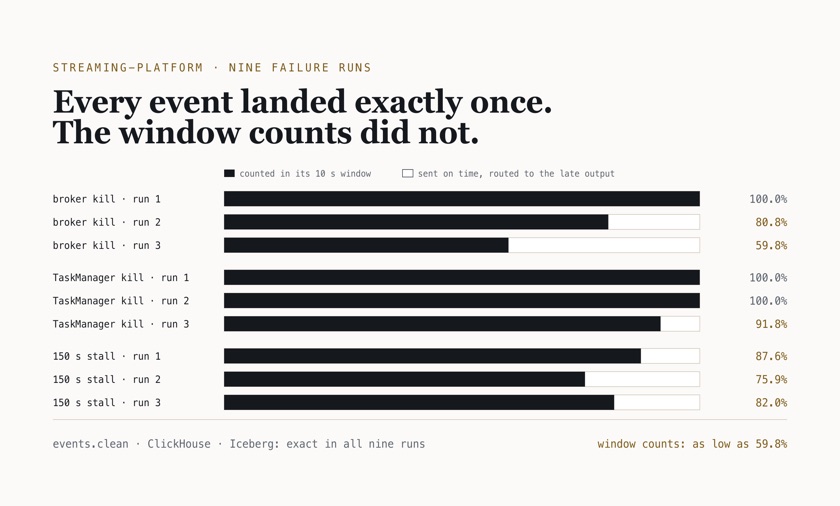
Exactly-once is a claim about counts, so every layer was counted against a ledger, through broker kills, TaskManager kills and stalls
9 of 9 failure runs with every event layer exactthree controller-broker kills, three TaskManager kills and three 150 s stalls under load; Kafka, ClickHouse, Iceberg and the dead-letter topic reconciled against the generator's ledger by sequence number · Oct 2026
59.8% of on-time events left in the window counts after one broker kill118,229 of 197,749 on-time events counted in their 10 s windows in the worst of three broker-kill runs; the rest went to the late side output because catch-up reordered partitions past the 5 s watermark bound · Oct 2026
Apache Kafka 4.3 · Apache Flink 1.20 · ClickHouse · Apache Iceberg · Schema Registry · Avro · Prometheus
Continue the conversation
See the full career record, or get in touch about a senior data, platform, or AI engineering role.