Problem and decision
ProblemA real-time model can pass every offline check and still fail: the training join reads the future, the backfill computes a feature differently from the stream, labels arrive weeks late, and the drift monitor fires on the calendar instead of the drift.
DecisionBuild each failure on purpose next to the correct version — naive and point-in-time joins, SQL and stream features, mature and immature labels, four drift monitors — on seeded data, and measure the difference instead of asserting it.
Scope
- Team
- One person
- Scale
- Seeded payments: 874,446 transactions over 90 days, 0.80% fraud; a live stack of Kafka, Redis, Postgres, MLflow and Prometheus, one container per service
- Links
- Source
Outcomes
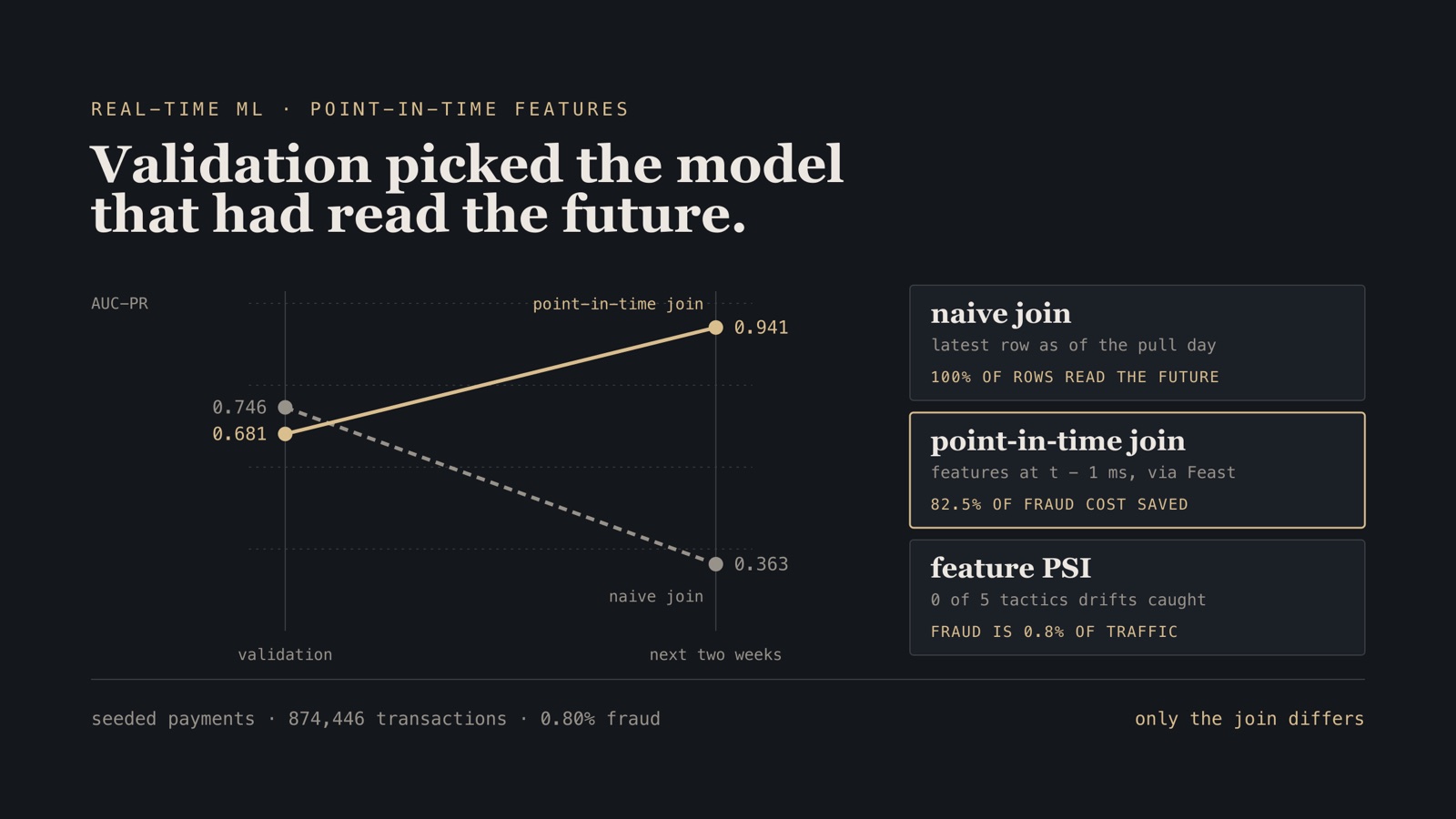
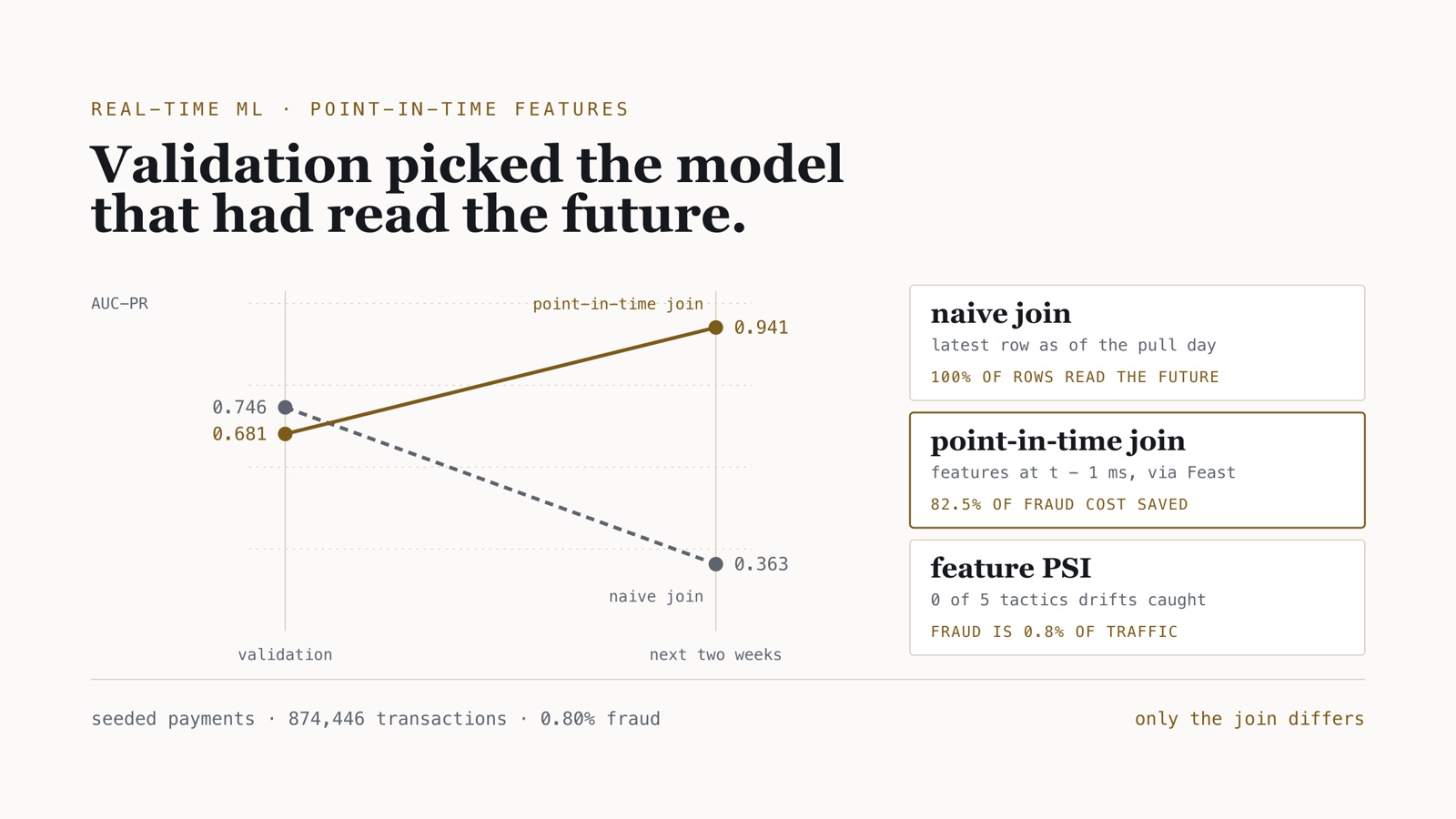
- 0.363 vs 0.941 future AUC-PR, naive join against point-in-time join same rows, labels, model and hyperparameters; only the training join differs. Scored on the two weeks after training with point-in-time features and true labels, on seeded synthetic payments (874,446 transactions, 0.80% fraud) · measured 2026-10 · seeded synthetic data
- 82.5% of fraud cost saved on two unseen weeks a $5 review per flag plus the amount of every missed fraud, against approving everything; threshold chosen on the validation window, true labels. A hand-written rule saved 20.7% · measured 2026-10 · seeded synthetic data
- 99.905% of 9,500 live requests served exactly the training features features logged by the API compared with Feast's point-in-time join for the same transactions, on a live stack replaying a day in about seven minutes · measured 2026-10 · replay speed
- 0 of 5 tactics drifts caught by feature PSI five seeded runs with a fraud-tactics drift and five without, monitors replayed every 6 hours over the trailing 24; calendar-trending features excluded, threshold 0.2 or 0.1 · measured 2026-10 · seeded synthetic data
- Backfill DuckDB · Parquet Each row is an entity's state after an event, so training can ask for any instant.
- Train Feast · LightGBM · MLflow Joined 1 ms before each payment; the naive join fell to 0.363 AUC-PR against 0.941.
- Stream Kafka · Feast push · Redis Matched the SQL backfill on 100% of 68,273 rows; a planted defect was caught per feature.
- Score FastAPI · LightGBM Served point-in-time features on 99.905% of 9,500 live requests; server p99 under 5 ms.
- Gate evalproof · MLflow Promotes only on a significant paired saving within 2 ms p99; refused a reseeded copy.
- Monitor Postgres · Prometheus PSI did not see the fraud-tactics drift; the flag rate caught 5 of 5 at 17% false alarms.
Context
realtime-ml scores payments for a fictional homewares retailer as they happen. Payments flow through Kafka into a stream processor that keeps window features — card counts per device in the last hour, purchases per customer in the last day — in Feast’s online store. A FastAPI service scores each payment with the champion model, runs the challenger in shadow, and logs both. A gate promotes the challenger only on a statistically significant, paired improvement, and a monitor exports drift signals to Prometheus.
None of that is unusual, and none of it was the point. The ways a model like this goes wrong mostly happen before it is served, and they are quiet: the offline numbers look fine. So each failure is built here on purpose, beside the correct version, and the difference between them is the measurement. The finding I did not expect is written up in Validation picked the fraud model that had read the future.
Constraints
The data is synthetic, from a seeded generator: 8,000 customers, 90 days, card-testing bursts, account takeovers, lone anomalies, and chargebacks that arrive after a lognormal delay with a median of seven days — 15% of frauds are never reported at all. That makes every absolute score a property of the generator. The comparisons are the findings: the same rows, the same model, one thing changed.
The live stack is Kafka 4.3.1 in KRaft mode, Redis, Postgres, an MLflow server and Prometheus, each a container on one Docker VM of 8 CPUs and 11.7 GiB. All containers share one host, so latency figures contain no real network hops. Kafka runs one broker and one partition, because the log’s guarantees are not what is under test.
Architecture
The offline side writes every window feature into Feast from SQL window functions in DuckDB, joins it point-in-time for training, trains LightGBM, and registers champion and challenger in MLflow. The online side recomputes the same features in a per-entity state machine over the Kafka stream and pushes them into Redis, where the API reads them at scoring time. Every prediction, with the features it was served, lands in a Postgres log that feeds the gate and the drift monitor.
Two implementations of each feature is deliberate. A single shared function would hide skew instead of testing for it; two implementations with a parity test make skew a measured quantity.
In the code
This is the decision behind the leakage result. Both training sets are built from the same rows; the point-in-time join asks Feast for each payment’s features one millisecond before that payment, while the naive one hands every row the entity’s latest state as of a single pull date, and that one difference is 0.941 against 0.363 AUC-PR on the two weeks that followed.
# A transaction is scored before its own event reaches the feature pipeline. Offline, the
# same thing is expressed by asking for features one millisecond before the event.
SCORE_OFFSET = pd.Timedelta(milliseconds=1)
# …
def pit_join(store: FeatureStore, rows: pd.DataFrame) -> pd.DataFrame:
    """Point-in-time features for ``rows``, through Feast's historical retrieval."""
    ent = rows[["txn_id", "customer_id", "device_id"]].copy()
    ent["event_timestamp"] = rows["ts"] - SCORE_OFFSET
    feats = store.get_historical_features(entity_df=ent, features=FEATURE_REFS).to_df()
    feats = feats.drop(columns=["customer_id", "device_id", "event_timestamp"])
    out = rows.merge(feats, on="txn_id", how="left", validate="one_to_one")
    return out.sort_values("ts").reset_index(drop=True)


def naive(rows: pd.DataFrame, tables: dict[str, pd.DataFrame], as_of: pd.Timestamp) -> pd.DataFrame:
    return naive_join(rows, tables, as_of).sort_values("ts").reset_index(drop=True)
The full file, including the label view a model is allowed to see at training time, is src/rtml/dataset.py.
Decisions and trade-offs
| Decision | Alternative considered | Why | What it cost |
|---|---|---|---|
| Train with features as of 1 ms before each transaction | Join each entity’s latest row | The latest row includes the rest of the fraud burst and the transaction’s own chargeback | The honest model looks worse on validation, scored with the labels known on the day |
| Every window feature written twice, SQL and stream | One shared feature function | Two implementations make skew measurable | Twice the feature code, and a parity test to maintain |
| Score with the state after the entity’s previous event; no TTL on feature views | Re-expire windows at read time | Feast applies a view’s TTL offline but not on Redis reads, which would build skew into the store | A customer quiet for three days still shows that day’s one-hour count; the model is told the window’s age instead |
| Train on rows at least 14 days old | Train on everything with the labels known on the day | Immature labels ruined the threshold | 31% fewer training rows than using everything |
| Promote only on a significant paired saving within a 2 ms p99 | Promote the higher number | Shadow traffic is paired; the higher number promotes noise | An improvement smaller than this one would have to wait for chargebacks to mature before it clears the bar |
| Hour-matched PSI, calendar-trending features excluded | PSI against the training distribution, all features | The textbook recipe fired on evenings and on the calendar | No label-free monitor caught the tactics drift; that is reported, not tuned away |
Results
On the two weeks after training, with true labels, the champion reached AUC-PR 0.941 and recall 0.954 at precision 0.668, flagging 1.2% of payments and saving 82.5% of fraud cost against approving everything. A hand-written rule saved 20.7%.
The leakage measurement is the one that changed how I would review a training pipeline. With features joined naively, the model scored 0.746 on validation against 0.681 for the point-in-time join — and then 0.363 against 0.941 on the following two weeks. Every naive training row took its customer features from a row timestamped after the transaction.
The SQL backfill and the stream state machine agreed on 100% of 68,273 replayed rows. A planted defect changed 16.84% of one feature and was caught at the feature level, while AUC-PR, flag rate and cost saving were unchanged to three decimals — a model-level parity check would have passed it. On the running stack, 99.905% of 9,500 live requests were served exactly the point-in-time features; all nine disagreements were stream lag at replay speed.
Scoring took a server-side p50 of 0.54–0.73 ms and a p99 of 3.5–4.3 ms at 25, 50 and 100 requests per second, with no errors. Offline, the gate promoted the device-feature model at a saving of $0.109 per transaction (95% CI 0.085 to 0.137) over 68,016 paired shadow transactions, and refused a reseeded copy, an underfit model, and an oversized one that beat only the weaker champion. Live, it promoted the same model and the API was serving it 6.1 seconds later.
What the measurements refused to show
Drift monitoring does not work well here, and that is the finding. When fraudsters slowed down and stayed closer to normal, recall fell 3 to 9 points. Feature PSI never fired on that change, and neither did score PSI: fraud is 0.8% of traffic, and when it changes tactics the population barely moves. The flag rate caught all five drifts in a median 48 hours at a threshold that also fired on 17.2% of drift-free windows. Recall on the chargebacks that had arrived tracked the real damage and was about 300 hours late.
The client-side latency tail is not explained. Inside the API, p99 stayed under 5 ms. The client saw p99 of up to 257 ms at 100 requests per second over the same requests. Moving the Kafka producer off the replay’s event loop removed the largest cause; at least one more remains between the two timers.
Calibration is good on average and wrong where it matters. The expected calibration error is 0.002 because nearly every score is near zero and correct. In the top 1% the model is consistently under-confident — a score of 0.42 was fraud 67% of the time — because it learned P(chargeback), and 17% of frauds in its training window were never reported.
What I’d do differently
Monitor the flagged slice, not the population. Every label-free monitor here watched all traffic, where a tactics change in 0.8% of it is invisible. The next step on the roadmap is to watch the decisions the model makes rather than the traffic it sees, and to recalibrate on matured labels.
Partition the stream from the start. One Kafka partition kept the parity measurement clean and left the processor unable to scale out. Customer, device and customer-device state have to stay together, and that partitioning scheme does not exist yet.
Measure parity at real speed. Replaying a day in seven minutes puts a card-testing burst’s attempts closer together than the stream’s lag, which is where every disagreement came from. The real-speed figure would be smaller; it is unmeasured, so it is not claimed.
Every number above comes from the repository’s MEASUREMENTS.md, which has the seeds, the environment and the command behind each table.
Connected systems
All case studiesevalproof: LLM evaluation as measurement, gated on what the data can show
Author
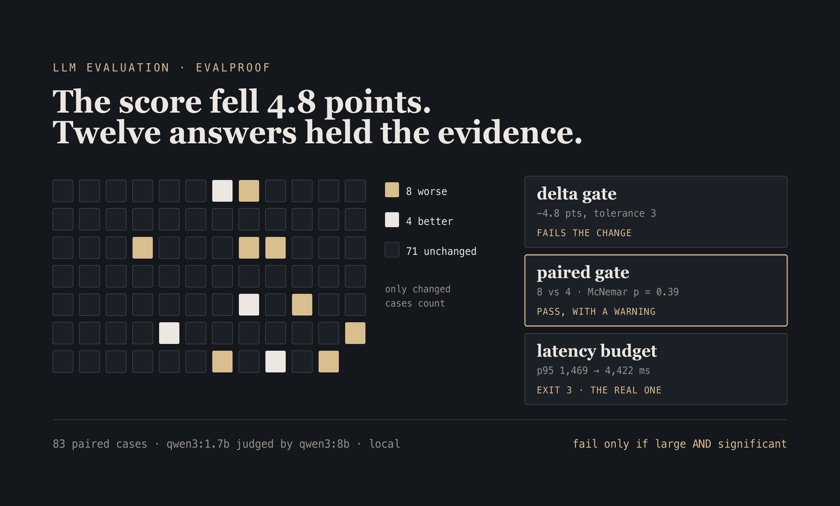
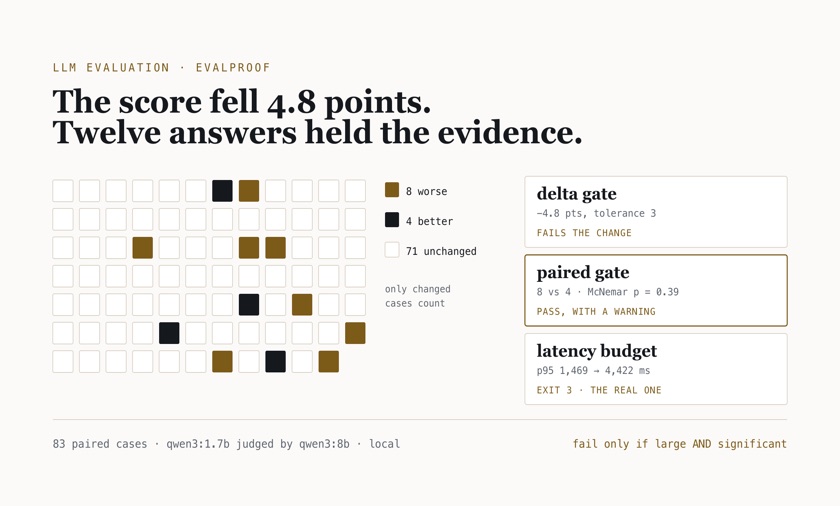
An LLM judge's pass rate is a biased estimate, and a few-point drop on a small suite is mostly noise
p = 0.39 for a 4.8-point judge drop the gate declined to failexact McNemar on 83 paired cases — 8 worse, 4 better, 71 unchanged — qwen3:1.7b judged by qwen3:8b on Ollama, temperature 0 · measured Oct 2026
1,469 → 4,422 ms p95 latency, the regression that was realsystem latency over the same 83 cases, sequential, one Apple M5; mean answer length went from 19 to 77 tokens · measured Oct 2026
Python · numpy · Pydantic · httpx · Ollama · Qwen3
streaming-platform: exactly-once clickstream, counted at every layer
Author
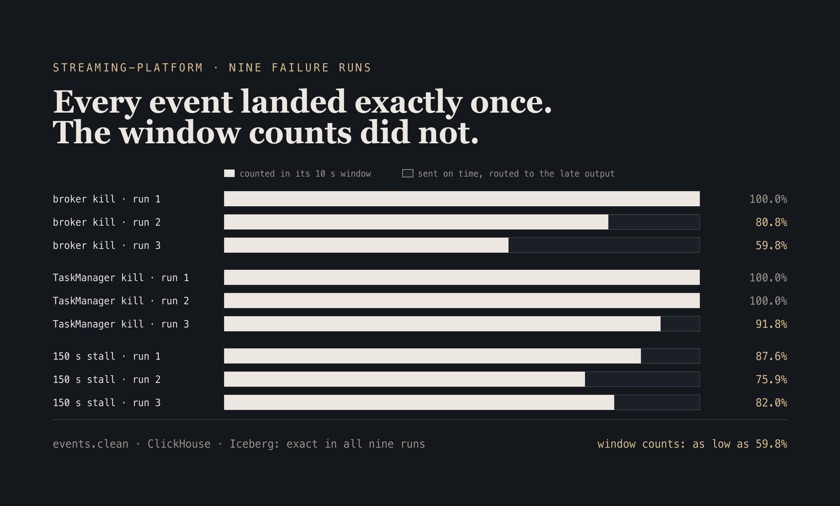
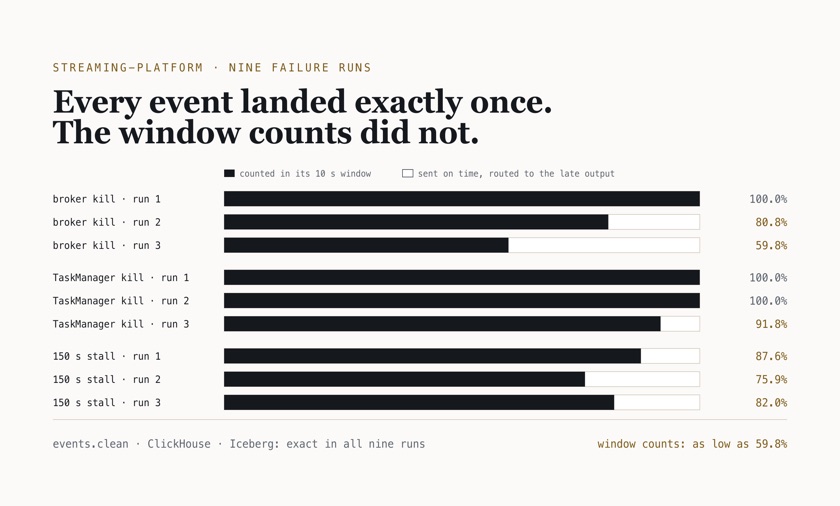
Exactly-once is a claim about counts, so every layer was counted against a ledger, through broker kills, TaskManager kills and stalls
9 of 9 failure runs with every event layer exactthree controller-broker kills, three TaskManager kills and three 150 s stalls under load; Kafka, ClickHouse, Iceberg and the dead-letter topic reconciled against the generator's ledger by sequence number · Oct 2026
59.8% of on-time events left in the window counts after one broker kill118,229 of 197,749 on-time events counted in their 10 s windows in the worst of three broker-kill runs; the rest went to the late side output because catch-up reordered partitions past the 5 s watermark bound · Oct 2026
Apache Kafka 4.3 · Apache Flink 1.20 · ClickHouse · Apache Iceberg · Schema Registry · Avro · Prometheus
dataset-registry: data contracts that wait for the consumers they break
Author
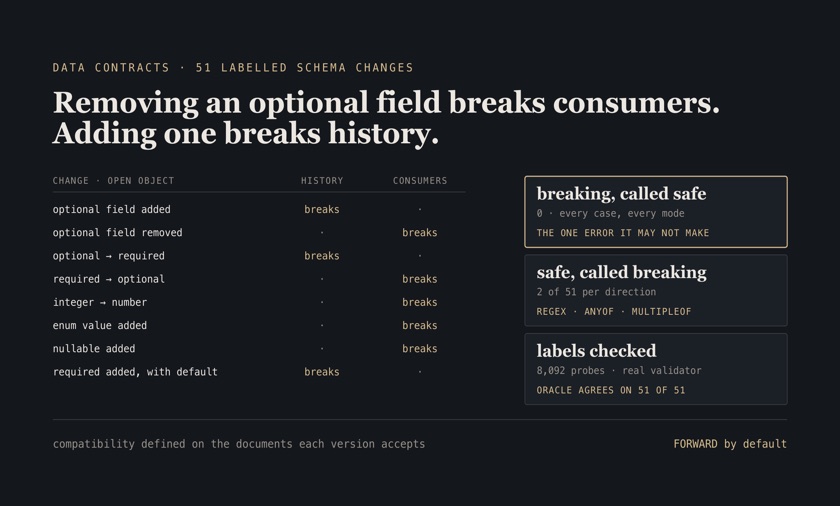
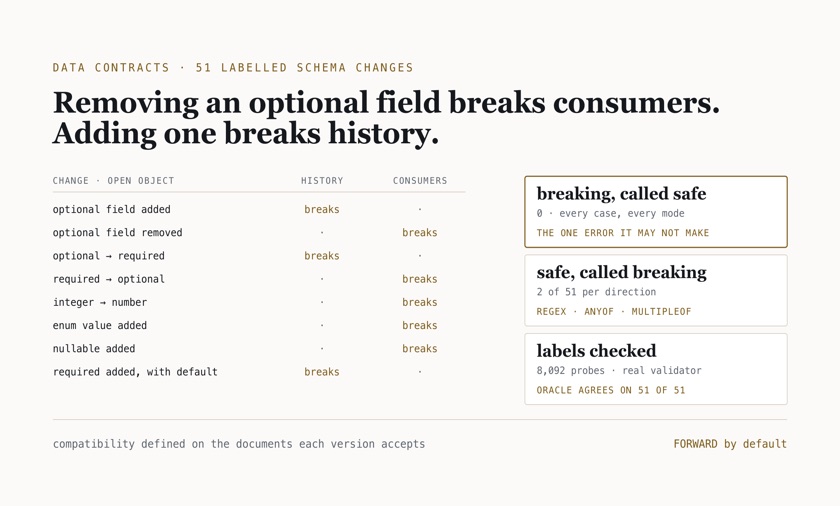
A breaking schema change should be a question to the teams it breaks, asked by a registry that knows who they are
0 breaking schema changes passed as safe, in any mode51 hand-labelled JSON Schema changes, each scored under BACKWARD, FORWARD and FULL; every label cross-checked by an oracle that ran 8,092 generated probe documents through a real JSON Schema validator · measured Oct 2026
2 of 51 changes flagged as breaking that are safe, per directionthe same 51 cases; a widened and a narrowed regular expression, an added anyOf branch and an added multipleOf are flagged in both directions by design, and each truly breaks only one · measured Oct 2026
Go · PostgreSQL 18 · sqlc · OpenLineage · JSON Schema · Next.js
Continue the conversation
See the full career record, or get in touch about a senior data, platform, or AI engineering role.