On this page
- Why AI coding agents slow seniors down — and why they still feel faster
- How to integrate Cursor, Claude Code, or Codex into an existing repository
- How to govern AI-generated PRs in a monorepo
- What human review should still own when agents write the diff
- Common Cursor, Claude Code, and Codex pitfalls
- An operating checklist I will actually enforce
- Frequently asked questions
- How do you use Cursor, Claude Code, or Codex in an existing repository?
- What is the difference between AGENTS.md, CLAUDE.md, Cursor rules, skills, and hooks?
- How do you govern AI-generated PRs in a monorepo when non-developers open them?
- What are the most common Cursor, Claude Code, and Codex pitfalls?
- Should seniors still read every line of an AI-generated pull request?
The throughput problem is no longer “can someone produce a patch.” Cursor, Claude Code, and Codex will produce one. The problem is that the patch arrives faster than anyone can honestly review it, and it now arrives from people who were never supposed to be in the commit graph: design, QA, product, sometimes a manager who pasted a ticket into an agent and opened a pull request.
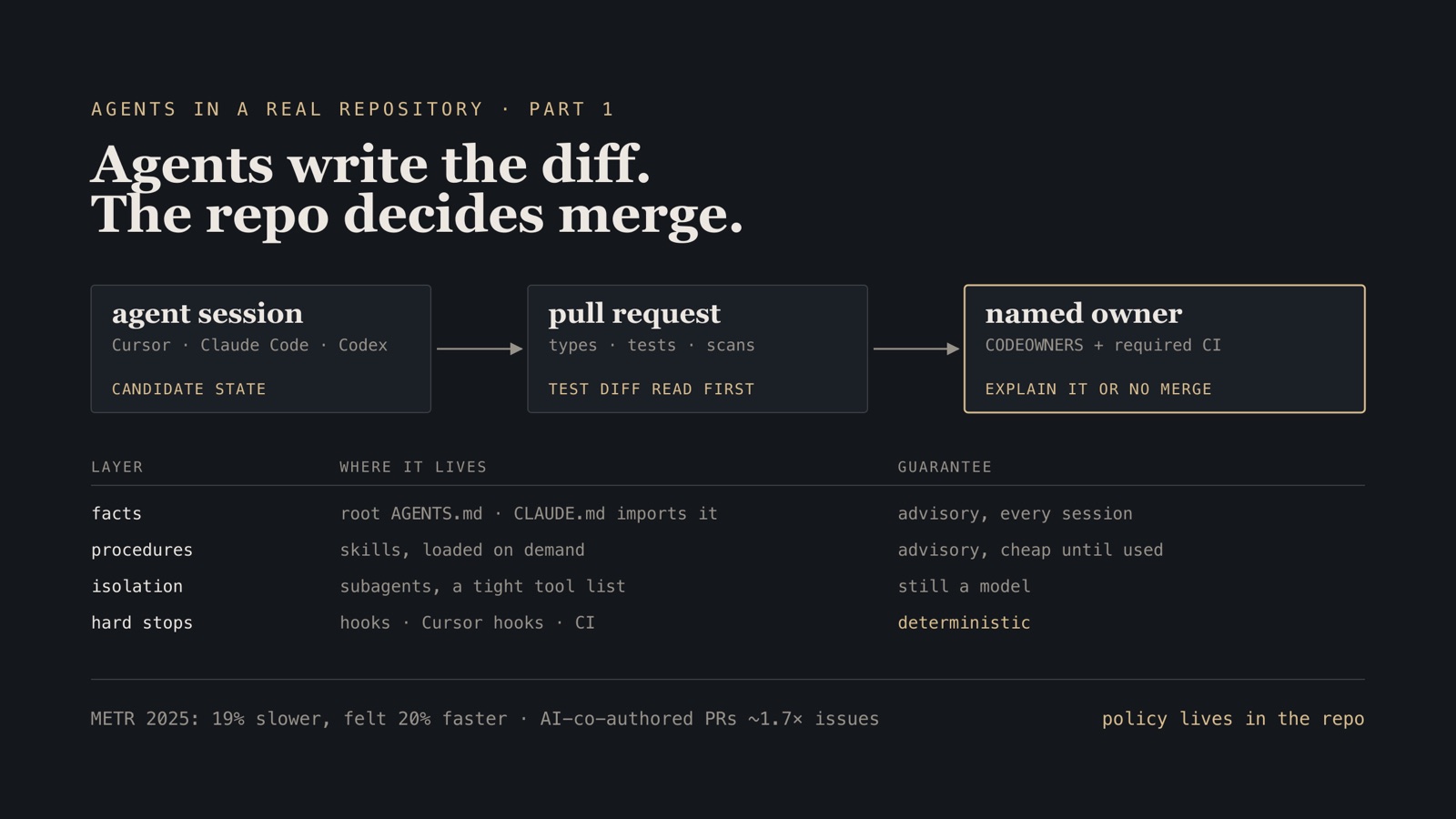
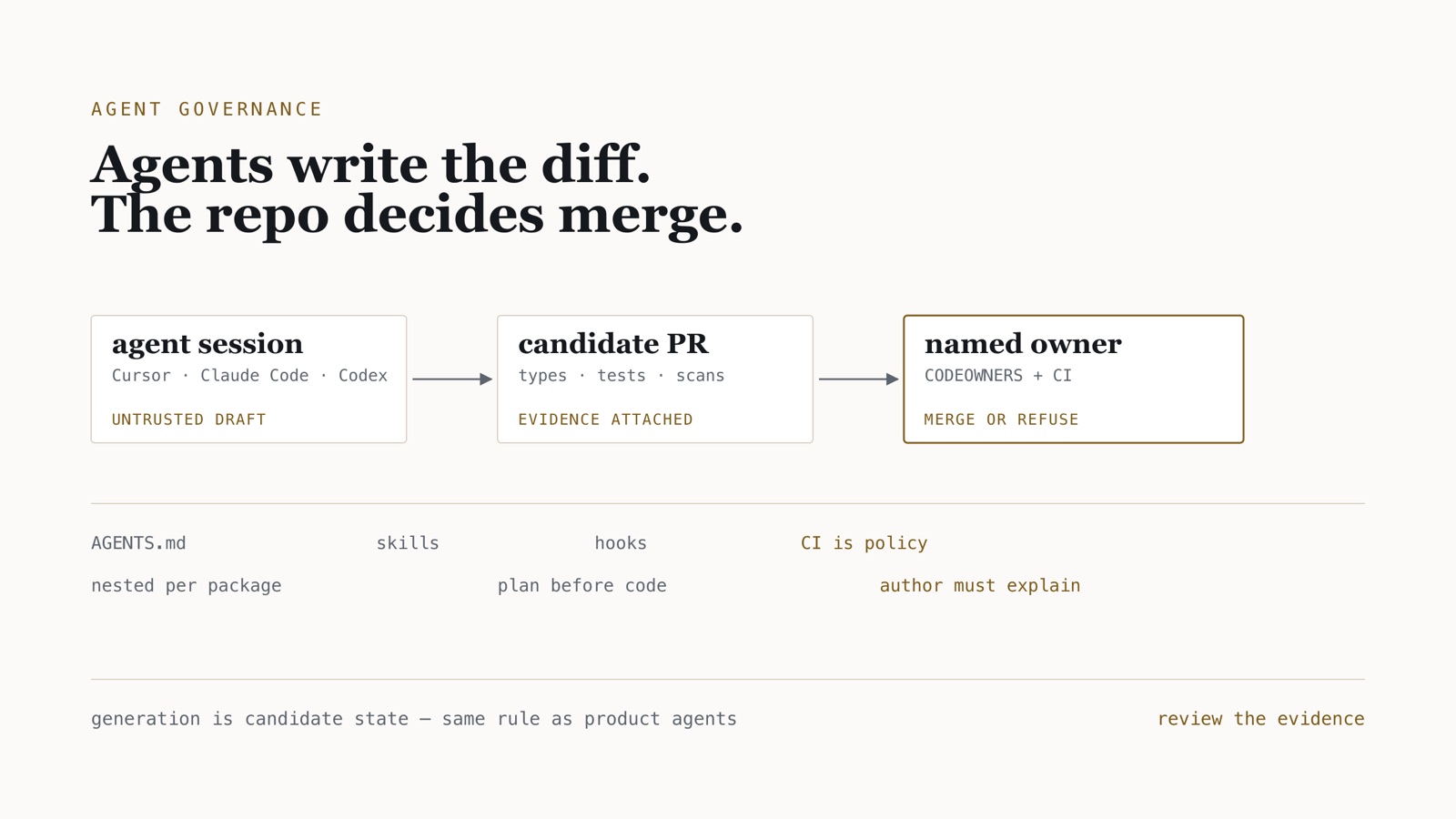
Operating rule. Treat output from Cursor, Claude Code, and Codex as candidate state — the same rule I use for governed product agents. A fluent diff is not the main branch. It becomes mergeable only after a short AGENTS.md, executable CI, CODEOWNERS, and an author who can explain the change. Policy lives in the repository, not in the chat window.
That is the control plane this essay specifies. Part two is the measured version from this site’s own gates.
Why AI coding agents slow seniors down — and why they still feel faster
Self-reported speed is a bad instrument here. METR’s 2025 randomized trial on experienced open-source developers, working real issues in repositories they already knew, found that allowing early-2025 AI tools — mostly Cursor with Claude 3.5/3.7 Sonnet — made them 19% slower, while those same developers still believed they had sped up by about 20%. The paper is a snapshot of one setting, not a law of physics. METR’s February 2026 follow-up estimated “a speedup of -18% with a confidence interval between -38% and +9%” for returning developers and -4%, “with a confidence interval between -15% and +9%”, for new ones, and METR itself calls that data “only very weak evidence” because of who declined to take part. The durable fact is the perception gap: agents feel fast while the hidden cost moves into reading, repairing, and re-deriving intent.
Quality data points the same way. CodeRabbit’s 2025 comparison of 470 open-source pull requests found AI-co-authored changes carried about 1.7× more issues than human-only PRs, with logic/correctness up ~75% and security findings up to ~2.7×. It is a vendor-run taxonomy on public OSS, so treat the multipliers as directional. The operating consequence does not depend on the third decimal: agents over-produce plausible code, and reviewers inherit the comprehension debt.
An empirical study of agentic GitHub PRs found the same caution in security work. Security-relevant agent PRs merged at 61.5% versus 77.3% for non-security ones, with median review latency jumping from 0.11 hours to 3.92. Reviewers are already rationing attention by blast radius. A team that lets every vibe-coded PR consume a senior’s afternoon will not ship; it will drown.
The New Stack is right about the queue: open-source maintainers saw it first, enterprise teams get it next, and the person who opened the PR often cannot explain the change when asked. That is the tell. If the author cannot walk the diff, the agent did not make them faster. It made them a courier.
Martin Fowler’s distinction is the one worth keeping. Vibe coding is prompting, running, and forgetting that the code exists — fine for a throwaway. Agentic programming is an agent that reads the repo, edits, tests, and iterates, while people keep ownership of structure and behaviour. vm0 published the volume version of that model: six engineers authoring 556 of the 630 PRs merged in one week (release automation authored the rest), median merge around 53 minutes, with types, contracts, real databases, browser loops, and a merge queue carrying what line-by-line review can no longer carry. They did not get there by asking seniors to read harder.
How to integrate Cursor, Claude Code, or Codex into an existing repository
An existing monorepo is hostile to a naked agent in predictable ways. The README is written for humans. The real rules live in someone’s head: which package owns auth, which test command is a lie, which generated file you must never edit, which “temporary” flag is load-bearing. The agent will do the locally reasonable thing — invent a helper, widen a type, add a new HTTP client, “clean up” an adjacent file — and the PR will look tidy while coupling three teams that did not ask to be coupled.
The first integration step is not a better prompt in chat. It is making the repo self-describing for every tool the team actually uses. Cursor, Claude Code, and Codex do not share one config file, but they do share a job: they need facts, procedures, and hard stops, and those are three different layers.
| Layer | What it is for | Where it lives | Guarantee |
|---|---|---|---|
| Facts the agent must always know | Layout, install, test, “never touch” | Root AGENTS.md (portable); Claude Code reads it directly, or a CLAUDE.md imports it |
Advisory. Loaded every session. Keep it short. |
| Procedures used sometimes | PR shape, security review, release, “add a design token” | Skills (SKILL.md), invoked on demand |
Advisory. Cheap until used. |
| Isolation | Deep search, adversarial review, log archaeology | Subagents with a tight tool list | Still a model. Fresh context, summary returns. |
| Hard stops | Ban rm -rf, force lint after edit, block secret files |
Hooks / Cursor hooks / CI | Deterministic. The model cannot talk its way around it. |
Anthropic’s own steering note is the practical split: CLAUDE.md for always-on facts under ~200 lines; skills for runbooks; hooks for anything that must happen even when the model would rather skip it. Cursor’s native equivalent is path-scoped .cursor/rules/*.mdc plus root AGENTS.md. Codex reads AGENTS.md natively, including nested files. Claude Code reads AGENTS.md directly from v2.1.277 when the repo has no CLAUDE.md; once you also keep a CLAUDE.md, or for sessions that cannot load AGENTS.md, the compatibility move is a one-line import, not a second copy of the same novel.
# CLAUDE.md
@AGENTS.md
Root AGENTS.md should answer the questions you would give a new teammate on day one, and almost nothing else:
# AGENTS.md

## Repo
- Package manager and the exact install command.
- How to run the smallest useful test for a touched package.
- Which paths are generated. Do not edit them.
- Which paths are security-sensitive. Stop and ask.

## Change rules
- One concern per PR. No drive-by refactors.
- Do not add a dependency that is not already in the lockfile.
- Do not delete or weaken tests to make CI green. Fix the code or stop.
- If a check is in CI, run that same check locally before you stop.
- If you cannot name the owner of a package, you are not done exploring.

## Verify
- `pnpm turbo run test --filter <package>`
- `pnpm lint --filter <package>`
That file is policy. Put it under CODEOWNERS. A prompt-injection in an issue is annoying; an unreviewed edit to AGENTS.md is an instruction to every future agent. GitHub Well-Architected’s advice here is the right one: treat agent instruction files like IAM.
For path-scoped constraints that AGENTS.md cannot express — a glob that should fire only on apps/web/** — keep a thin layer in each tool’s rules directory: .cursor/rules/*.mdc for Cursor, .claude/rules/ with a paths: field for Claude Code. Do not maintain three essays that say the same thing in .cursorrules, CLAUDE.md, and AGENTS.md. Drift is how agents learn yesterday’s architecture.
How to govern AI-generated PRs in a monorepo
Once designers, QA, and managers can open PRs, a single root file becomes a liability. It either stays vague and the agent invents, or it grows until the model ignores the middle. Nested files are the intended design. AGENTS.md says the closest file wins; OpenAI’s own monorepo has shipped dozens of them. Cursor scopes a nested AGENTS.md to its subtree. Claude Code walks from the working directory and concatenates.
Put repo-wide facts at the root. Put the package’s test command, data store, and “do not migrate from here” at the package. State facts (“this service owns payments.ledger”) rather than global slogans. Datadog’s pattern of a gitignored AGENTS.local.md for personal overrides is the right split: local taste does not merge into main and silently retune every session. Check that your tools load it: neither Claude Code nor Codex reads AGENTS.local.md by default, and a CLAUDE.local.md stops Claude Code reading AGENTS.md unless you change its project-instructions setting.
Then make Git do the thing Markdown cannot: refuse the merge.
# Agent instruction surface — platform owns it
/AGENTS.md                          @org/platform
/**/AGENTS.md                       @org/platform
/.claude/                           @org/platform
/.cursor/                           @org/platform
/.github/workflows/                 @org/platform

# High blast radius — humans, always
/packages/auth/                     @org/security
/packages/billing/                  @org/payments
/infra/                             @org/platform
/**/migrations/                     @org/data-platform

# Places non-dev agents may land without a staff engineer in the loop
/apps/web/src/content/              @org/design
/packages/qa-fixtures/              @org/qa
That last block is the friction design. You want a designer’s agent to ship copy and tokens inside a fenced path, with visual regression and CODEOWNERS on design. You do not want that same session “just adding a webhook” in billing. Path-scoped Cursor rules and nested AGENTS.md files should say so in language an agent will actually load when it touches those files.
Pydantic AI’s maintainer response to the flood is the other half: for anything that is not a trivial bugfix with a regression test, sign off on the approach before anyone looks at implementation. A PLAN.md PR, or a labelled “API review” PR with no code, is cheaper than a 1,700-line agent diff. GitHub’s own engineering advice is to split a giant agent PR into a reviewable stack. Agents amplify whatever PR shape you already tolerate. If you tolerate novels, you will review novels.
What human review should still own when agents write the diff
Seniors should not try to out-read the agent. They should decide where judgement is still required, and make everything else executable.
Always a human, named by CODEOWNERS
- Auth, payments, PII, encryption, tenancy.
- Migrations and backfills.
- New network egress, new MCP servers, new dependencies with install-time scripts.
- Changes to agent instruction files, CI, and branch protection.
- Anything that alters a public contract.
Never only a human
- Formatting, import order, type errors, dead code, secret scanning, lockfile integrity, “does the package test suite pass.”
- “Did the author attach the command output they claim.”
vm0’s list is the mature version of that split: converge the environment so agents and people run the same commands; put standards in types and linters rather than wiki pages; test at module boundaries against real infrastructure; give the agent a browser; delete slop continuously so it does not become architecture. Uncle Bob’s provocative version — review the metrics, not the code — only works if those metrics are actually connected to behaviour. Mutation tests and coverage without a contract are a new way to be confident and wrong.
For non-dev authors, add a social gate the tools will not invent: the person who opened the PR must be able to explain the change in review, including what they told the agent not to do. If they cannot, it goes back. That sounds harsh. It is kinder than merging a system nobody on-call understands.
Specialized agents belong inside that loop, not instead of it. A security-review subagent that only reads the diff and cannot push; a docs agent that fails when a public API changed with no changelog; a “adversarial plan” agent that runs before code exists. They reduce the mechanical part of review. They do not own merge. Hooks and CI own the hard stops. CODEOWNERS owns the judgement. The author owns the explanation.
Preview environments close the last common lie. An agent that “tested it” on a laptop with two-year-old Docker volumes has tested nothing the reviewer can see. Per-PR databases and a URL in the PR body are how a designer’s change becomes reviewable without a senior re-running the stack from memory.
Common Cursor, Claude Code, and Codex pitfalls
Most of the queue cost is a handful of repeating failure modes. OWASP’s cheat sheet on secure coding with AI names several of them; the rest show up as soon as non-devs can open PRs. I treat these as expected inputs, not surprises.
| Pain | What it looks like in review | Why the agent did it | Gate that actually stops it |
|---|---|---|---|
| Drive-by refactor | The ticket was a label colour; the diff also “tidies” three packages | Locally reasonable cleanup; no one-concern rule | Diff-size cap, one-concern AGENTS.md, reject extra packages |
| Green by cheating | Tests deleted, assertEquals became assertNotNull, the unit under test is now mocked |
You told it to make CI pass | Fail CI on deleted/weakened tests without CODEOWNERS; review test diffs first |
| Auth vanished in a cleanup | Middleware gone, CORS *, tenant filter dropped, debug route left on |
Refactor without an invariant | Diff scan for removed auth/validation; negative tests the agent did not write |
| Hallucinated supply chain | New package with a plausible name, or a vulnerable pin from a README | Models invent names; attackers register them (slopsquatting); setup files can steer the install | Lockfile allowlist, package age check, no npm install of a name the agent invented |
| Instruction poisoning | AGENTS.md, a skill, or .mcp.json changed in the same PR as a feature |
Those files steer every future agent; issues and READMEs are untrusted text | CODEOWNERS on the control plane; never pipe issue bodies into the session as instructions |
| Giant PR | 1,700 lines, three layers, one “LGTM if CI is green” | No plan, no stack | Plan-first; stacked PRs; warn above ~30 files / ~800 lines |
| Courier author | Opener cannot explain the diff or what they forbade | Vibe coding | Social gate: no explanation, no merge |
| Nested rules leak | Frontend conventions applied to the API because someone said “follow the repo guidelines” | The agent grepped every AGENTS.md |
Path-scoped rules; nested files apply only to their subtree |
| “Works on my machine” | Agent claims tests passed; CI or a preview disagrees | Stale volumes, skipped commands, wrong package filter | Same command in CI; attach output; preview URL |
The cheating-tests row is the one seniors miss because the suite is green. OWASP’s wording is blunt: a passing suite generated by the same agent that wrote the code is not independent assurance. Review the test diff before the implementation diff. If a failing test disappeared, the PR is a lie.
The supply-chain row is getting less hypothetical. Agents suggest package names that do not exist; those names get registered. Third-party skills can nudge the model toward more speculative installs. A README or Makefile can point the agent at an extra index or an old pin. A prompt that says “be careful” does not replace a hook that refuses any install not already in the lockfile.
The poisoning row is why AGENTS.md is IAM. Indirect prompt injection through a GitHub issue, a support ticket, or an MCP tool description does not look like an exploit in the diff. It looks like a helpful agent that suddenly wants network, home-directory, or pull_request_target. Pin MCP servers. Audit tool descriptions. Block the agent from editing GitHub Actions that widen permissions in the same PR as the feature.
Failure boundary. A 2,000-line root AGENTS.md does not make these safer. Models drop the middle. Put facts in a short root file, procedures in skills, and the hard stops in hooks and CI. Markdown that the agent can ignore is not a control.
An operating checklist I will actually enforce
This is the control plane I want in a repo before I am willing to let a non-specialist agent open PRs against it. It is the same shape as governed product agents: candidate, schema, evidence, review, fallback.
- One portable
AGENTS.mdat the root; anyCLAUDE.mdimports it; no duplicate novels. - Nested
AGENTS.md(or path-scoped Cursor rules) per package, reviewed like code. - Skills for repeatable workflows; hooks for bans and “run the linter after every edit.”
CODEOWNERSon instruction files, CI, auth, data, and infra.- CI that the agent is told to run, and that branch protection actually requires.
- Secret scan, dependency audit, and a test command that fails closed on the touched package.
- CI fails if tests are deleted or assertions weakened without owner approval.
- New dependencies must already be in the lockfile, or pass an age and allowlist check.
- Diff scan for removed auth, open CORS, committed
.env, and GitHub Actions permission widening. - Plan-first for new surfaces; stacked PRs instead of one agent novel.
- Preview or equivalent evidence attached to the PR.
- The opener can explain the diff. If not, it is not their PR yet.
- A named fallback: revert is cheap, “we will clean it up later” is not a policy.
Frequently asked questions
How do you use Cursor, Claude Code, or Codex in an existing repository?
Do not start with a longer chat prompt. Put a short AGENTS.md at the repo root with install, test, and never-touch paths. Claude Code reads it directly; if you also keep a CLAUDE.md, import it there. Keep Cursor-only globs in .cursor/rules. Then make CI and CODEOWNERS refuse merges the model can talk past.
What is the difference between AGENTS.md, CLAUDE.md, Cursor rules, skills, and hooks?
AGENTS.md is the portable file for facts every agent should always know. A CLAUDE.md, if you keep one, should import it rather than duplicate it. Cursor rules add path-scoped constraints AGENTS.md cannot express. Skills are on-demand procedures. Hooks and CI are the only hard stops, because the model cannot skip them.
How do you govern AI-generated PRs in a monorepo when non-developers open them?
Use nested AGENTS.md files per package, CODEOWNERS on auth, data, infra, and instruction files, and fenced paths where design or QA agents may land. Require a plan before implementation for new surfaces. The person who opened the PR must be able to explain the diff.
What are the most common Cursor, Claude Code, and Codex pitfalls?
Drive-by refactors, tests deleted or weakened to go green, auth removed in a cleanup, hallucinated packages (slopsquatting), unreviewed edits to AGENTS.md or MCP config, giant PRs, and authors who cannot explain the change. A 2,000-line root prompt does not stop any of these.
Should seniors still read every line of an AI-generated pull request?
No. Spend human review on architecture, auth, payments, migrations, public contracts, and blast radius. Put formatting, types, secret scanning, lockfile integrity, and package tests in CI. Review the test diff before the implementation diff, because agents often make the suite green by cheating.
The credibility move for a senior who leads this work is not collecting more agents. It is making merge a published policy: which files an agent may touch, which checks must pass, who is allowed to say yes, and what happens when the model is fluent and wrong. Teams that skip that layer will spend the “productivity gain” in review, incident, and rewrite. Teams that install it can let more people write — because the repository, not the chat window, is what stands behind the code.
The same pattern shows up in product agents whose output becomes state and in this site’s own CI gates. More writing on AI agents in production.