On this page
The last post ended on a list. greenproof’s SPEC.md had a section called “Known limits (0.3.0)” that named the edits the gate could not see: an expected value replaced by mock.ANY, a row dropped from a table a loop checks, a tolerance loosened through a variable, a test script that quietly stopped running pytest. I wrote that list because a gate that hides its blind spots asks to be trusted for things it does not do.
A list like that is also a set of instructions. It tells anyone who wants the suite green without fixing the code exactly which edits will get through, and a coding agent working in the repository can read SPEC.md as easily as I can. I don’t have evidence that an agent has ever read it for that. I didn’t want to find out, so greenproof 0.4.0, released on 9 November 2026, set out to close the list.
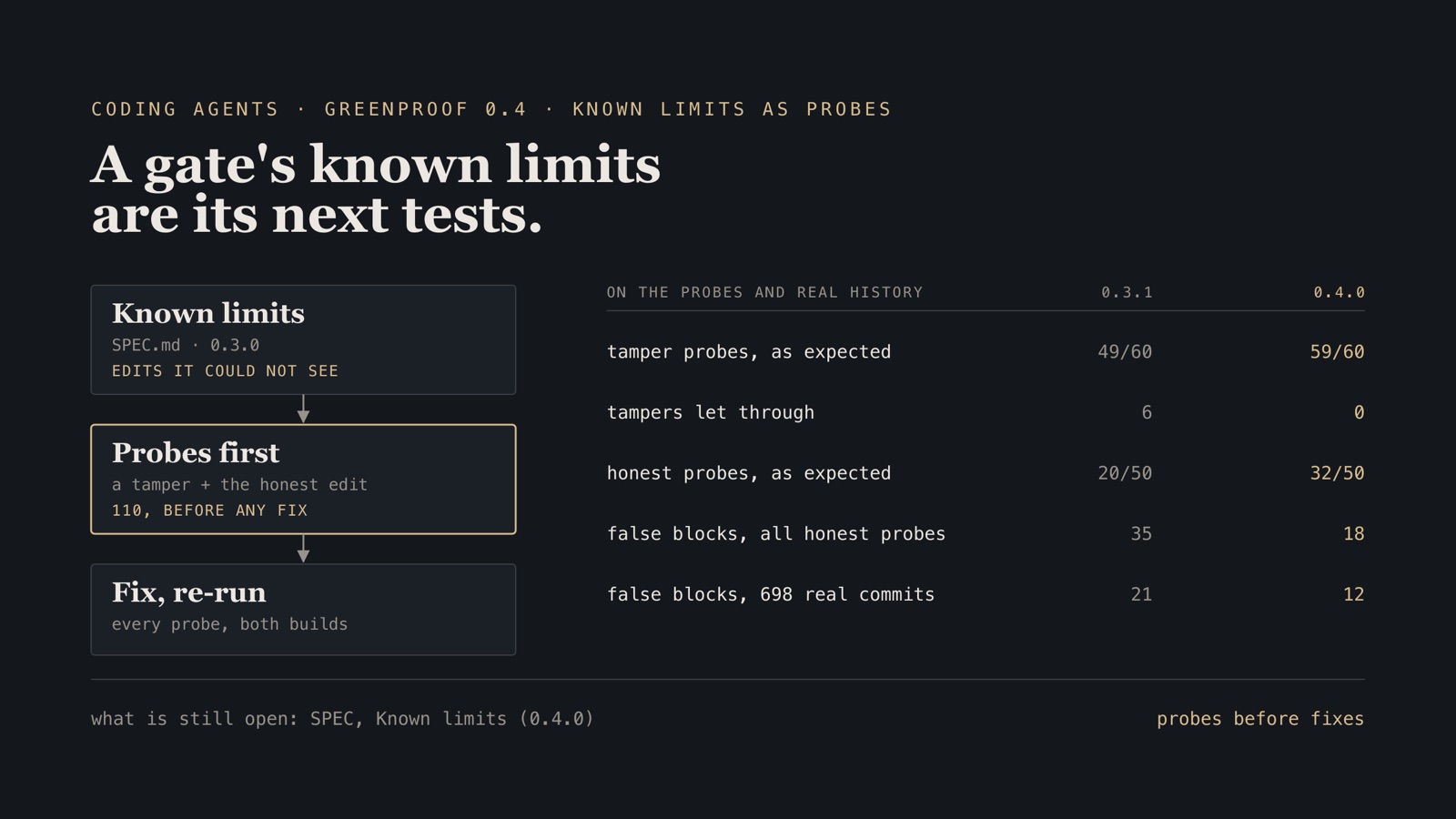
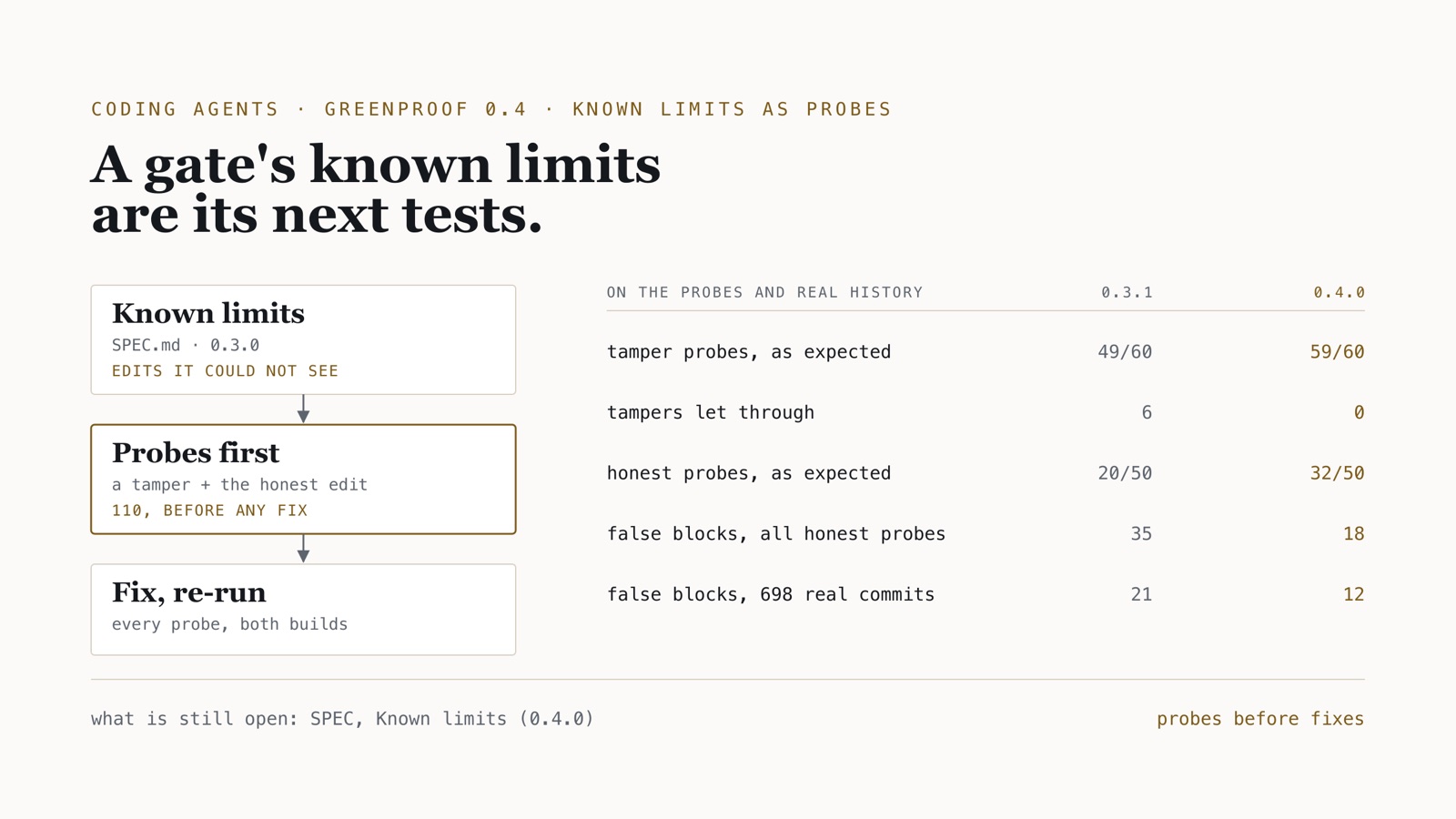
Operating rule. Treat a gate’s known-limits list as its backlog. Before changing any code, write a probe for each limit: the tamper it lets through, and the honest edit that looks most like it. Run every probe against the old build and the new one, replay real history, and publish the limits that are left.
Probes before fixes
The 0.3.0 list had about forty items in six groups: Python tests, test identity, Go, Rust and JS tests, Makefiles, test-runner configuration and selection, and shell scripts and CI. For each one I wrote probes from the text of the limit alone, before any fix existed. A probe is one edit to a small fixture repository with the verdict it must get. A TAMPER- probe is the nearest weakening, and it has to be caught. A HONEST- probe is the change the limit wrongly blocks, and it should pass once the limit is closed. There are 110 of them in bench/probes/spec_040_*.py, next to the 1,134 from the earlier rounds, and the same harness runs them against any build.
Run against 0.3.1 first, they measured the list:
| Probes aimed at the 0.3.0 limits | 0.3.1 | 0.4.0 |
|---|---|---|
| Tamper, handled as expected | 49 of 60 | 59 of 60 |
| Tamper, passed with no finding | 6 | 0 |
| Honest, handled as expected | 20 of 50 | 32 of 50 |
The six tampers that got through 0.3.1 cleanly were all outside the test files. A deleted root Makefile, so the targets the policy runs went with it. A -k filter built by a command substitution. A long script that dropped its test line. nx run-many swapped for nx affected, and two npm workspace selections narrowed in CI. The other limits mostly produced a warning where a block was due. A warning reaches the agent, but the agent can still stop.
Four edits 0.3.1 let through
Each of these is a scratch repository with one commit of tests and one commit of tampering, checked with greenproof check --base HEAD~1 --checks static. 0.3.1 passes all four.
An expected value replaced by a matcher. ANY compares equal to everything, so the assertion still runs and can no longer fail:
from unittest.mock import ANY

def test_add():
    assert add(1, 1) == ANY      # was: == 2
BLOCK tests.weakened  tests/test_calc.py:6  test test_add checks less than at the base:
      exact check on `add(1, 1)` loosened to `add(1, 1) == ANY`
The matchers it knows are ANY, dirty-equals, callee, testfixtures Comparison, a class in the file or the test tree whose __eq__ never reads the other operand, and a function that returns one of those, followed three calls deep.
A row dropped from a table. One assertion in a loop over three cases became one assertion over two. 0.3.1 counted assertions, and there was still one:
def test_add():
    for a, b, want in [(1, 1, 2), (2, 2, 4)]:    # was: ..., (-1, 1, 0)
        assert add(a, b) == want
BLOCK tests.weakened  tests/test_calc.py:4  test test_add checks less than at the base:
      table rows reduced from 3 to 2
0.4.0 counts distinct rows of a literal list or tuple, whether a loop or parametrize reads it. Fewer rows block unless every base row is still among the candidate’s rows or a new test’s. Rows count toward the check total too, so unrolling a three-row loop into two explicit asserts blocks as well.
A tolerance moved into a name. pytest.approx with a literal tolerance was already read. A name was not:
TOL = 0.5

def test_add():
    assert add(0.1, 0.2) == pytest.approx(0.3, abs=TOL)   # was: pytest.approx(0.3)
BLOCK tests.weakened  tests/test_calc.py:8  test test_add checks less than at the base:
      exact check on `add(0.1, 0.2)` against 0.3 loosened to a tolerance of 0.5
      (1% of the expected value or more)
A module-level number is resolved first, so TOL = 1e-9 still passes. A name it cannot resolve is read as an unbounded tolerance and blocks.
A test script that stopped running the tests. The policy’s test command is sh scripts/test.sh, and the script kept its lint line:
set -e
ruff check .
# pytest        <- removed
BLOCK runner.tampered  scripts/test.sh  scripts/test.sh: it changed and it no longer runs
      `pytest` (`sh scripts/test.sh` runs it)
0.3.1 blocked a script that lost every check, not one that lost a kind of check while others remained. 0.4.0 compares the kinds of check a policy script runs, reads the scripts it calls into it (four levels deep, 64 files and 1 MiB per file), and follows a script that a Makefile recipe runs.
The honest side was harder
Closing a tamper is a matter of reading one more construct. Closing a false block means letting an edit through, and every edit let through is one an agent can use. Several fixes went in and came back out for that reason.
The largest single cause of false blocks in real history was a test renamed while its body changed. 0.3.1 saw a test removed and a different one added, and blocked it. 0.4.0 pairs the two when the match is unique and the bodies share most of their tokens: 0.6 in the same file, 0.75 across files, and only for bodies of at least 10 tokens. A paired test then goes through the weakening comparison, so a rename that also drops a check still blocks, now with the reason:
BLOCK tests.weakened  tests/test_calc.py:4  test test_add_integers checks less than at the
      base: checks dropped from 4 to 3
The thresholds came from the replayed commits and were then checked against the probes. Below them, or on a tie, a rename stays a removal and blocks.
Go was the case where letting an edit through needed the most care. Go table tests often replace separate if got != want checks with a loop over a slice of cases, and 0.3.1 blocked that because the line count of checks dropped. 0.4.0 credits the loop with its rows times the checks in its body, but only for checks that read the row, and only when every number and string from the removed checks is still in the file. The first version credited any loop over the table. A probe then showed what that allowed. Go rejects an unused loop variable, so the obvious tamper discards it:
for _, c := range cases {
	_ = c
	if got := Add(1, 1); got != 2 {
		t.Errorf("x")
	}
}
That loop runs the same fixed check three times and earns three rows of credit. A row that is only assigned to _, printed or logged now counts as unread, and that loop blocks.
One fix was reverted outright. An edit to an existing sed -i rewrite of the tests had always blocked. A work package made a plain name swap only warn, and the fix rounds took that back: it stays a block, as in 0.3.1. That decision costs one false block in the replayed history, in zustand.
What real history said
The probes come from the same project as the rules, so they show which classes of edit are closed, not a detection rate. The check on that is replaying human commits that nobody gamed: the same 698 test-touching and 394 runner-touching commits of click, httpx, zustand and cobra as last time, on both builds.
| 0.3.1 | 0.4.0 | |
|---|---|---|
| Tamper probes: blocked, warned, passed | 687, 50, 7 of 744 | 693, 51, 0 of 744 |
| Honest probes blocked that should not be | 35 of 502 | 18 of 502 |
| Test-touching commits blocked | 75 of 698 | 66 of 698 |
| Of those, false blocks | 21 | 12 |
| Runner-touching commits blocked | 18 of 394 | 19 of 394 |
Ten blocks cleared and one is new. Nine of the ten were false on 0.3.1: five renamed tests now paired, three Go checks moved into a helper or a literal table loop, and exact checks merged into one equality against a QueryParams(...) value in httpx. The new block is httpx 5b5f6d8e1, which renames test_url to test_complete_url and drops a copy_with(scheme=..., port=None) check that no other test makes. 0.3.1 only said the test was replaced. 0.4.0 says what it lost, and the block is correct.
Read against each diff, the 66 blocks are 46 correct, 12 false and 8 ambiguous. About one honest change in sixty is still blocked wrongly on this history. The rules were tuned on these commits, so expect more on yours.
The bug the article found
The changelog says npm test becoming npm test -w web in a workflow blocks: npm ran every workspace before and now runs one. The unit tests agreed. For this article I built the example in a scratch repository with the workflow most projects actually have, npm ci and then npm test, and the 0.4.0 build passed it.
The cause was one word. The rules treat a script named ci as a test task, which is right for npm run ci. npm ci is npm’s clean install, but it matched too, so the job seemed to contain an npm test run over every workspace, and the narrowed step beside it never counted as narrowing. The fix reads npm’s own command first: ci, install and the other subcommands that install or publish are not test runs. Four tests now cover npm ci in the same step, in a step of its own, and beside a widened selection. The probes and replays were run again on the fixed build before the release.
No probe had an npm ci step beside a narrowed selection. The probes were written from the limits list, and this was not on it. Two probes now do. On 0.3.1 the narrowed run passes, on 0.4.0 it blocks, and the honest widening passes on both. They are in the totals above but not in the first table, which counts only the probes written blind from the list. An example in an article is a claim about what the tool does, so it gets run like one.
What is still open
SPEC.md has a “Known limits (0.4.0)” section now. The parts most likely to matter:
- One tamper still only warns. A
-k smokethat a Makefile adds through$(if $(CI),-k smoke,)runs fewer tests in CI only. Make functions are not evaluated, so the gate sees a computed argument and warns. - Kinds, not counts. A policy script that runs
pytesttwice and loses one run passes, and so does swappingruffformypy, because the lint tools count as one kind. A call to a script that cannot be read, past the depth, file or size limits or missing, might run anything, so that script is not judged by kind at all. - Top-level matchers only.
== ANYblocks.== (ANY, 2)does not, and neither does a matcher class with an inherited or metaclass__eq__. - Literal tables only. Row counts apply to a list or tuple bound once and never changed. A table built by
range, a comprehension or a call falls back to plain counts and warns when the base’s table could be read. - The 12 false blocks. Go checks in a helper or loop that 0.4.0 still does not credit, exact checks merged into one larger equality, tests moved to another file and rewritten at once, and the
sed -iedit above.
The list is shorter than 0.3.0’s, and it is still a map. I am keeping it public for the reason I wrote it. An agent in the repository can read everything in the repository, so leaving a limit out of the docs hides it from the people deciding whether to trust the gate, not from the agent. What protects the gate is that its policy comes from the base revision and CI runs the same check where local edits do not count. Each limit in the list is the first probe of the next round.
The same gate, in two other places
The shape is not specific to tests. The AI platform architecture ships every prompt, model and semantic-layer change through a paired evaluation gate: a drop that is significant on a McNemar test fails, one that is not warns with the sample size needed, and an isolation leak fails outright. evalproof is the measurement behind that, and governed-agent applies it to an agent’s writes: nothing it produces becomes state until a schema, a policy and a grounding check pass.
All three split block from warn on purpose and publish what they measured, including how often they are wrong. A gate that blocks too much gets switched off, and one that hides its misses gets trusted for things it does not check. Both failures are the operator’s to prevent, with numbers. The rest of this series is about where those gates go in a repository that agents write to; the governance post explains why the repository has to review what agents write, and the knowledge post covers the definitions they read.
Upgrading
pipx install --force greenproof==0.5.0     # or: uvx greenproof@0.5.0 check
greenproof check --base origin/main
The current release is 0.5.0. The rules and every number above are unchanged since 0.4.0: 0.4.1 made the hooks greenproof init writes run through uvx and added an install step to the CI template, and 0.5.0 added experimental hooks for six more agents (GitHub Copilot CLI, Qwen Code, Droid, Antigravity, OpenHands and Auggie). The Claude Code, Codex and Cursor plugins and greenproof init pick up the new version through the installed command. OpenCode users can pin opencode-greenproof@0.5.0 in opencode.json. Every number above, with the raw per-probe and per-commit results and the commands to reproduce them, is in the repository’s MEASUREMENTS.md, and the full list of changes is in the changelog.