Problem and decision
ProblemSharding Postgres is usually explained as a topology diagram. What decides whether it works is which key every table carries, which constraints change before the first table can move, what a rebalance does to live writes, and what to do with the tenant that dwarfs the rest.
DecisionRebuild the patterns on synthetic data: generate the migration from the catalog, distribute and co-locate everything by tenant, measure the rebalance under load, then put one dataset into four engines and compare rather than crown one.
Scope
- Team
- One person
- Scale
- Citus 14.2 coordinator + 3 workers, TimescaleDB 2.30, ClickHouse 25.8 at 2 shards × 2 replicas; one container per node; 6M to 20.7M rows per part
- Links
- Source
Measured results
- 0 errors while a worker joined and 7 shard groups moved under load 8 client threads for 600 s, 80% one-tenant reads and 20% single-row inserts against the Citus coordinator; every acknowledged write counted back afterwards · measured Oct 2026
- 4.2× faster join co-located than repartitioned the same join over tenants 1–400, both returning 617,895 rows; p50 of 7 runs, 1,251.7 ms co-located on (tenant_id, user_id) vs 5,206.0 ms against a copy distributed by user_id · measured Oct 2026
- 2.36× → 1.10× spread between the largest and smallest worker node bytes after the default by_disk_size rebalance, then after isolating the largest tenant to its own shard and rebalancing with citus.rebalancer_by_disk_size_base_cost set to 0 · measured Oct 2026
- 17.0× smaller after TimescaleDB columnstore 11 of 12 one-day chunks of 20.7M ticks, segmented by entity and metric; 2,785.5 MB → 163.4 MB from hypertable_compression_stats · measured Oct 2026
- 40 of 40 inserts succeeded with a ClickHouse replica down one replica of a 2-shard × 2-replica ReplicatedMergeTree cluster killed for 60.3 s while inserts and reads ran through the Distributed table · measured Oct 2026
- Plan plan_distribution.py · pg_catalog Reads the live catalog and lists all 15 blocking issues before a single table moves.
- Distribute Citus 14.2 · PostgreSQL 17.11 One co-location group by tenant, so a one-tenant query and its joins hit 1 of 32 shards.
- Rebalance citus_rebalance_start · tenant isolation 0 errors as shards moved under load; the whale's shard, 7.4× the median, needed a split.
- Time-series TimescaleDB 2.30 · continuous aggregates Raw chunks age out; daily candles, checked against raw, survive the retention drop.
- Replicate ClickHouse 25.8 · ReplicatedMergeTree · Keeper 2 shards × 2 replicas: with one replica down 60 s, all 40 inserts and 30 reads succeeded.
- Compare one 10M-row dataset · warm and VM-cold Same rows in four engines, counts verified equal; each fits a workload, none is crowned.
Context
Horizontal scale for Postgres is usually sold as a diagram: add nodes, the data spreads, queries get faster. What decides whether it works is less photogenic. Every table has to carry the distribution key. Primary keys, unique constraints and foreign keys have to be reshaped before the first table can be distributed. A rebalance has to run while writes keep arriving. And there is always one customer whose data is several times anyone else’s.
Citus has been part of my work since 2021; citusdata/citus#4776 is a report of mine from then, about adding an unnamed constraint to a distributed table, which Citus’s maintainers fixed by adding that support in January 2023. This lab rebuilds, from scratch and on synthetic data, the patterns I worked through on consulting engagements: a schema migrated table by table onto Citus, and an audit of a TimescaleDB hypertable whose index outweighed its data. Then it loads one dataset into four engines to see where each earns its place. No client code, schema or figures are in it. Every number is in the repository’s MEASUREMENTS.md, next to the file it came from.
Constraints
Every node is its own container, and all of them run on one host — an Apple M5 with a Docker VM of 8 CPUs and 11.67 GiB — so node-to-node latency is local and there are no network partitions to test. The host was not quiet either: load average sat between 10 and 44 during the runs, partly from a network filter on the host. Medians are the figures to trust; p99s carry that noise.
The data is seeded: 2,000 tenants with Zipf-shaped sizes, one tenant pinned to 15% of events, and 0.5% of events with no tenant at all. The published Citus images are amd64-only, and timing an emulated database would have been meaningless, so Citus 14.2.0 is built from its source tag; CI runs the official image at small scale. Each part runs alone and is torn down before the next.
Architecture
Four parts, one compose stack each, with a benchmark container inside each network. Running the client from the host instead added about 3 ms to a SELECT 1.
- Citus 14.2 on PostgreSQL 17.11. A coordinator and two workers with 32 shards, then a third worker added under load. Eight tables distributed by
tenant_idand co-located withtenants; two small lookup tables as reference tables. - TimescaleDB 2.30. 20.7 million ticks in one-day chunks, loaded twice with opposite primary-key orders, then columnstore, hierarchical candles and retention.
- ClickHouse 25.8. Two shards × two replicas of ReplicatedMergeTree behind a Distributed table sharded by
intHash64(tenant_id), with one Keeper. - A comparison. The same 10 million rows in PostgreSQL with a B-tree, Citus columnar, TimescaleDB columnstore and ClickHouse, warm and VM-cold.
The Citus migration is generated by a planner that reads the live catalog, picks the root table and writes the SQL for every change. On this schema it found 15 issues, from primary keys without the tenant column to a mixed-case table name.
In the code
This function writes the whole migration, and its order is the answer to the naive attempt’s six failures: the key and constraint fixes run first in one transaction, and every foreign key comes off before any table moves, because Citus will not distribute a table that local tables still reference. The foreign keys return only once all eight tenant tables sit in one co-location group led by tenants, which is what keeps one tenant’s joins on one shard.
def emit_sql(cat: Catalog, p: Plan) -> str:
    """Fixes, then reference tables, then the co-located distribution, then FKs."""
    drops, adds = _fk_readd(cat, p)
    out = ["-- generated by tools/plan_distribution.py — review before running", "BEGIN;"]
    out.append("\n-- every foreign key comes off first; they return once all tables are placed")
    out += drops
    for code in ["NULL_KEY", "MISSING_KEY", "PK_WITHOUT_KEY"]:
        for i in (i for i in p.issues if i.code == code):
            out.append(f"\n-- {i.code} {i.table}: {i.detail}")
            # …
    out.append("COMMIT;\n")
    out.append("-- reference tables (replicated to every node)")
    out += [f"SELECT create_reference_table('{q(r)}');" for r in p.reference]
    out.append("\n-- distributed tables, one co-location group led by the root")
    out.append(f"SELECT create_distributed_table('{q(p.root)}', '{p.key}');")
    for name, col in p.distributed.items():
        if name != p.root:
            out.append(
                f"SELECT create_distributed_table('{q(name)}', '{col}', "
                f"colocate_with => '{q(p.root)}');"
            )
    out.append("\n-- foreign keys, re-added; between distributed tables they carry the key")
    out += adds
    # …
Two tests pin that order, and the planner, catalog queries included, is in tools/plan_distribution.py.
Decisions and trade-offs
| Decision | Alternative considered | Why | What it cost |
|---|---|---|---|
Distribute every tenant table by tenant_id, co-located with tenants |
Each table by its own id | One tenant’s joins and foreign keys stay on one shard | Every primary key and foreign key had to gain the tenant column first |
| Generate the migration from the catalog | Hand-write it table by table | The naive attempt failed six different ways, one at a time; a planner finds them all at once | Its first run still failed on a foreign key it had not cleared, now fixed and pinned by a test |
| Rows with no tenant go to a reserved tenant | A separate local table | One query path for everything | Their references to other tenants’ rows had to be cleared, because a composite foreign key cannot hold them |
| Isolate the largest tenant before rebalancing | Trust the rebalancer | No move can split a shard | The split needed a setting changed on every node first (below) |
| One dataset, four engines, no winner declared | Tune each engine and rank them | The useful question is which workload each one fits | Not a vendor benchmark: each engine would do better with an expert’s settings |
Results
Routing is the performance model. A one-tenant query routed to a single shard ran at a p50 of 3.77 ms; the same question across every tenant fanned out to 32 shards and took 677 ms. The same join was 4.2× faster co-located than repartitioned: 1,252 ms against 5,206 ms, both returning 617,895 rows.
A node can join under write load. With eight client threads running, adding a third worker moved seven shard groups in 37.1 s with 0 errors across 977,368 operations, and all 195,543 acknowledged writes were there afterwards. Write p99 rose from 38.0 ms to 54.7 ms while shards moved.
Skew needs splitting, not moving. The largest tenant’s shard was 7.4× the median. After the default rebalance the workers were 2.36× apart and the rebalancer declined every further move, because by_disk_size adds a fixed 100 MiB to each shard group’s cost and shards of tens of megabytes all look alike. Isolating that tenant to its own shard and rebalancing with the base cost at 0 took the spread to 1.10×.
TimescaleDB: key order is a trade-off. An entity-led primary key made entity queries 2.3–3.2× faster, but its index grew to 1.43× the heap against 0.91× for a time-led key, because time-ordered ingest only appends to a time-led B-tree. Columnstore made the data 17.0×, and daily candles came from a continuous aggregate in 0.157 ms instead of 15.3 ms.
ClickHouse: the sort key is the index. With a tenant-first ORDER BY, one tenant’s query read 49,152 rows; ordered by time, it read the whole shard, 4,168,647. With one replica down for 60 s, 40 of 40 inserts and 30 of 30 reads succeeded, and the replica caught up 0.8 s after it was serving again.
On one dataset, PostgreSQL with a B-tree answered the one-tenant question as fast as anything (2.1 ms) and took 8–9× the disk of the three columnar engines, which landed within 14% of each other. ClickHouse was fastest on all three scans and the least affected by a cold start; TimescaleDB tied PostgreSQL on the point query and came within 5 ms of ClickHouse on the month-long scan.
What went wrong
These cost more time than everything that worked, and none came with an obvious error.
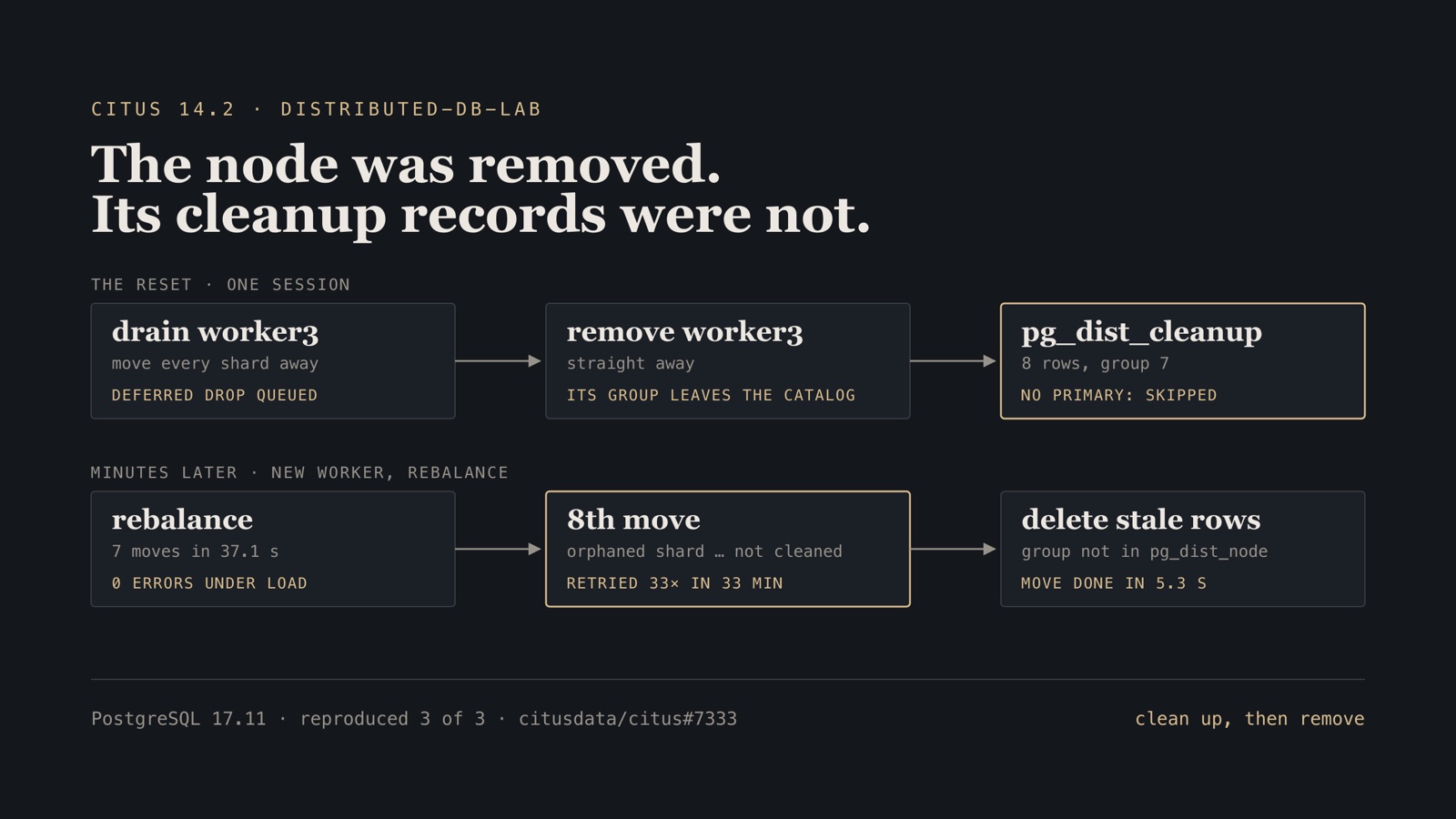
A removed node blocked a rebalance half an hour later. To reset a run, I drained the third worker and removed it straight away. The drain’s last move had queued a deferred drop in pg_dist_cleanup, and the removal left those eight records pointing at a node group that no longer existed. Later, the rebalance moved seven shard groups and retried the eighth 33 times over 33 minutes. Deleting the stale rows let it finish in 5.3 s. It is the open citusdata/citus#7333, reported in 2023; I confirmed it on 14.2 with a minimal reproduction. The mechanism is in the write-up.
A PostgreSQL minor release switched off tenant isolation. The August 2026 minor releases, 17.11 among them, only allow the logical-decoding output plugins listed in the new output_plugin_libraries, and Citus’s shard split decodes through citus. isolate_tenant_to_new_shard failed with library "citus" may not be used as an output plugin, while shard moves, which use pgoutput, kept working. The fix is a bare list on every node; quoting the whole value stores it as one name and silently does nothing.
One table without a primary key stopped the rebalancer for the whole cluster. A CREATE TABLE … AS copy left distributed for a join test had no replica identity, and citus_rebalance_start refused to move anything until it was gone.
ClickHouse 25.7 changed what LIMIT means. INSERT INTO <Distributed> SELECT … FROM <Distributed> LIMIT n now runs on each shard and applies the limit per shard. My “2,000,000 rows” wrote 3,950,848.
What I’d do differently
Guard node removal from the start. Run CALL citus_cleanup_orphaned_resources() and check that pg_dist_cleanup is empty for the node’s group before citus_remove_node. The later reproduction showed that sequence avoids the stale records; the lab itself did not use it.
Put a real network between nodes. One host means no partitions and loopback latency. QEMU VMs on a shared fabric, as in the Patroni lab, would let the rebalance and the replica outage be measured with a network in the way.
Add a connection pooler and a Keeper quorum. Nothing here put PgBouncer in front of the coordinator, which is where an application of this shape meets connection limits first. And one Keeper coordinates replication without being a quorum, so the ClickHouse outage tests a replica, not the coordination layer.
The code, the planner and every result file are in distributed-db-lab.
Connected systems
All case studiesMulti-engine HA lab: eight failover scenarios
Personal lab
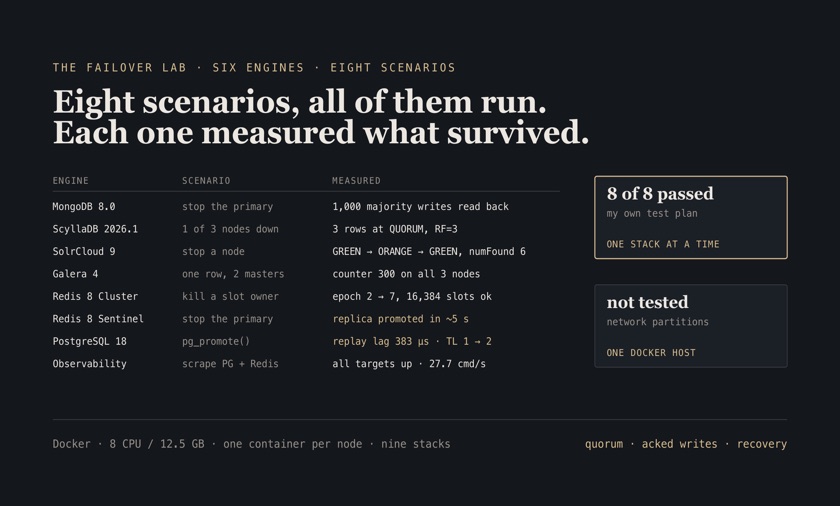
Six database engines, eight failover scenarios on real multi-node clusters — with the numbers
8 of 8 failover scenarios passedmy own test plan, executed on Docker with 8 CPU / 12.5 GB · 2026
383 µs replay lag measured on one hosta single pg_stat_replication reading with primary and hot standby on the same machine — loopback, no network, so it is a floor for the configuration rather than a latency anyone should expect across hosts
MongoDB · ScyllaDB · SolrCloud · MariaDB · Galera · Redis
Orchestrated failover and a restore I actually performed
Personal lab
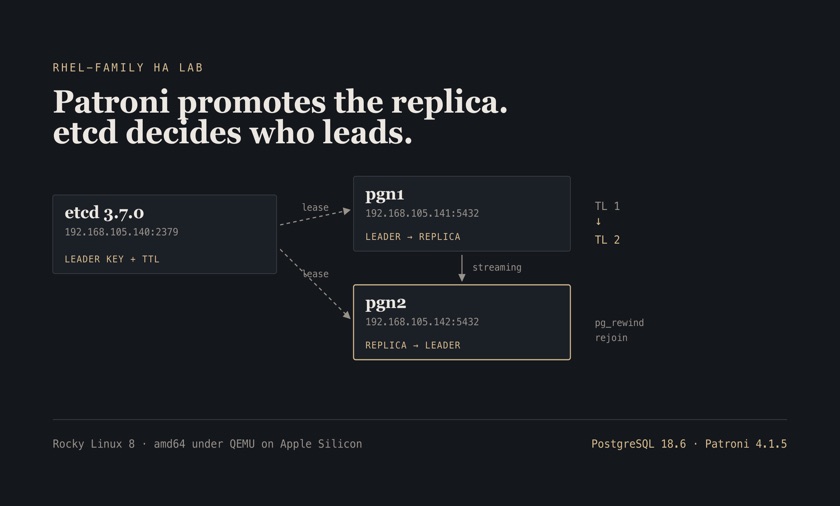
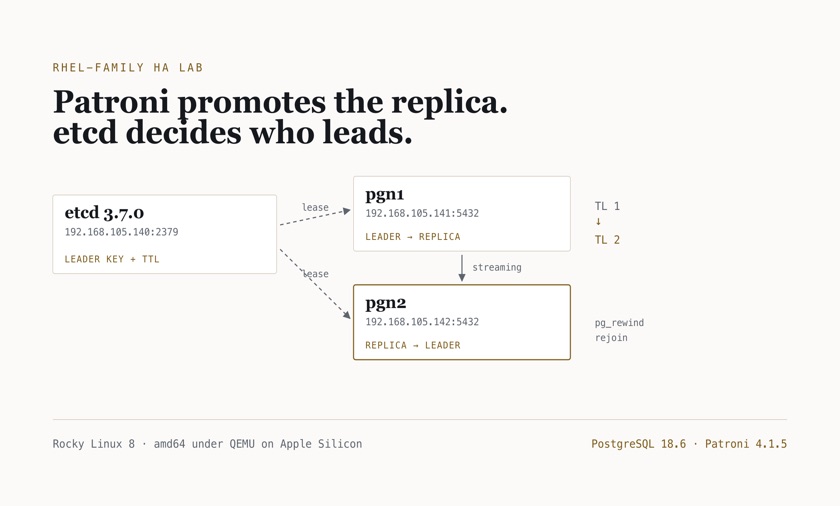
A production-shaped Postgres cluster on amd64 VMs: killed the primary, rebuilt the replica, recovered a dropped table
10–20 s observed promotion window after SIGKILLSIGKILL of the Patroni leader, then patronictl polled every 10 s until the survivor showed as Leader — so 10 s is the measurement resolution, not the precision of the result · 2026
~5 s replica rebuilt from backuppatronictl reinit; the pgBackRest restore itself logged 5,020 ms, then Patroni reported the replica created · 2026
PostgreSQL · Patroni · etcd · pgBackRest · Ansible · Rocky Linux
ClickHomes: an independent real-estate product
Founder and sole engineer — built outside my day job
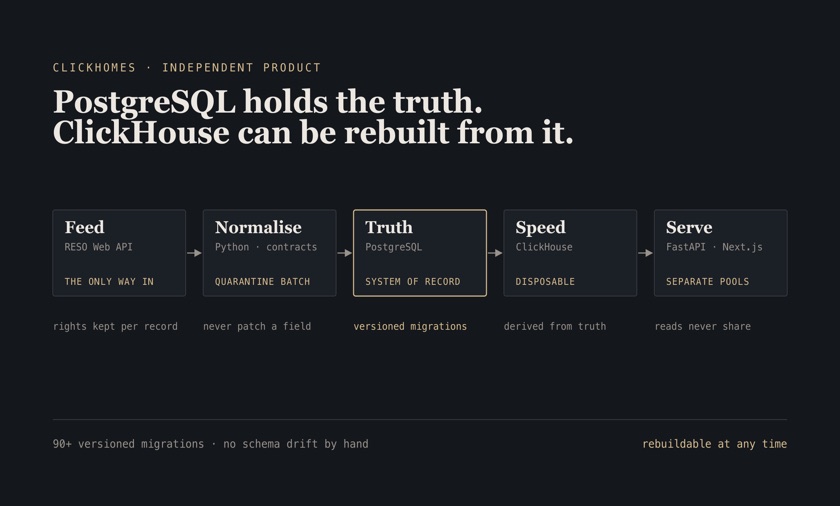
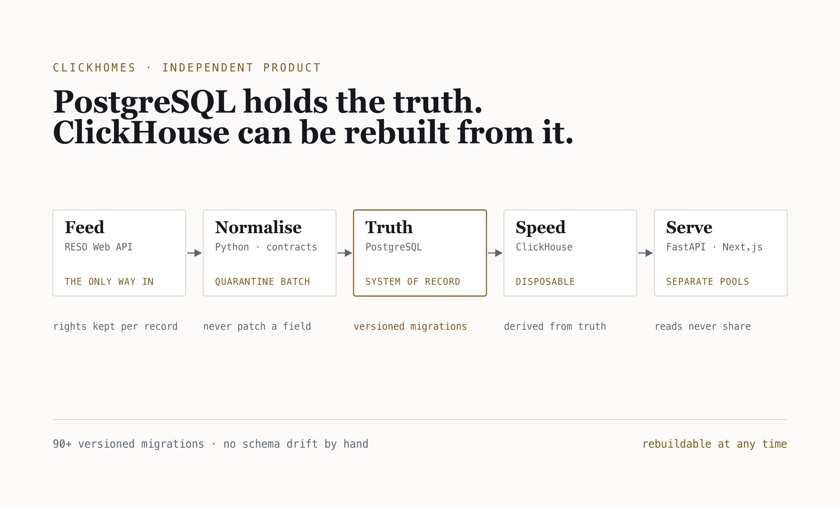
A real-estate product I own end to end: PostgreSQL for truth, ClickHouse for speed, RESO as the only way in
90+ SQL migrationsversioned migration files in the repository
Python · FastAPI · PostgreSQL · ClickHouse · RESO · Next.js
Continue the conversation
See the full career record, or get in touch about a senior data, platform, or AI engineering role.