Problem and decision
ProblemA cluster that has never failed is a cluster whose recovery path is a hypothesis. I wanted a rig where the primary dies badly, the replica is thrown away, and a table is dropped on purpose — with the timings recorded rather than described.
DecisionBuild it on VMs rather than containers so the failure modes are the ones production has, drive the backup path from Ansible and publish the etcd and Patroni bootstrap as exact commands so the lab is rebuildable, and refuse to publish a number that did not come off a run.
Scope
- Team
- One person
- Scale
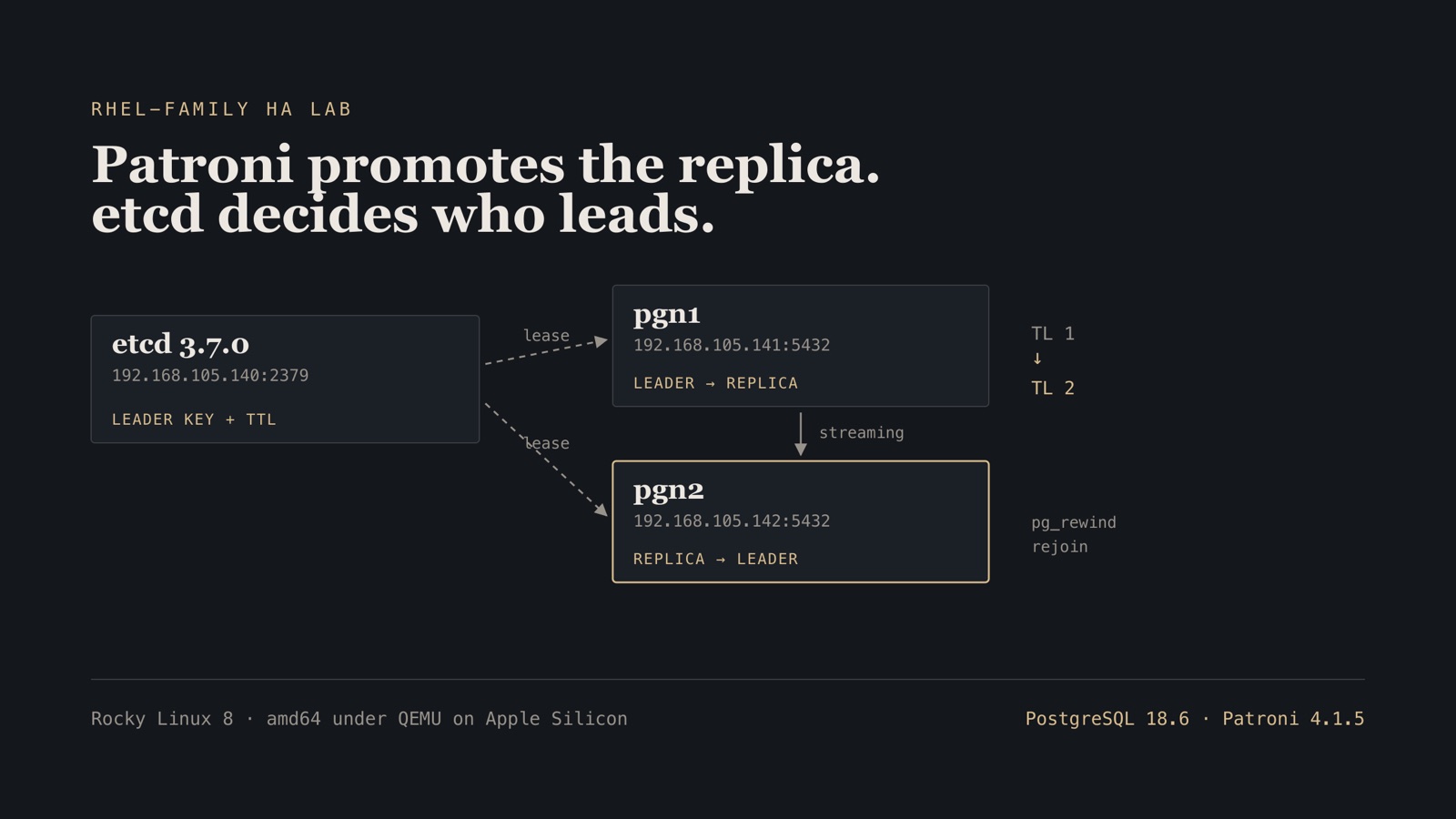
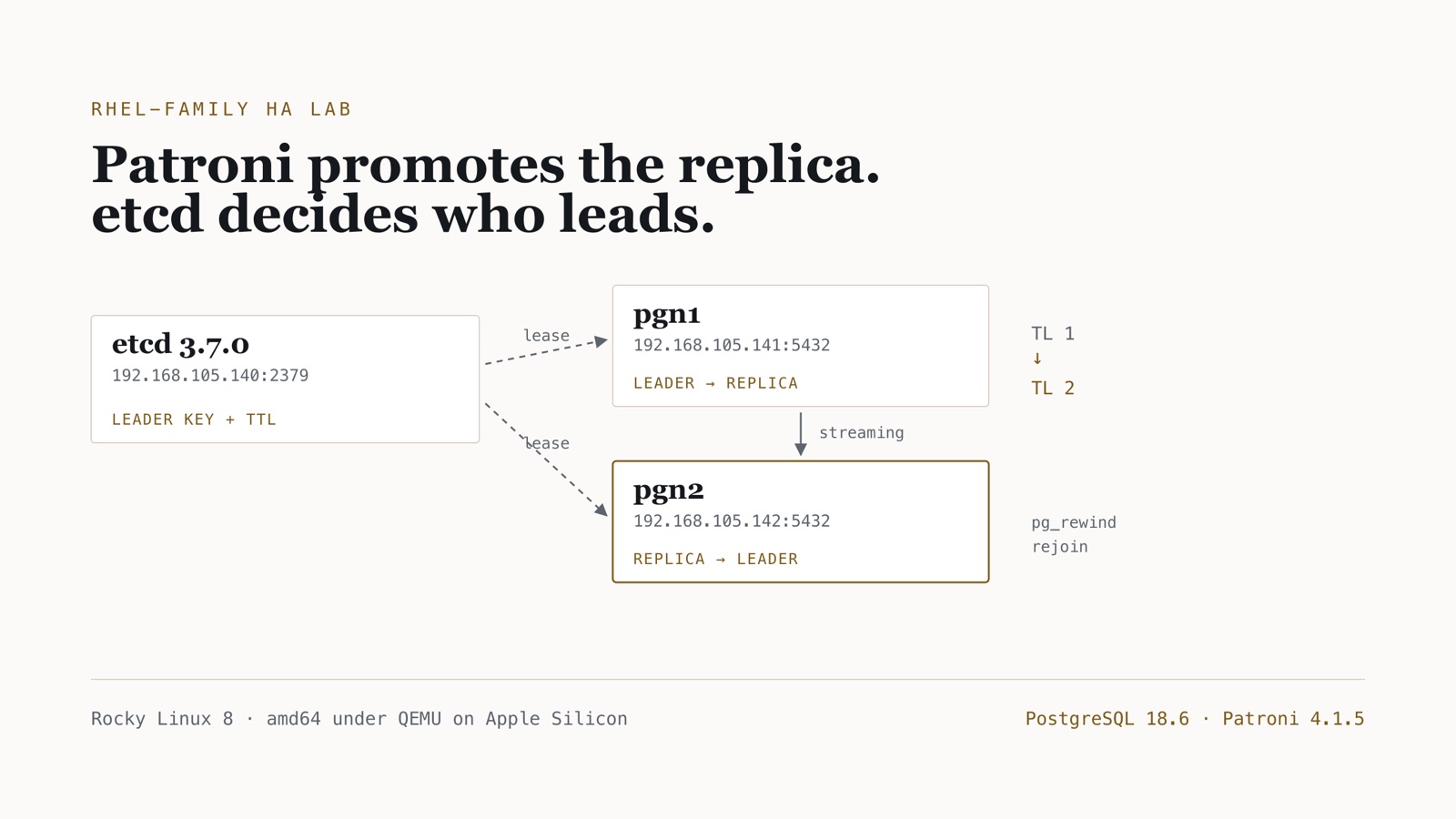
- Three amd64 Rocky 8 guests under QEMU on Apple Silicon; PostgreSQL 18.6, Patroni 4.1.5, etcd 3.7.0, pgBackRest 2.59 on a shared socket_vmnet fabric
- Links
- Source
Measured results
- 10–20 s observed promotion window after SIGKILL SIGKILL of the Patroni leader, then patronictl polled every 10 s until the survivor showed as Leader — so 10 s is the measurement resolution, not the precision of the result · 2026
- ~5 s replica rebuilt from backup patronictl reinit; the pgBackRest restore itself logged 5,020 ms, then Patroni reported the replica created · 2026
- 5 of 5 rows recovered by point-in-time restore dropped a table, restored to a timestamp taken before the DROP, counted rows against the pre-incident total · 2026
- Provision Docker · Vagrant · QEMU One reproducible cluster, pinned versions, stated resource ceiling.
- Seed known dataset Write verifiable state and capture the baseline before touching anything.
- Fault SIGKILL · partition Kill the primary badly. A graceful stop tests a different code path.
- Measure wall clock · engine metrics Promotion time, data survival, and what the survivors disagreed about.
Context
The multi-engine lab answered a comparison question: what do six different databases do when a node disappears. This one answers a narrower and more operational question about a single stack — what happens to a PostgreSQL cluster that is managed, when the managing layer has to make a decision under pressure.
Containers were the wrong shape for it. A Docker network cannot produce the failure modes an operator actually meets — clock drift, systemd ordering, firewalld, a package manager refusing a key import. So the rig is three amd64 virtual machines on a shared L2 fabric, running the same RHEL-family distribution and the same PostgreSQL packages as the servers this pattern is deployed on.
Constraints
One host, so the whole cluster fits in about 4 GB of RAM. amd64 guests under emulation on an Apple Silicon host, which is slow on purpose: a lab that lies about the instruction set makes every later packaging story suspect.
The honest limit is etcd. It runs on one node, so this rig proves PostgreSQL failover, not cluster availability — and rather than caveat that, I measured what a DCS outage costs and published the answer.
Architecture
Three nodes: one carrying etcd and the pgBackRest repository, two running PostgreSQL 18.6 under Patroni. Vagrant boots the boxes and wires the lab NIC; the pgBackRest repository, certificates and archive wiring belong to Ansible, and the etcd and Patroni bootstrap is a short, published sequence of commands with the exact config files — not yet a playbook. Rebuildability is the only thing that makes a measurement repeatable; the bootstrap is the part still waiting to become a command.
The repository declares every cluster member rather than a primary, because the primary moves. Transport between the repo and the database hosts is mutual TLS with an explicit certificate CN allow-list, not SSH: no shell account on the peers, and authorisation that can be read out of a config file.
Decisions and rejected alternatives
| Decision | Alternative considered | Why | What it cost |
|---|---|---|---|
| VMs under emulation | Containers on the host | Systemd, firewalld, chrony and package managers are where the real failures live | Slow: hours for a first bring-up |
| Rocky 8 | Unregistered RHEL 8 | An unregistered RHEL box has no AppStream, so no python3.12, so no current Patroni at all | One paragraph of explanation in every post |
| Ansible for the backup path; published commands for the bootstrap | Shell over SSH throughout | The pgBackRest wiring rebuilds with one command, and the bootstrap is documented exactly | The bootstrap is still manual — the next part to become a playbook |
| Mutual TLS between repo and nodes | SSH keys | No shell accounts, and authorisation is an explicit allow-list | Certificate lifecycle, and a clock-skew failure that cost real time |
| Single etcd node | Three-node quorum | Fits the RAM budget, and the resulting limitation is measurable rather than hypothetical | The rig cannot claim cluster availability |
Results
Three claims, each with a number that came off a run.
Promotion. A SIGKILL of the leader — not a graceful stop, which is the easy case — produced a promoted replica in 10–20 s, with the timeline advancing 1 to 2. The old primary rejoined afterwards via pg_rewind from the last common checkpoint rather than a full re-clone.
Replica rebuild. Discarding a replica and letting Patroni rebuild it from the backup repository took ~5 s, and the Patroni journal names the method rather than leaving it to inference. The primary was never read during the rebuild, which is the entire reason to wire the two tools together.
Restore. A deliberately dropped table was recovered by point-in-time restore with 5 of 5 rows intact, ending on a new timeline.
The most useful result was not a success. Stopping the single etcd node did not merely remove protection — the healthy leader demoted itself and the cluster went read-only within about 45 seconds, because Patroni could not renew the leader key and correctly refused to accept writes. That is the argument for a three-node DCS, and it is stronger as a measurement than as advice.
Operating consequence
Two settings decided whether recovery was cheap or expensive, and neither can be added usefully during an incident: use_pg_rewind with data checksums, which is the difference between a rejoin and a rebuild; and create_replica_methods ordering pgBackRest ahead of basebackup, which is the difference between restoring from a repository and dragging a full copy off a primary that is serving traffic.
A third is an ordering rule rather than a setting: after a point-in-time restore, take a fresh full backup before rebuilding any replica, or it will ask the restored leader for a timeline history file that no longer exists.
What I would do differently
Three etcd nodes. The single-node DCS is the one place this rig cannot speak to production, and the read-only demotion showed exactly why.
Load during failover. Every measurement here happened on an idle cluster. A background writer during the kill would make the promotion and rewind numbers mean considerably more.
Automate the restore drill. The point-in-time recovery was performed by hand, which means it is a thing I have done rather than a thing that is tested. A scheduled restore into a scratch instance, with the row count asserted, would turn it into a capability.
The full build is written up as a three-part series: the lab fabric, Patroni HA and the failover measurements, and pgBackRest, backup and the restore.
Related work
All case studiesSharding Postgres with Citus, measured against TimescaleDB and ClickHouse
Author
A schema that refused to distribute six ways, a tenant whose shard was 7.4× the median, and a rebalance under live writes
0 errors while a worker joined and 7 shard groups moved under load8 client threads for 600 s, 80% one-tenant reads and 20% single-row inserts against the Citus coordinator; every acknowledged write counted back afterwards · measured Oct 2026
4.2× faster join co-located than repartitionedthe same join over tenants 1–400, both returning 617,895 rows; p50 of 7 runs, 1,251.7 ms co-located on (tenant_id, user_id) vs 5,206.0 ms against a copy distributed by user_id · measured Oct 2026
Citus · PostgreSQL 17 · TimescaleDB · ClickHouse · ClickHouse Keeper · Docker Compose
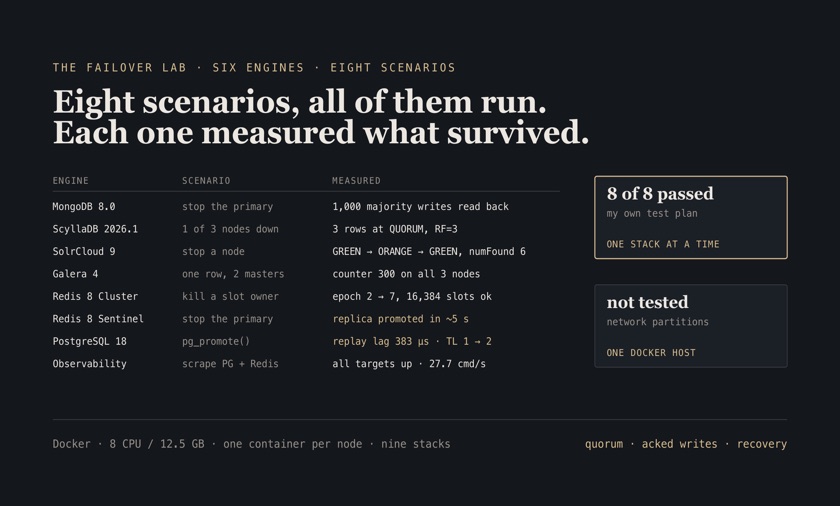
Multi-engine HA lab: eight failover scenarios
Personal lab
Six database engines, eight failover scenarios on real multi-node clusters — with the numbers
8 of 8 failover scenarios passedmy own test plan, executed on Docker with 8 CPU / 12.5 GB · 2026
383 µs replay lag measured on one hosta single pg_stat_replication reading with primary and hot standby on the same machine — loopback, no network, so it is a floor for the configuration rather than a latency anyone should expect across hosts
MongoDB · ScyllaDB · SolrCloud · MariaDB · Galera · Redis
Continue the conversation
See the full career record, or get in touch about a senior data, platform, or AI engineering role.