Problem and decision
ProblemOne client had to plan PostgreSQL 16's capacity and decide whether to run it as a managed service or on its own servers; another ran a fleet of RDS and Aurora databases that needed tuning and proof that failover worked.
DecisionDefault to managed PostgreSQL for ordinary applications, since it costs about the same as running it yourself and brings HA, configuration and monitoring; run it yourself only for extensions the service lacks or superuser access; and test failover rather than assume it.
Scope
- Team
- Remote, with each client's engineering team
- Scale
- Application databases for web products and services, one PostgreSQL 16 system and a fleet of RDS and Aurora instances
Context
Two engagements asked the question most PostgreSQL decisions start with, from opposite ends.
A capacity plan. A client running PostgreSQL 16 needed a plan for its growth and, with it, a decision: run the database as a managed service, or on servers of its own. The work also traced a performance problem to its root in the background writer, the PostgreSQL process that flushes changed pages to disk.
A fleet. Another ran its applications on a fleet of Amazon RDS and Aurora databases. The work was an optimisation programme across the fleet, connection pooling benchmarked with PgBouncer, and failover tests, so that the availability the services relied on was demonstrated rather than assumed.
My role
I planned capacity, found the root cause and set out the managed-or-self-run decision on the first engagement; on the second I ran the optimisation programme, the PgBouncer benchmarks and the failover tests with the client’s team.
The rule both came down to
For an ordinary web application or a single service, the comparison is closer than it looks on a price list. Running PostgreSQL on EC2 yourself and running it on RDS came out at about the same cost. What differs is everything around the database:
| Managed (RDS, Aurora) | Self-run (EC2 or own servers) | |
|---|---|---|
| High availability | Multi-AZ failover, operated by the provider | yours to build, test and keep working |
| Backups and point-in-time recovery | built in | yours to run and to restore |
| Configuration and upgrades | parameter groups, managed minor and major upgrades | yours |
| Monitoring | built in, with performance insight | yours to assemble |
| Extensions | the provider’s list | any |
| Superuser access | no | yes |
So the rule: managed by default; self-run only when an extension the service does not offer, or full superuser access, is a requirement. When it is, high availability, backup and recovery become your work, and they are real work.
Measured behind the decisions
What self-running high availability involves is measured in labs:
- In postgres-ha-lab, a Patroni cluster with etcd and pgBackRest over mutual TLS promoted a new leader 10–20 s after the old one was killed, rebuilt a replica from backup in ~5 s, and recovered 5 of 5 rows by point-in-time restore: the machinery a managed service already includes.
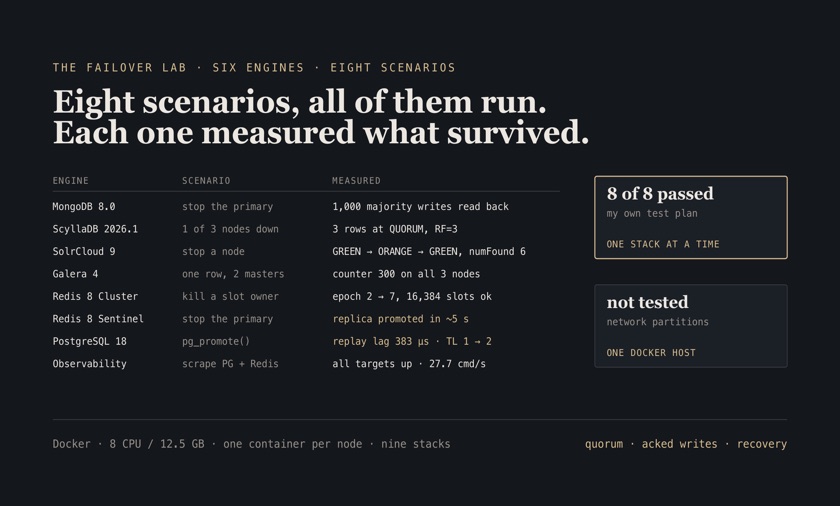
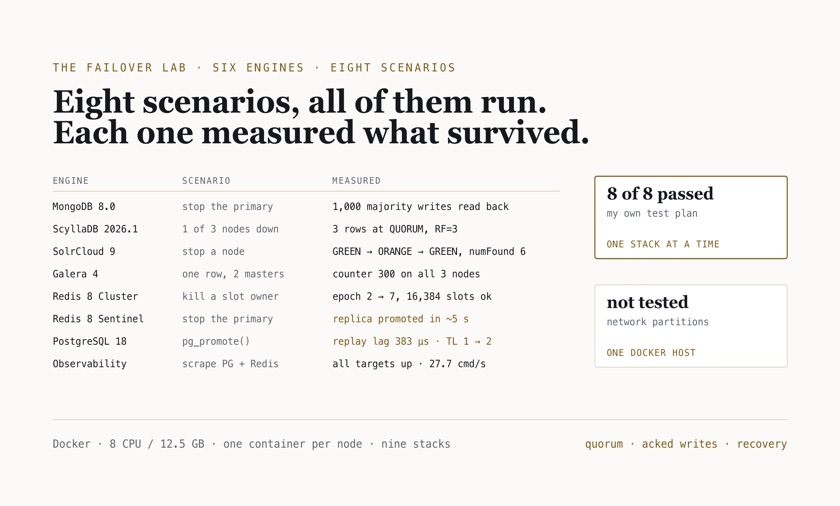
- In the multi-engine HA lab, 8 of 8 failover scenarios passed across six engines, because each one was rehearsed, which is the point of failover tests on a managed fleet too.
Lessons that carry over
A failover nobody has triggered is a hope. Managed services make failover easy to configure; only a test shows what the application does during it, which connections drop and how long the pool takes to recover.
Root causes hide in settings. A database that slows down is often doing exactly what its configuration asks; the background writer is one of the places to look before buying a larger instance.
Price the work, not the instance. The instance prices were close; the difference was who builds, tests and runs high availability, backups and upgrades.
When an application outgrows one PostgreSQL server altogether, the next step is in the Citus case study, and the wider choice of store is in the decision guide.
Related work
All case studiesTwo Postgres servers that ran out of room: an application database and a vector store, moved to Citus
Consultant — database architecture and migration
One database outgrew its server's disk, memory and CPU; another could no longer insert, read or index its vector embeddings. Both moved to Citus, with the data model doing most of the work.
PostgreSQL · Citus · pgvector · HNSW · repmgr · HAProxy
Sharding Postgres with Citus, measured against TimescaleDB and ClickHouse
Author
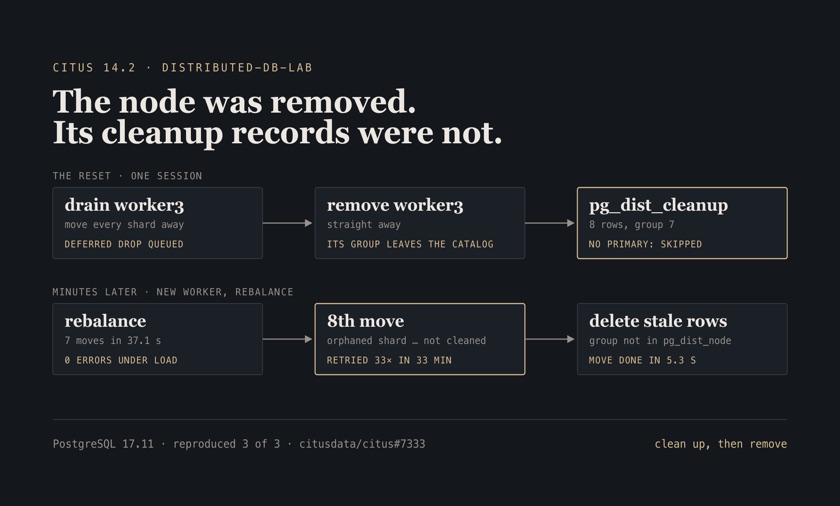
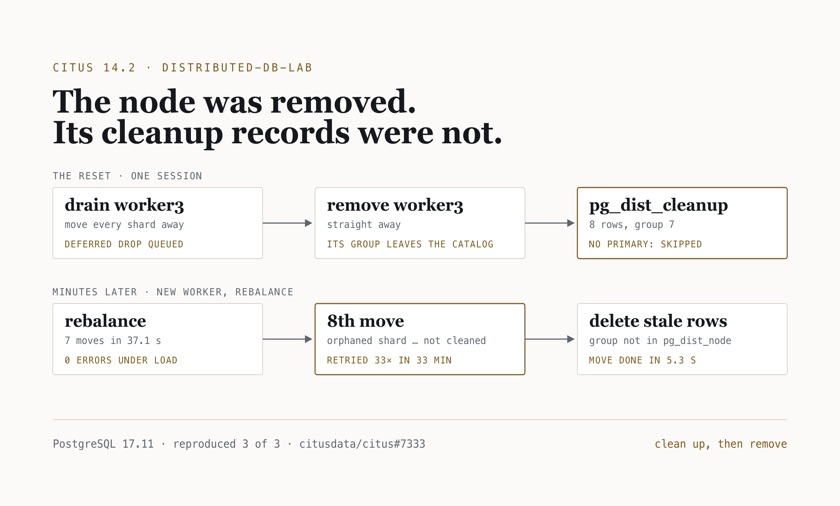
A schema that refused to distribute six ways, a tenant whose shard was 7.4× the median, and a rebalance under live writes
0 errors while a worker joined and 7 shard groups moved under load8 client threads for 600 s, 80% one-tenant reads and 20% single-row inserts against the Citus coordinator; every acknowledged write counted back afterwards · measured Oct 2026
4.2× faster join co-located than repartitionedthe same join over tenants 1–400, both returning 617,895 rows; p50 of 7 runs, 1,251.7 ms co-located on (tenant_id, user_id) vs 5,206.0 ms against a copy distributed by user_id · measured Oct 2026
Citus · PostgreSQL 17 · TimescaleDB · ClickHouse · ClickHouse Keeper · Docker Compose
Multi-engine HA lab: eight failover scenarios
Personal lab
Six database engines, eight failover scenarios on real multi-node clusters — with the numbers
8 of 8 failover scenarios passedmy own test plan, executed on Docker with 8 CPU / 12.5 GB · 2026
383 µs replay lag measured on one hosta single pg_stat_replication reading with primary and hot standby on the same machine — loopback, no network, so it is a floor for the configuration rather than a latency anyone should expect across hosts
MongoDB · ScyllaDB · SolrCloud · MariaDB · Galera · Redis
Facing the same decision?
Send a short briefing: what breaks today, or what you need to decide.