Problem and decision
ProblemA single PostgreSQL server per client had run out of headroom: one could not keep up with its tables and queries, the other with inserting, reading and indexing vector embeddings.
DecisionMove both to Citus, keeping PostgreSQL and its extensions: distribute by the key the queries filter on, co-locate what joins, make the coordinator highly available, and choose columnar or heap storage per table by its workload.
Scope
- Team
- Remote, with each client's engineering team
- Scale
- Single-server PostgreSQL databases at the limit of their hardware, one relational and one of vector embeddings
Context
Two clients came with the same problem in different clothes.
An application database. One PostgreSQL server held the product’s data, and it was running out of everything at once: disk, memory and CPU. Queries and tables took longer every month, and the trend made the business’s own growth the risk. A bigger server would have bought time, not a way out.
A vector store. The other kept vector embeddings in PostgreSQL with pgvector, next to the data they described. Embeddings grew quickly, and one server stopped coping: it could not keep up with the inserts or the reads, and building the vector index took longer and longer, failed more often than not, and performed poorly when it did finish.
My role
On both engagements I designed the move and carried it out with the client’s team: the distribution model, the cluster and the migration. On the first I also made the coordinator highly available and evaluated analytical engines for the reporting that was outgrowing the database.
Why Citus for both
Both workloads were PostgreSQL, used its extensions and its tools, and had a key most queries filtered on. Citus keeps all of that and spreads tables across worker nodes, so the database grows by adding workers rather than by buying a larger server, and the application keeps speaking PostgreSQL. A different engine would have meant rewriting the application’s queries and, for the vector store, moving embeddings away from the rows they describe.
The design
| Decision | Alternative | Why |
|---|---|---|
| Distribute by the key most queries filter on | Distribute by the primary key of each table | A query for one tenant runs on one shard instead of all of them |
| Co-locate tables that join, on the same key | Distribute each table independently | Joins stay on one worker; repartitioning joins across the network is the slow path |
| Small shared tables as reference tables | Distribute them too | Copied to every worker, they join locally |
| A standby for the coordinator, managed by repmgr, with HAProxy in front | A single coordinator | The coordinator routes every query; without a standby it is the cluster’s single point of failure |
| Columnar or heap storage per table, by workload | One storage format for everything | Columnar for read-heavy scans of mostly appended data; heap for write-heavy tables with updates |
| For vectors, shard the embeddings and build the index per shard | Keep one ever-larger index on one server | Each shard builds and searches a smaller index, and the workers share inserts, reads and builds |
| Evaluate ClickHouse, Apache Pinot, StarRocks and Trino for analytics | Keep analytics on the application database | Reporting at scale is a scan workload; the application database’s job is the application |
Measured behind the decisions
The behaviours the decisions rely on are measured in labs anyone can re-run:
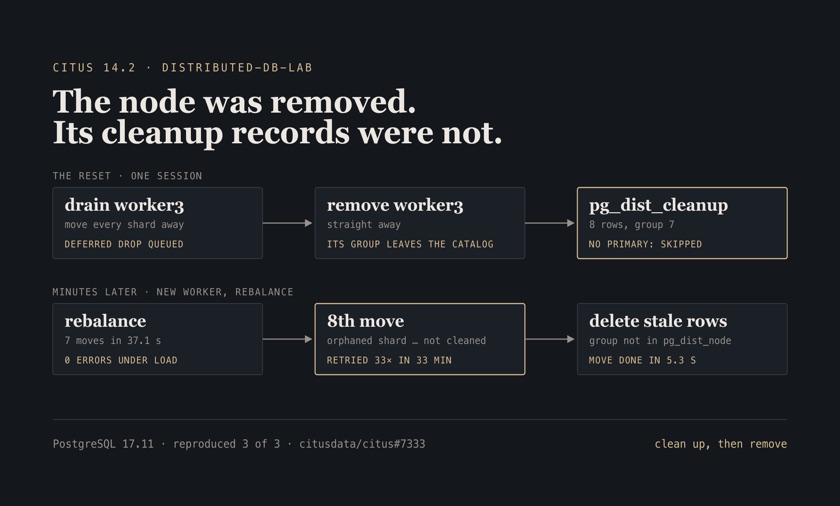
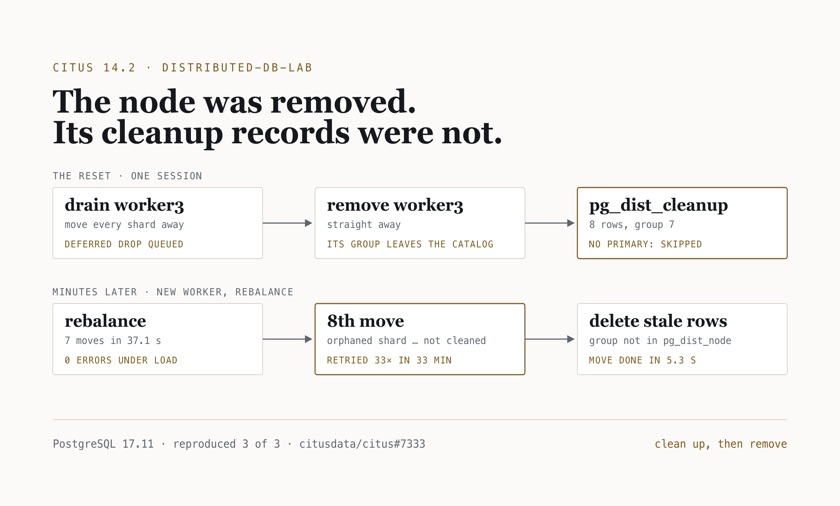
- In distributed-db-lab, a co-located join ran 4.2× faster than one that had to repartition, a worker joined and 7 shard groups moved under load with 0 errors, and the spread between the largest and smallest worker narrowed, 2.36× → 1.10×.
- In retrieval-bench, pgvector matched exact search as closely as Qdrant and OpenSearch, and the trap that matters for any vector store showed up clearly: a post-filtered HNSW search at 10% selectivity returned 3.9 of 10 rows until pgvector’s iterative scan restored recall to 0.949.
Lessons that carry over
The data model is the scaling plan. A Citus cluster with the wrong distribution key is a slower PostgreSQL. Choosing the key, the co-location groups and the reference tables is most of the work, and it is done before any node is added.
Plan the coordinator’s failure on day one. A distributed cluster with a single coordinator has moved the single point of failure, not removed it.
Vectors are data, with the same growth curve. Embeddings grow with the content they describe, and their index is the expensive part; giving them the same scale-out path as the rest of the data kept them next to it.
The wider choice, when to stay on one managed PostgreSQL, when to shard, and when a different store fits, is in the decision guide.
Related work
All case studiesManaged or self-run PostgreSQL: a capacity plan and an RDS fleet
Consultant — PostgreSQL capacity, operations and platform choice
A capacity plan that had to choose between a managed service and running PostgreSQL yourself, and a fleet of RDS and Aurora databases tuned and failover-tested: the same rule decided both.
PostgreSQL · Amazon RDS · Amazon Aurora · PgBouncer · AWS
Sharding Postgres with Citus, measured against TimescaleDB and ClickHouse
Author
A schema that refused to distribute six ways, a tenant whose shard was 7.4× the median, and a rebalance under live writes
0 errors while a worker joined and 7 shard groups moved under load8 client threads for 600 s, 80% one-tenant reads and 20% single-row inserts against the Citus coordinator; every acknowledged write counted back afterwards · measured Oct 2026
4.2× faster join co-located than repartitionedthe same join over tenants 1–400, both returning 617,895 rows; p50 of 7 runs, 1,251.7 ms co-located on (tenant_id, user_id) vs 5,206.0 ms against a copy distributed by user_id · measured Oct 2026
Citus · PostgreSQL 17 · TimescaleDB · ClickHouse · ClickHouse Keeper · Docker Compose
Multi-engine HA lab: eight failover scenarios
Personal lab
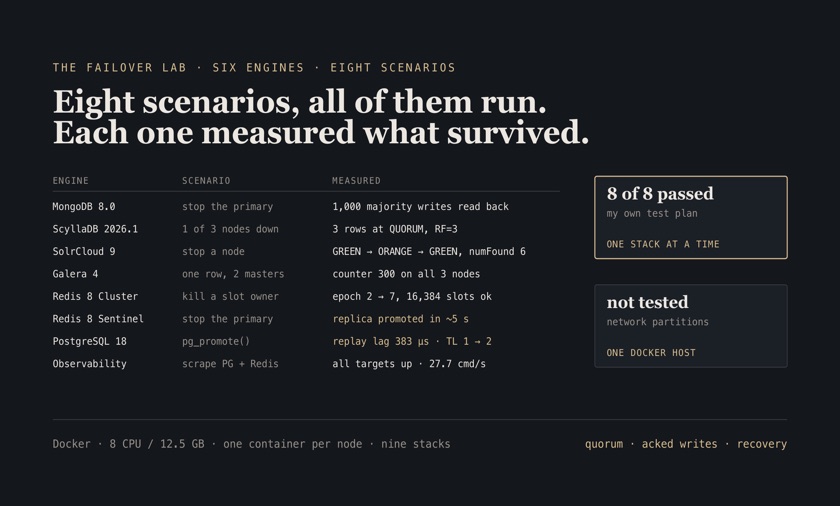
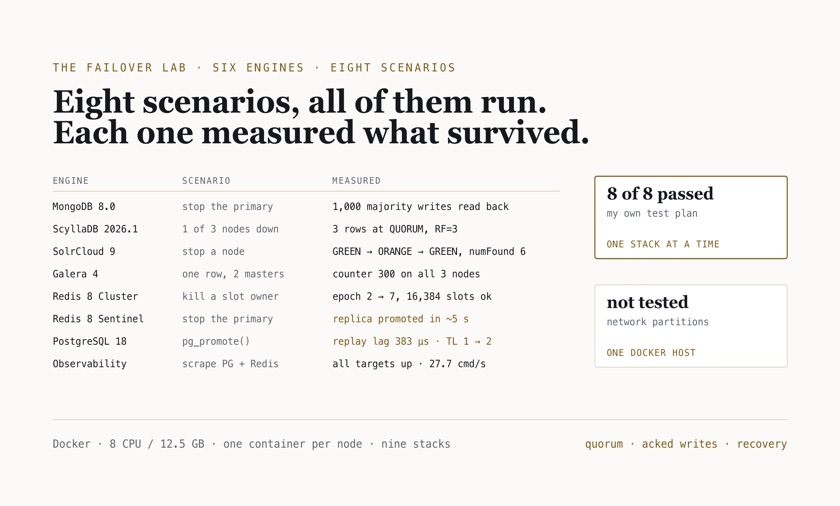
Six database engines, eight failover scenarios on real multi-node clusters — with the numbers
8 of 8 failover scenarios passedmy own test plan, executed on Docker with 8 CPU / 12.5 GB · 2026
383 µs replay lag measured on one hosta single pg_stat_replication reading with primary and hot standby on the same machine — loopback, no network, so it is a floor for the configuration rather than a latency anyone should expect across hosts
MongoDB · ScyllaDB · SolrCloud · MariaDB · Galera · Redis
Facing the same decision?
Send a short briefing: what breaks today, or what you need to decide.